🌐 IPv6 Subnet Mask Calculator
Calculate IPv6 subnets, host counts, address ranges, and network breakdowns instantly
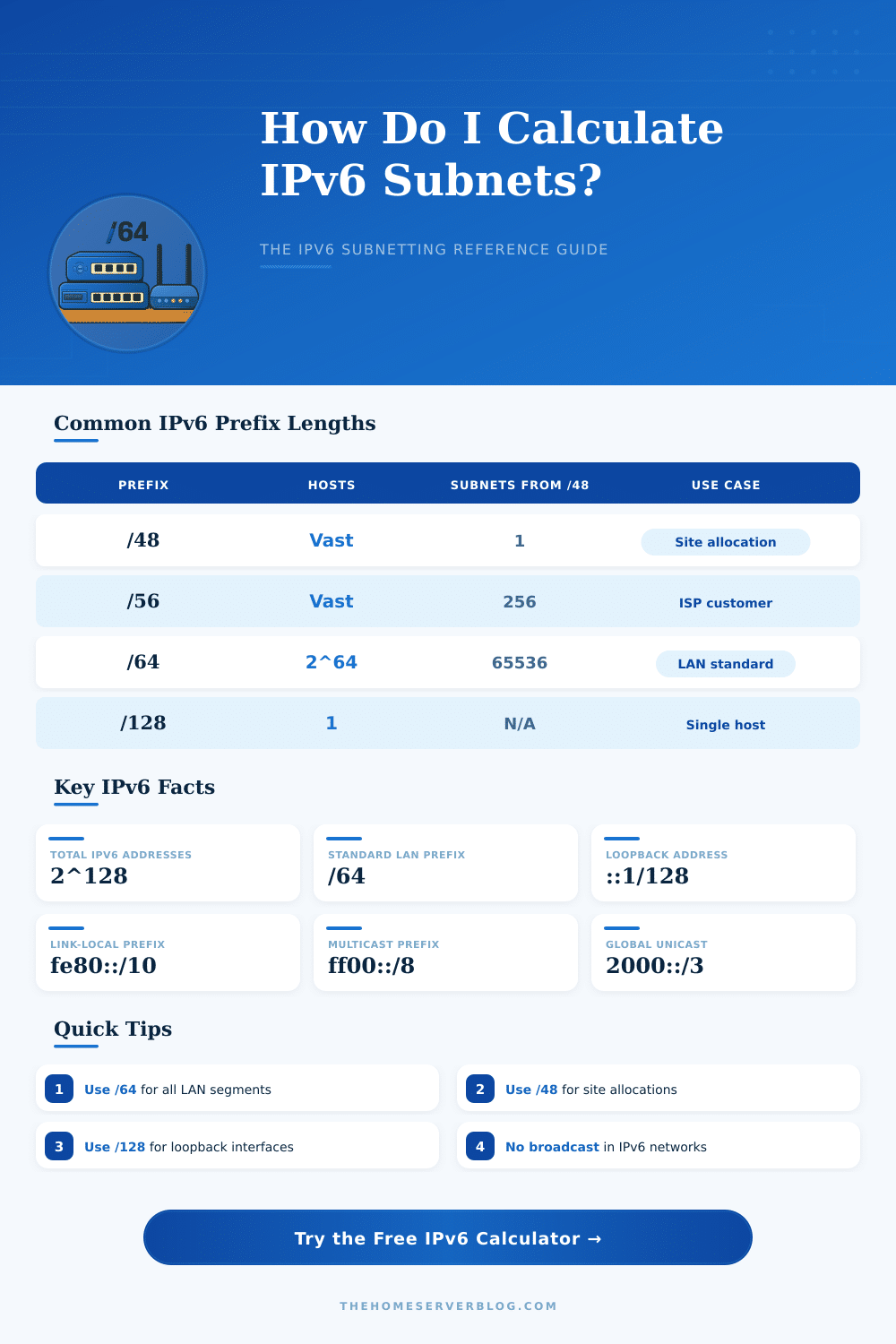
| Prefix Length | Subnets from /48 | Hosts per Subnet | Typical Use Case |
|---|---|---|---|
| /32 | N/A (ISP block) | 2^96 ≈ 7.9×10^28 | ISP allocation (RIR) |
| /40 | N/A | 2^88 | Large ISP sub-block |
| /48 | 1 | 2^80 ≈ 1.2×10^24 | Standard site / enterprise |
| /52 | 16 | 2^76 | Large campus sub-block |
| /56 | 256 | 2^72 ≈ 4.7×10^21 | ISP customer allocation |
| /60 | 4,096 | 2^68 | Small office VLANs |
| /64 | 65,536 | 2^64 ≈ 1.8×10^19 | Standard LAN segment (SLAAC) |
| /80 | — | 2^48 ≈ 2.8×10^14 | Large device pools |
| /96 | — | 2^32 ≈ 4.3×10^9 | NAT64, IPv4-mapped |
| /112 | — | 65,536 | Small segments |
| /120 | — | 256 | Server subnets |
| /124 | — | 16 | Small transfers |
| /126 | — | 4 | Point-to-point (2 usable) |
| /127 | — | 2 | P2P links (RFC 6164) |
| /128 | — | 1 | Single host / loopback |
| Type | Prefix | Scope | Notes |
|---|---|---|---|
| Global Unicast | 2000::/3 | Global / Internet | Publicly routable; assigned by RIRs |
| Unique Local (ULA) | fc00::/7 (fd00::/8) | Site-local | Not routable on internet; RFC 4193 |
| Link-Local | fe80::/10 | Link only | Auto-assigned; required on all interfaces |
| Loopback | ::1/128 | Host only | Equivalent to 127.0.0.1 in IPv4 |
| Multicast | ff00::/8 | Group | Replaces broadcast; many reserved groups |
| Unspecified | ::/128 | N/A | Source before address assignment |
| IPv4-Mapped | ::ffff:0:0/96 | Host only | IPv4 compatibility representation |
| Solicited-Node | ff02::1:ff00:0/104 | Link-local | Used for Neighbor Discovery (NDP) |
| Scenario | Allocation | Subnets Used | Hosts Available |
|---|---|---|---|
| Home Lab (single router) | /48 | 4–8 /64s | 2^64 per LAN |
| Small Office (5-20 users) | /56 or /48 | 1–16 /64s | Effectively unlimited |
| Proxmox 3-Node Cluster | /48 | 6 /64s (mgmt+VM+storage) | 2^64 per VLAN |
| Enterprise Campus | /32 or /48 | 100–500 /64s | 2^64 per segment |
| ISP — Customer Assignment | /56 per customer | 256 /64s per customer | 2^64 per subnet |
| Data Center (VLANs) | /48 | Up to 65,536 /64s | 2^64 per VLAN |
| Point-to-Point Links | /127 per link | 1 per P2P link | 2 addresses |
| IoT Sensor Network | /64 | 1 flat subnet | 2^64 ≈ 18.4 quintillion |
IPv6 change the way address nets work compared to IPv4. The main difference? How one uses subnet mask.
In IPv4 one uses something like 255.255.255.0 to split the address between network and host parts. IPv6 drops the whole idea of “subnet mask”. Instead, one works with something called prefix length.
How IPv6 Uses Prefixes Instead of Subnet Masks
Or simply “prefix” if you want to simplify.
Here the key reason: the prefix length points out exactly how many bits, counted from the left side of the address, belong to the net. It works like the CIDR notation of IPv4. Instead of writing a long mask, you simply add a slash and number at the end of the address.
For instance, 2001:aaaa:bbbb:cccc:0:0:0:10/64, that /64 shows that the first 64 bits form the network part, so the subnet is 2001:aaaa:bbbb and everything that comes after that.
Writing a full ipv6 subnet mask as ffff:ffff:ffff:ffff:0000:0000:0000:0000 would drive you mad. The slash notation exists because of that, /64 simply points how many one-bits sit there from left to right in the mask. All ipv6 addresses use slash notation now.
Goodbye too dotted addresses.
An ipv6 address has 128 bits, split in eight groups of four hex signs, separated by colons. Every group stands for 16 bits, and eight times 16 give the full 128. Technically, prefix length can be anything and not always line up with those 16-bit blocks.
In practice though, the most common network uses of prefixes happen in multiples to keep everything nicely sorted.
The /64 is the standard size for one single subnet (whether it is LAN), WAN or similar. Using less than /64 creates real troubles, because you then invade the 64-bit identifier for devices. Tools like SLAAC, that allow devices to automatically create addresses without a DHCP server, will not work on smaller subnets.
So, /64 is the smallest size, if you want those basic features to work.
Here another important note: ipv6 does not use broadcast addresses everywhere. Not every possible mix of bits, that is not covered by the prefix rules, counts as host address. If you need something like broadcast, multicast to “all hosts” does the job instead.
ISPs usually deliver blocks around /48, which gives enough space for up to 65535 different subnets. The fourth group of 16 bits becomes your space for subnetting. During setup of VLANs in ipv6, that fourth group is what you split up.
Big companies depend on subnetting to control network security, simplify routing tables and reach better performance. Subnetting in ipv6 builds on the same basic ideas as variable length subnet mask in IPv4, onlywith much more addresses and a cleaner notation system.