GSM Link Budget Calculator
Estimate GSM downlink or uplink margin from transmit power, antenna gain, cable loss, receiver sensitivity, frequency, distance, and planning losses.
⚙Fast GSM Scenarios
📡Link Inputs
📊GSM Equipment Snapshot
📝GSM Band Reference
| Band | Downlink Range | Typical Use | Planning Note |
|---|---|---|---|
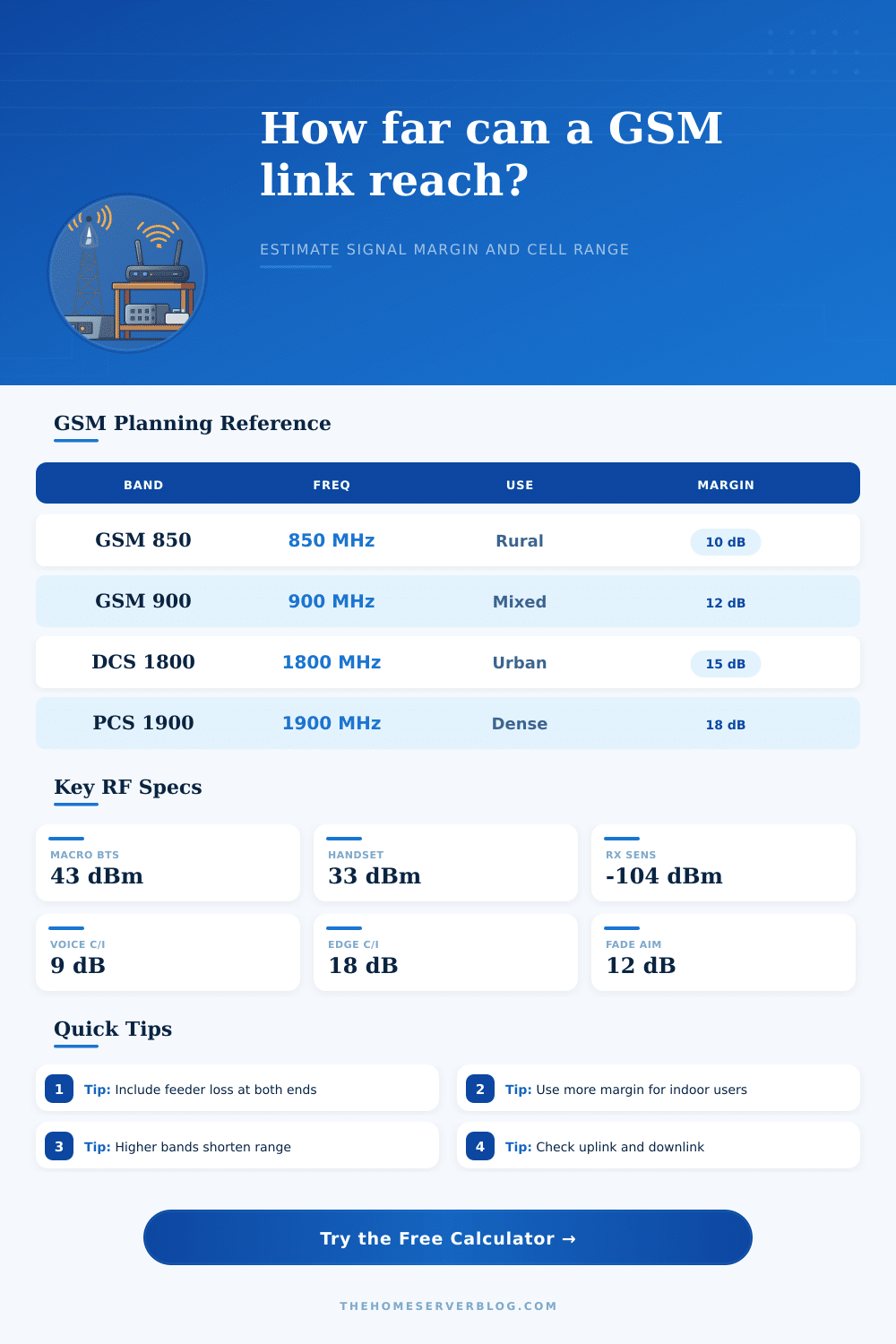
| GSM 850 | 869 to 894 MHz | Coverage-oriented cellular band | Lower path loss than 1900 MHz |
| GSM 900 | 935 to 960 MHz | Rural and suburban macro coverage | Often strong balance of range and capacity |
| DCS 1800 | 1805 to 1880 MHz | Urban capacity layer | About 6 dB more FSPL than 900 MHz |
| PCS 1900 | 1930 to 1990 MHz | Urban and suburban PCS networks | Use tighter ranges and more sites |
🔌Link Budget Terms
| Term | Formula / Value | Unit | How It Affects Margin |
|---|---|---|---|
| EIRP | Tx power + Tx gain - Tx losses | dBm | Higher EIRP improves downlink received level |
| FSPL | 32.44 + 20log(f) + 20log(d) | dB | Loss rises with frequency and distance |
| Fade margin | 10 to 20 dB typical | dB | Reserve for fading and local variability |
| Clutter loss | 5 to 35 dB typical | dB | Buildings, trees, and indoor penetration reduce signal |
| Receiver threshold | -95 to -110 dBm typical | dBm | More negative thresholds allow longer links |
🏙Common GSM Planning Cases
| Project | Profile | Expected Range | Critical Check |
|---|---|---|---|
| Rural macro voice | 900 MHz, high antenna, light clutter | Long cell edge | Uplink handset power can dominate |
| Urban capacity layer | 1800 or 1900 MHz, microcell | Shorter street grid | Penetration and interference margin |
| Indoor repeater | Donor antenna plus indoor antenna | Building zones | Isolation and feeder losses |
| Fixed modem link | External antenna, stable location | Medium to long link | Antenna gain and cable length |
💡Planning Notes
A link budget is a calculation that help engineers to keep track of the strength of a radio frequency signal. Link budget work in a similar way to financial ledgers. They start with a certain amount of power and then subtract every type of loss that the signal will experience as it makes it journey from one device to another.
The result of the calculation is a prediction of whether a link will be successful or not. If the signal strength drop to a low level by the time it is calculated, then the link wont be succesful. The first calculation engineers makes within a link budget is to determine the starting power of the signal.
How a Link Budget Works
This is referred to as the Effective Isotropic Radiated Power, or EIRP. The EIRP of a signal is the total strength of the signal that radiate from the antenna. The engineers calculate the EIRP as the transmit power of the radio are combined with the gain of the antenna.
However, engineers must account for signal loss that occur before the signal reaches the air. For example, loss occurs through the use of cables and combiners to connect the radio to an antenna. The longer the feeder cables that are used, the more loss will occur to the signal.
This will reduce the EIRP of the signal that is emitted from the antenna. The second type of loss that must be accounted for is path loss. Path loss is the weakening of the signal as the signal travel through the air.
Path loss is dependent upon the frequency of the signal. Lower frequencies, such as 850 MHz and 900 MHz, experience less path loss than higher frequencies, such as 1800 MHz and 1900 MHz. This is due to the fact that lower frequencies bend around obstacles in the environment more easy.
Thus, increasing the frequency of the signal will reduce the range of that signal, requiring many cell site to be deployed to cover the same geographic area. Another type of loss is caused by the signal encountering physical object in its path. Clutter loss occurs when the signal travels through objects like tree.
Penetration loss occurs when the signal travels through structures like brick wall. In rural area, there is less clutter for the signal to encounter, reducing clutter loss. In urban areas, the signal encounter many buildings along its path, which reduce the range of the signal.
The signal will lose strength when it passes through a building or when it bounce off of surfaces like glass or concrete. One last calculation that engineers make within a link budget is the introduction of the fade margin. A fade margin is used to provide some extra power to the signal to account for any fluctuation in the signal.
Radio signal can fluctuate in strength due to the weather, vehicles, and people in the signal path. If the link budget does not include a fade margin, the link will fail each time the signal fluctuate in strength. Including the fade margin provides for the signal to still reach the destination with strength, even during times when the signal fluctuates.
Engineers must account for both the downlink and uplink signal transmissions. The downlink signal travel from the tower to the phone. It has high signal strength because the tower uses an amplifier with high power.
The uplink signal travels from the phone to the tower. It has low signal strength because the phone has low battery power and a low antenna power. Both signal must be strong enough for the link to be successful.
Failing to account for the uplink signal will cause the tower to not be able to hear the phone. Thus, engineers must account for the uplink signal in they link budget calculations. Finally, these calculations can help to predict the range of the signal at the edge of the cell, or the cell edge.
While engineers cannot change the laws of physics, they can adjust the height of the antennas or change the frequency at which the signal is transmitted. By calculating the link budget, engineers can determine how much signal power will remain after the signal travels from the tower to the user.