📡 Fiber Optic Loss Calculator
Calculate total link loss, power budget, and safety margin for fiber optic runs
📡 Link Loss Budget Results
dB/km
dB/km
dB/km
dB/km
| Component | Type | Typical Loss | Max Loss |
|---|---|---|---|
| Connector | LC | 0.10 dB | 0.20 dB |
| Connector | SC | 0.15 dB | 0.25 dB |
| Connector | ST | 0.20 dB | 0.30 dB |
| Connector | MPO/MTP | 0.25 dB | 0.35 dB |
| Connector | FC | 0.15 dB | 0.25 dB |
| Splice | Fusion | 0.02 dB | 0.05 dB |
| Splice | Mechanical | 0.30 dB | 0.50 dB |
| Fiber Type | Wavelength | Attenuation | 1G Max | 10G Max |
|---|---|---|---|---|
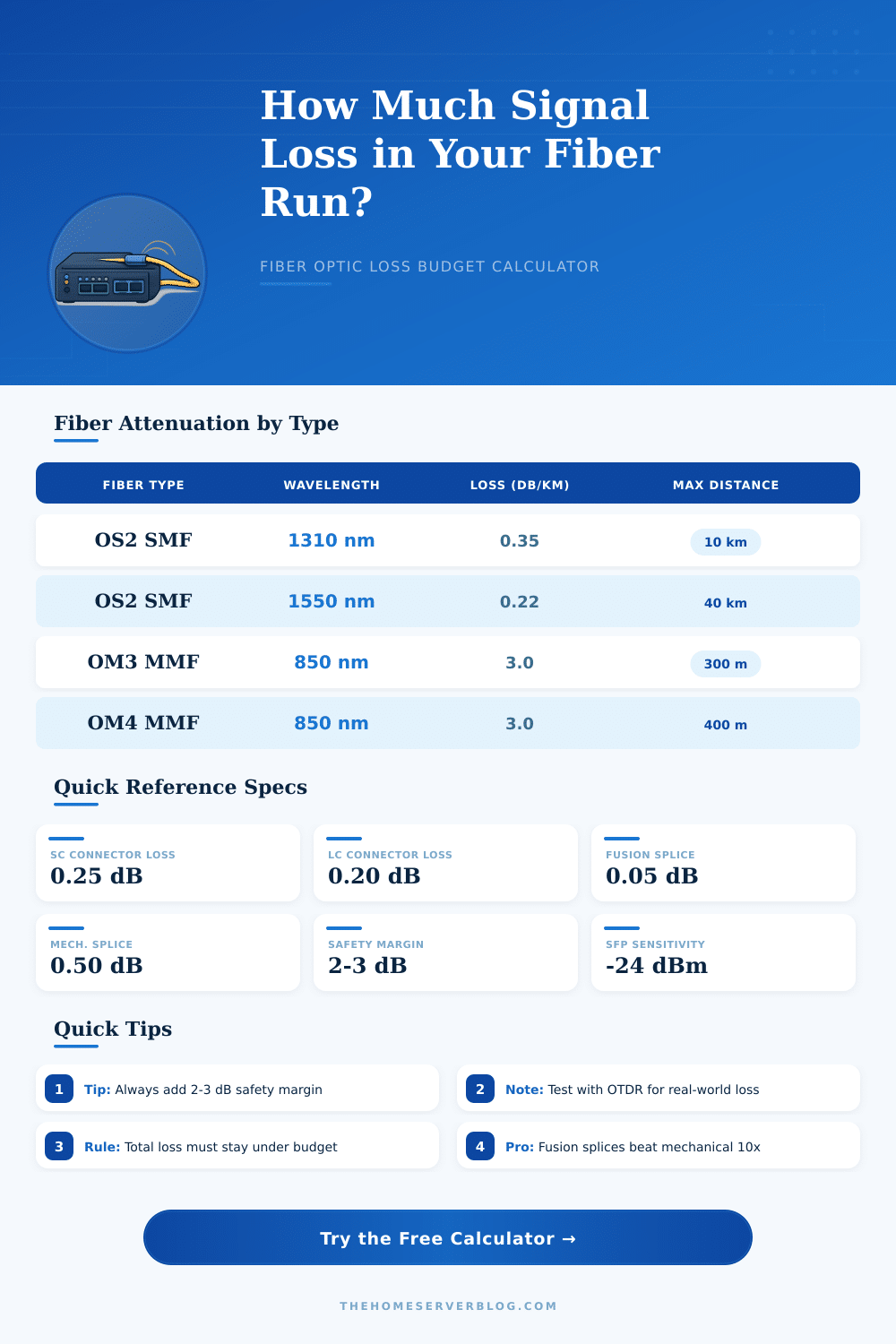
| OS2 SMF | 1310 nm | 0.35 dB/km | 10 km | 10 km |
| OS2 SMF | 1550 nm | 0.22 dB/km | 40 km | 40 km |
| OM1 MMF | 850 nm | 3.5 dB/km | 275 m | 33 m |
| OM2 MMF | 850 nm | 3.5 dB/km | 550 m | 82 m |
| OM3 MMF | 850 nm | 3.0 dB/km | 550 m | 300 m |
| OM4 MMF | 850 nm | 3.0 dB/km | 550 m | 400 m |
| OM5 MMF | 850 nm | 3.0 dB/km | 550 m | 400 m |
| Scenario | Fiber | Distance | Connectors | Typical Loss |
|---|---|---|---|---|
| Data Center Cross-Connect | OM4 | 15 m | 2 pairs | 0.85 dB |
| Office LAN Backbone | OM3 | 50 m | 2 pairs | 1.05 dB |
| Building Riser | OM3 | 200 m | 3 pairs | 1.80 dB |
| Campus Short Run | OS2 | 500 m | 2 pairs | 1.18 dB |
| Campus Extended | OS2 | 2 km | 3 pairs | 2.20 dB |
| Metro Ring | OS2 | 20 km | 4 pairs | 8.40 dB |
| Long Haul | OS2 | 40 km | 4 pairs | 10.80 dB |
Fiber optic loss, or simply loss in fibers, measures how much light disappears between the entry and the exit. Light cannot travel by means of optical fiber with 100 percent impact. Many factors cause that, for instance absorption in the core and cladding because of impurities or leak of light from the cladding The whole loss sums from all those tolls, and you usually measure it in decibels each kilometer (dB/km).
Various tolls in optical fibers happen because of internal or outside factors. Internal include absorption loss, dispersion and scattering because of structural damages. For instance Rayleigh scattering comes from microscopic changes in the refraction rate of the core material, that scatters the beam.
What Causes Loss in Fiber Optic Cables
External tolls are splicing loss, connector loss and bending loss. Micro bending happen because of little distorboj in the fiber, caused by unevenness during production or stress during cabling.
Bend forms big risk. When fiber bends too much, light escapes because it does not reflect inwardly, which lowers the intensity more below in the fiber. Even 90-degree bend can break optical fiber cable.
You should not touch fiber cable when you install it. Too tight zip-tie can cause micro crimps, that soon will stage signal loss.
Dirty connections are common problems. Cable ends need be polished flat. During signal bounces inside of the cable, any damage can create loss, signal loss and even signal escape from the cable.
Mismatched fiber ends also do troubles, especially if slices do not coincide.
Loss come from passive parts such as cables, splices and connections. Although it is much more small in optical fibers than in other parts, it happens in multimode and single-mode fibers. Multimode fibers show around 2.5 dB/km in 850 nm and 0.8 dB/km in 1300 nm.
Single-mode fibers have around 0.3 dB each kilometer in 1310 nm and 0.2 dB each kilometer in 1550 nm.
Industry standard requires around 0.75 dB each connection and 0.3 dB each splice. Fusion splice of 0.02 dB are good, but 0.2 dB are bad. The bigger the dB loss, the more probable will happen data loss.
The best way to control is use OTDR or optical time domain reflectometer, put it on the line and read the dB loss. Good optical data link require enough strong light source to beat the attenuation.