⚡ Supermicro Server Power Consumption Calculator
Calculate accurate power draw, heat output, and circuit requirements for Supermicro servers
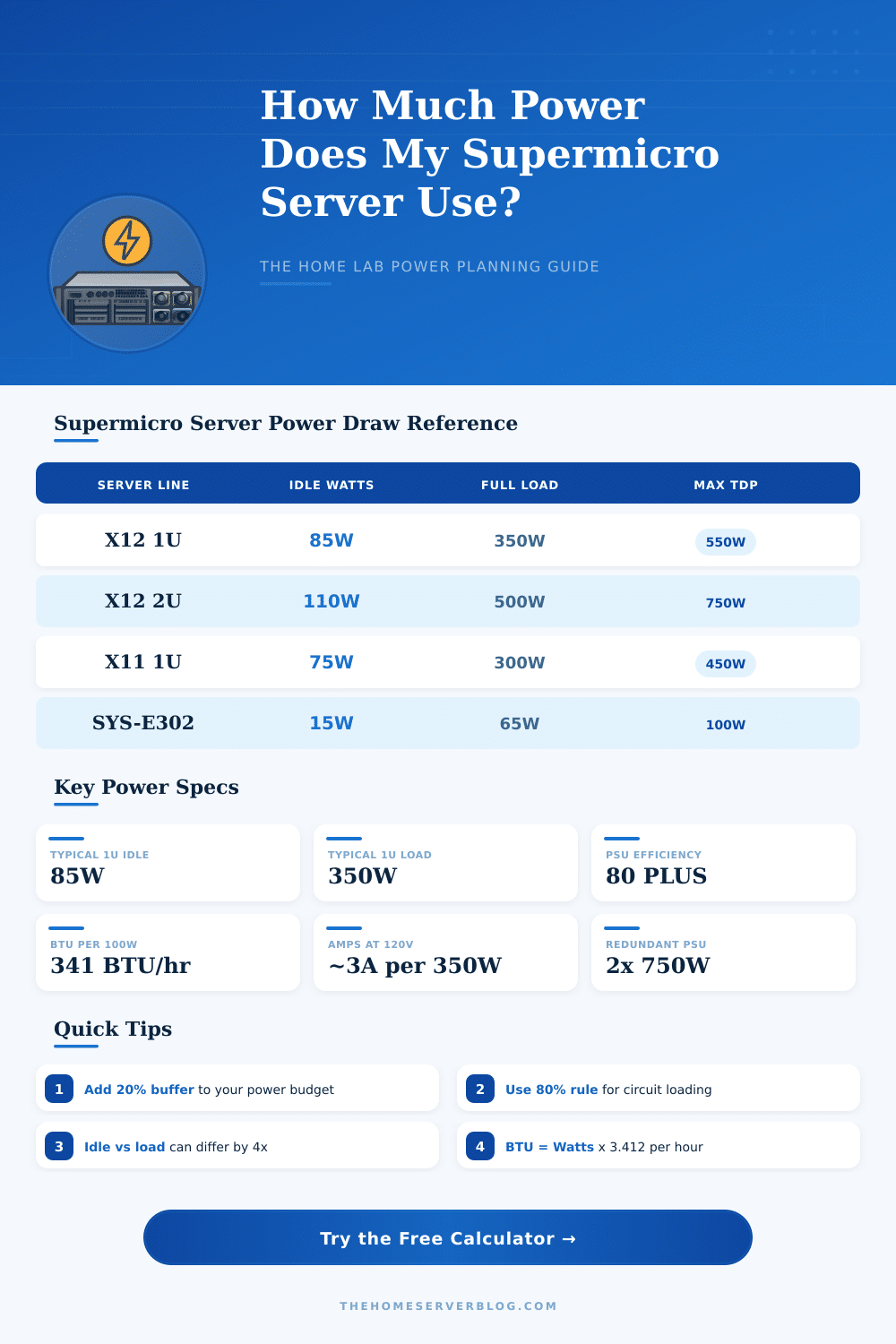
| Server Line | Form Factor | Idle (W) | Typical (W) | Full Load (W) | Std PSU Rating |
|---|---|---|---|---|---|
| X12 1U (Ice Lake) | 1U | 85 | 350 | 550 | 750W 80+G |
| X12 2U (Ice Lake) | 2U | 110 | 500 | 750 | 1000W 80+G |
| X12 4U Storage | 4U | 220 | 1200 | 1800 | 2x1200W |
| X12 Twin (Dual-Node) | 2U | 130 | 600 | 900 | 2x750W |
| X11 1U (Skylake) | 1U | 75 | 300 | 450 | 600W 80+P |
| X11 2U (Skylake) | 2U | 110 | 500 | 700 | 1000W 80+G |
| GPU / AI 1U | 1U | 150 | 1400 | 2000 | 2x2000W |
| SYS-E302 (Edge) | Mini | 15 | 65 | 100 | 150W Ext. |
| Circuit Breaker | Voltage | Max Continuous Load | Usable Wattage (80%) | Servers @ 350W |
|---|---|---|---|---|
| 15A | 120V | 12A | 1,440W | ~4 servers |
| 20A | 120V | 16A | 1,920W | ~5 servers |
| 20A | 208V | 16A | 3,328W | ~9 servers |
| 30A | 208V | 24A | 4,992W | ~14 servers |
| 20A | 240V | 16A | 3,840W | ~10 servers |
| 30A | 240V | 24A | 5,760W | ~16 servers |
| 80 PLUS Level | 20% Load | 50% Load | 100% Load | Typical Use |
|---|---|---|---|---|
| Bronze | 82% | 85% | 82% | Budget servers |
| Silver | 85% | 88% | 85% | Mid-range |
| Gold | 87% | 90% | 87% | Most Supermicro |
| Platinum | 90% | 92% | 89% | High-density |
| Titanium | 92% | 94% | 91% | HPC / GPU |
| Cluster Type | Servers | Typical Draw | Heat (BTU/hr) | Circuit Needed |
|---|---|---|---|---|
| Home Lab (Proxmox) | 3x X11 1U | ~900W | ~3,071 | 20A/120V |
| Small VM Cluster | 4x X12 1U | ~1,400W | ~4,777 | 20A/208V |
| Full Rack Compute | 6x X12 1U | ~2,100W | ~7,165 | 30A/208V |
| Storage Array | 1x X12 4U | ~1,200W | ~4,094 | 20A/208V |
| GPU AI Lab | 2x GPU 1U | ~2,800W | ~9,554 | 30A/208V |
| Edge Deployment | 4x E302 | ~260W | ~887 | 15A/120V |
Supermicro offer a wide selection of efficient power sources, that come with various tools for control of energy. They each test carefully and ensure their quality. Those power sources intend to help Server devices operate more well, what is important when machines work constantly whole day.
There are several strong options to choose. The model PWS-2K70A-1R forms a hot-swap power source, that gives up to 2700W with good output, fit for 1U-servers, and it has the rating 80 Plus. Also, the PWS-2K60A-1R operates as back-up power source, delivering up to 2600W with 80 Plus and active correction of power factor for better results.
Supermicro Power Supplies and How They Work
For more modest needs, the PWS-802-1R shows 80 Plus Titanium-source, that reaches 800W at 96% efficiency. Also there is the PWS-920P-SQ, that is a 920W single-unit power module with support for PFC and PMBus.
Supermicro produce also panels for sharing energy, that work for back-up sources. Each of those panels pass intense control for high reliability. But sometimes such power panels cause crashes.
For instance, in one case, a bad power panel inside the rack caused the main problem, because after change of parts to another rack everything else worked without issues.
When dealing about control of energy threw several servers, the Supermicro Power Manager helps to watch and lead them, especially if they have Intel Node Manager. It rests on the base of Intel Data Centre Manager and gives policy-based Power Consumption, that does not need an agent and operates outside the net. One can follow Power Consumption by means of IPMI, that shows values like current energy, minimum, maximum and average for a set time.
The usage of energy changes a lot based on the setup. For 4U-Supermicro with double CPU LGA2011-board, it uses around 140W in full work. Less fresh Supermicro-servers under low load reach average of only 50W, with spike around 80W. In one sample, one cut Power Consumption of 330W in pause to 205W after tuning.
If back panels and drives are removed, empty rack takes around 42W with two power sources or almost 30W with only one.
Servers of Supermicro make a lot of heat, so they need good cooling. In tight places, that means louder work of fans. The sound of back-up power sources is a known problem, but the PWS-920P-SQ is said to be a more quiet option.
Also the rack-mounted cases commonly are long, so one must check the sizes. Standard ATX power sources sometimes do not work for data centre gear. Even so Supermicro-boards follow ATX-standard, what adds some options.
The company creates energy-savingsolutions for servers on base of x86-architecture, made of machines, boards, storage systems and parts like cases, racks and power sources.