🖥 Rack Unit Calculator
Plan your server rack layout — calculate U space, utilization, and physical height
🖥 Rack Space Analysis
1.75 in
3.50 in
7.00 in
73.5 in
| Rack Height | Total Height | Common Use | Max Devices (Typical) |
|---|---|---|---|
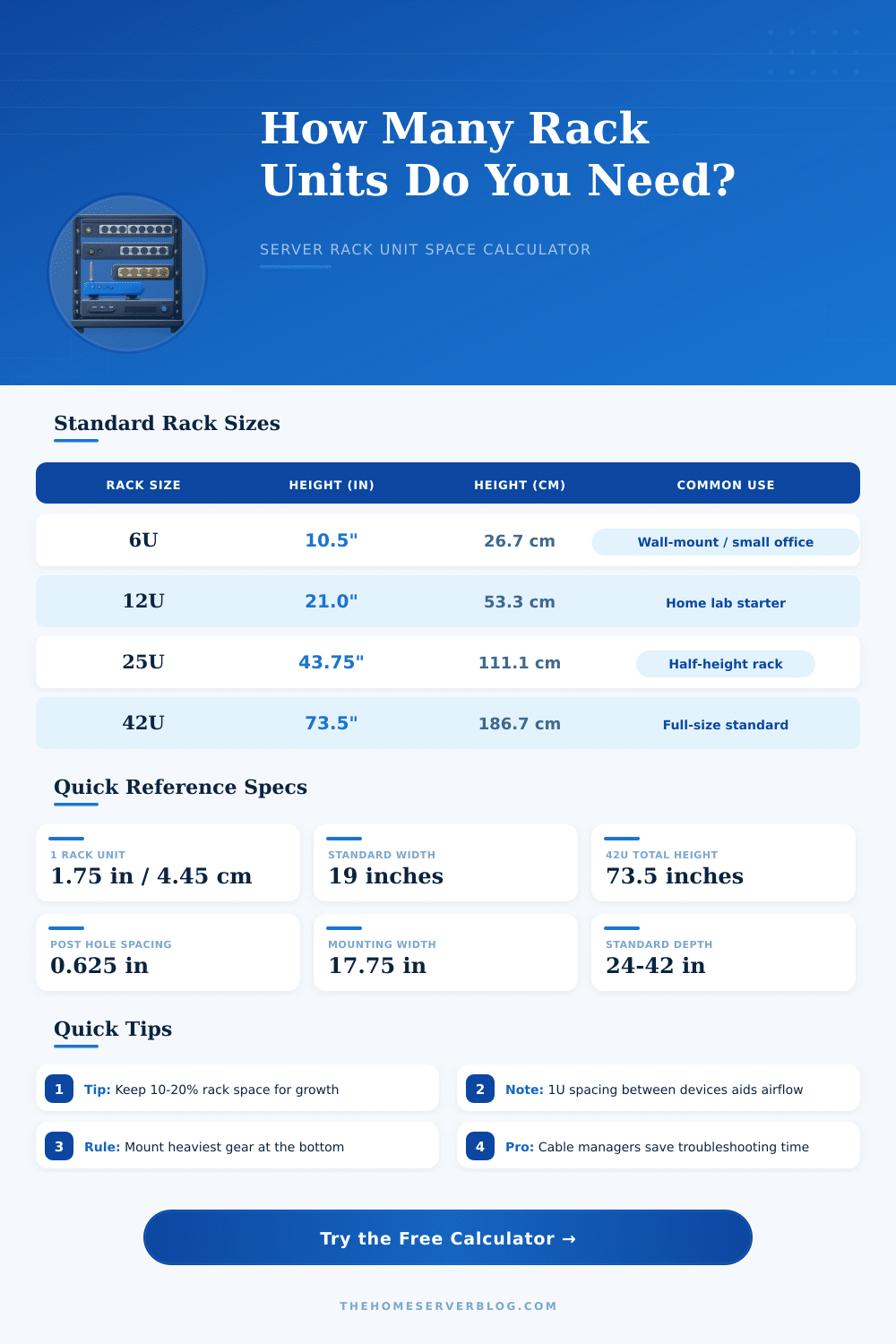
| 6U | 10.5 in / 26.7 cm | Wall-mount, small office | 3–5 |
| 9U | 15.75 in / 40.0 cm | Network closet, SOHO | 5–7 |
| 12U | 21.0 in / 53.3 cm | Home lab, small server room | 6–10 |
| 15U | 26.25 in / 66.7 cm | Branch office, surveillance | 8–12 |
| 18U | 31.5 in / 80.0 cm | Medium office, gaming servers | 10–14 |
| 22U | 38.5 in / 97.8 cm | NAS storage, mid-size lab | 12–18 |
| 25U | 43.75 in / 111.1 cm | Half-height, Proxmox cluster | 14–20 |
| 42U | 73.5 in / 186.7 cm | Full-size data center standard | 24–36 |
| 45U | 78.75 in / 200.0 cm | Enterprise lab, high density | 26–40 |
| 48U | 84.0 in / 213.4 cm | Tall cabinets, telco racks | 28–42 |
| Standard | Width | Unit Height | Notes |
|---|---|---|---|
| EIA-310-D | 19 in (482.6 mm) | 1.75 in (44.45 mm) | Most common; servers, networking, storage |
| IEC 60297 | 19 in (482.6 mm) | 1.75 in (44.45 mm) | International equivalent of EIA-310 |
| ETSI (Telco) | 21 in (535 mm) | 1.75 in (44.45 mm) | Telecom equipment; wider frame |
| Open Compute (OCP) | 21 in (537 mm) | 1.75 in (44.45 mm) | Open-source data center rack design |
| Configuration | Rack Size | Equipment Count | U Used | Notes |
|---|---|---|---|---|
| Home Lab Starter | 12U | 4 | 5U | Server, switch, patch panel, shelf |
| Proxmox Cluster | 25U | 6 | 12U | 3 servers, switch, patch, UPS |
| NAS Storage | 22U | 5 | 12U | NAS units, storage array, switch, UPS |
| Network Closet | 9U | 5 | 5U | Switch, patch panels, shelf, cable mgr |
| Full Enterprise | 42U | 15 | 27U | Servers, switches, UPS, KVM, panels |
| Surveillance | 15U | 5 | 7U | NVR, switch, patch, UPS, shelf |
| Colocation Quarter | 12U | 5 | 9U | Servers, switch, patch, UPS |
Rack unit is standard size used to estimate the vertical height of gear for rack-mountable. It is abbreviated as U or RU One rack unit is 1.75 inches, or 44.45 millimeters. This measure is most commonly used for 19-inch and 23-inch rack frames, as well as height of devices installed in them.
The height of frames or servers is shown by multiples of that unit.
What is a Rack Unit?
Rack unit helps to optimize the space and the design of server racks. It matters for data centers and management of IT infrastructure. Rack mount systems come in 1U, 2U or 4U forms, according to the used rack space.
For instance, 2U server requires twice more space than 1U server. Currently you use 1U servers, that are 1 3/4 inches high. Rack server is made for 19-inch wide equipment raks.
Standard rack has 42 units. Typical racks are 38 to 48 U, most commonly 40 to 44 U. The 19-inch width is standard, and U units measure the height. Some 1U servers are very deep to fit everything inside, so they require special deep racks or those with back open for overhang.
On modern racks you see labels with numbers and lines for the rack units. They are usually white on black racks and black on beige. Those lines show where starts the top and bottom of every rack unit.
Everything has standard width and measure by height units. In one box everything is the best way. Less cables, and everything stacks well.
In racks you find servers, network devices, routers, switches, cooling units and fans, cables and wires, cable management, trays, bridges, gateways, modems and repeaters.
Rack and stack is the process of physical install and setup of IT devices in data center racks. It includes assembly, mounting, cabling and initial setup of servers, storage devices, network switches and other rack parts. By racking and stacking you immediately use the floor space in data center.
If spaces stay empty in rack, you should cover them with blanking plates. This is important for servers, because air exits from the unit, pass through the gap and return back, without reaching the air conditioning. Less care about UPS units, because they do not cast a lot of heat.
Rack mount UPS is great, but running it in high loads will shorten the batery life.
There are also rails for two-post systems, that center the unit so the center of gravity match. Vertical PDUs on walls work better than horizontal and take no rackspace.