Spectral Efficiency Calculator
Estimate RF and wireless link efficiency in bits/s/Hz from modulation order, coding rate, MIMO streams, channel bandwidth, guard interval, overhead, and useful throughput.
📶Wireless and RF presets
⚙Spectral efficiency inputs
Spectral efficiency result
🔢Modulation spec grid
📊Reference tables
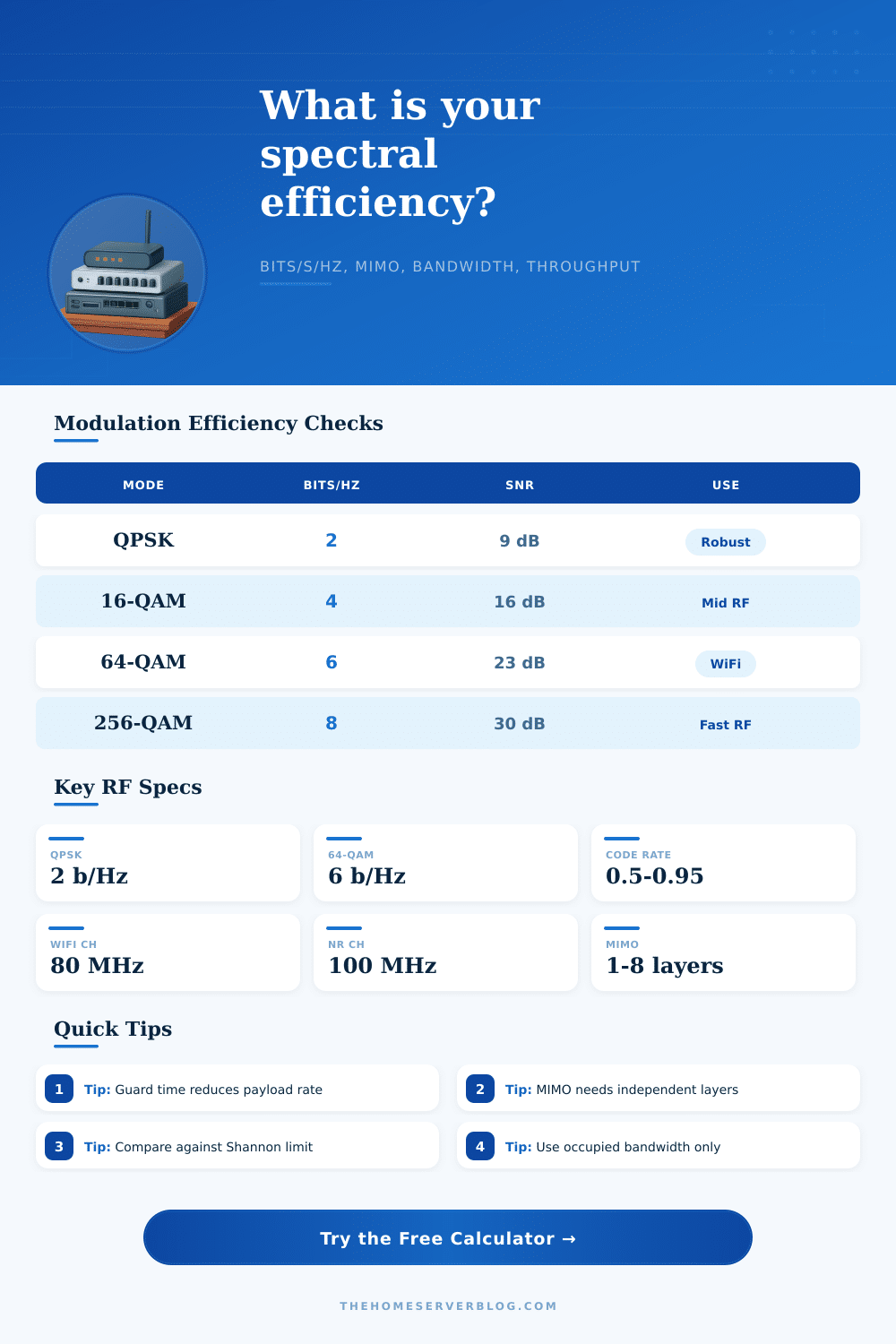
| Modulation | Order M | Raw bits/s/Hz | Typical clean SNR |
|---|---|---|---|
| BPSK | 2 | 1 | 6 to 9 dB for robust links |
| QPSK | 4 | 2 | 9 to 12 dB for mobile or IoT RF |
| 16-QAM | 16 | 4 | 15 to 18 dB for moderate broadband |
| 64-QAM | 64 | 6 | 21 to 24 dB for clean WiFi and cable |
| 256-QAM | 256 | 8 | 27 to 30 dB for high-rate RF |
| 1024-QAM | 1024 | 10 | 33 to 36 dB for very clean channels |
| 4096-QAM | 4096 | 12 | 38 to 42 dB for short, high-quality links |
| Wireless or RF preset | Bandwidth | Common layers | Practical efficiency range |
|---|---|---|---|
| WiFi 6 80 MHz 2x2 | 80 MHz | 2 streams | 5 to 11 useful bits/s/Hz |
| WiFi 7 320 MHz 4x4 | 320 MHz | 4 streams | 18 to 36 useful bits/s/Hz |
| LTE 20 MHz 2x2 | 20 MHz | 1 to 2 layers | 2 to 8 useful bits/s/Hz |
| 5G NR 100 MHz 4x4 | 100 MHz | 2 to 4 layers | 8 to 24 useful bits/s/Hz |
| LoRa 125 kHz sensor | 125 kHz | 1 layer | Very low payload efficiency |
| DVB-S2 carrier | 36 MHz | 1 layer | 1.5 to 4.5 useful bits/s/Hz |
| Overhead item | Typical value | Affects | Calculator field |
|---|---|---|---|
| Forward error correction | 1/2 to 7/8 | Payload symbols versus coded symbols | Coding rate |
| Guard interval or cyclic prefix | 3% to 25% | Useful OFDM symbol time | Guard interval |
| Pilots and control channels | 3% to 20% | Resource elements not carrying payload | Pilot overhead |
| MAC and protocol overhead | 5% to 45% | Headers, ACKs, contention, scheduling | MAC overhead |
| MIMO correlation | 60% to 95% | How much each layer adds to rate | MIMO efficiency |
| Implementation efficiency | 70% to 95% | Hardware, equalizer, scheduler, EVM gap | Implementation |
| Useful bits/s/Hz | 20 MHz throughput | 80 MHz throughput | Planning interpretation |
|---|---|---|---|
| 0.1 | 2 Mbps | 8 Mbps | Robust sensor, low SNR, or spreading-heavy link |
| 1 | 20 Mbps | 80 Mbps | Basic coded broadband payload channel |
| 3 | 60 Mbps | 240 Mbps | Mid-order modulation after overhead |
| 6 | 120 Mbps | 480 Mbps | Good single-stream WiFi or fixed RF result |
| 12 | 240 Mbps | 960 Mbps | Multi-stream or very clean high-QAM channel |
| 24 | 480 Mbps | 1.92 Gbps | Wide, clean MIMO link with low overhead |
✅Planning tips
Spectral efficiency are a measurement of how much data can move through a specific amount of spectrum. Because spectrum is a limited resource, it is important to understand how many bit can move through that limited spectrum. When data is carried along a wireless link, the link must account for several factor that may reduce the amount of data that is moved along that link.
Factors like coding, timing, and protocol overhead can all contribute to the reduction of the spectral efficiency of that wireless link. The calculator tool allows one to calculate the spectral efficiency of a wireless link by entering several different parameters. The first of such parameter is the modulation order, which impacts the amount of data that can be carried along with each symbol.
How to Calculate Spectral Efficiency and What Affects It
The second parameter is the coding rate, which help to protect the data from errors by removing some of the bits from the data. The third group of parameters relates to MIMO streams, which allow for different data streams to travel along the link simultaneously. However, the number of MIMO streams only increases the data capacity of the link if the antennas are able to capture independent channels.
Additionally, guard intervals and pilot symbols is used to maintain the stability of the link. MAC overhead is another parameter that must be accounted for, as it relates to the data headers and acknowledgments that are sent during data exchanges. Each of these parameters can impact the spectral efficiency of the link, so altering any of those parameters will impact the calculation of the spectral efficiency of that link.
Many people tend to focus only on the modulation number of a wireless link. However, the modulation order is not the total capacity of that link. For example, a link using 256-QAM may have a high capacity, but if the other parameters is factored in, that link may have a lower efficiency.
The calculator allows one to see how many bit per second can be sent along that link at the maximum possible capacity. Thus, the calculator allows individuals to determine whether the link will be able to meet the data transfer needs of the link. In addition to the mathematical calculation of spectral efficiency, real-world environments can introduce additional issue to the efficiency of that link.
For example, antenna correlation and amplifier linearity can reduce the gains that is provided by the MIMO streams. Additionally, interference from other wireless devices in the area can also reduce the efficiency of that link. The signal-to-noise ratio of a link that is acceptable in a laboratory may not be acceptable in a real-world scenario, due to the potential for interference.
These changing environment can impact the efficiency of the link. Thus, the Shannon comparison that the calculator provides allows individuals to determine how close the efficiency of the link is to its theoretical maximum efficiency. The reference tables the calculator provides allow individuals to understand the signal-to-noise ratios for each type of modulation order, as well as the efficiency of the systems.
For instance, 5G NR channels can reach high spectral efficiencies, but only if the conditions is ideal. In contrast, if the same 5G NR channel is placed in a congested area, the efficiency will drop. Thus, these tables allow individuals to make decision regarding the setup of the link, such as if more bandwidth should be allocated to that link, or if the antennas should be better placed.
One of the most common mistake made by individuals is to treat the advertised rates for the physical layer of the link as the usable capacity of the link. The advertised rates for the physical layer of the link only describe the capacity of the modulation and coding schemes for that link. That capacity does not include the overhead of that link.
If these specification are entered into the calculator, the result will show the difference between the physical layer rate and the useful data rate for that link. Useful rates for many WiFi and wireless links are only able to utilize 60-80% of the advertised physical layer rate. Another of the most common mistake made by individuals is to assume that each MIMO stream will add to the capacity of the link in a linear fashion.
Each MIMO stream is only able to contribute to the data capacity of the link if each antenna captures independent channels. If the link is established between close-range antennas, the MIMO streams will not provide as much data capacity as is calculate for the link. The efficiency for each MIMO stream can be adjusted in the calculator to reflect this potential lack of efficiency in real-world environments.
The same concept applies to narrowband IoT links, such as LoRa and Zigbee. These links use low-order modulation and coding rates to add error control to the link. However, because the bandwidth of these links is very small, they still have some useful spectral efficiency.
The spectral efficiency calculator makes it possible to understand how narrowband IoT links can still exist within the same spectrum as broadband channels of data. The value of the spectral efficiency number is only found in how it is used. If the spectral efficiency number of the link is found to meet the target number for that link, then the link can be established.
However, if the spectral efficiency of the link does not meet the target, there is several variables that can be changed to increase the efficiency of that link. Whether that link should be widened, the overhead should be decreased, or the physical layer should be improved can be determined by the spectral efficiency number. Thus, the goal is not the highest possible data rates (bits per second) for the link, but the data rate necessary to fulfill the needs of the link.