🗄️ N+1 Query Cost Calculator
Calculate the exact query overhead, time cost, and optimization impact of N+1 query problems in your application
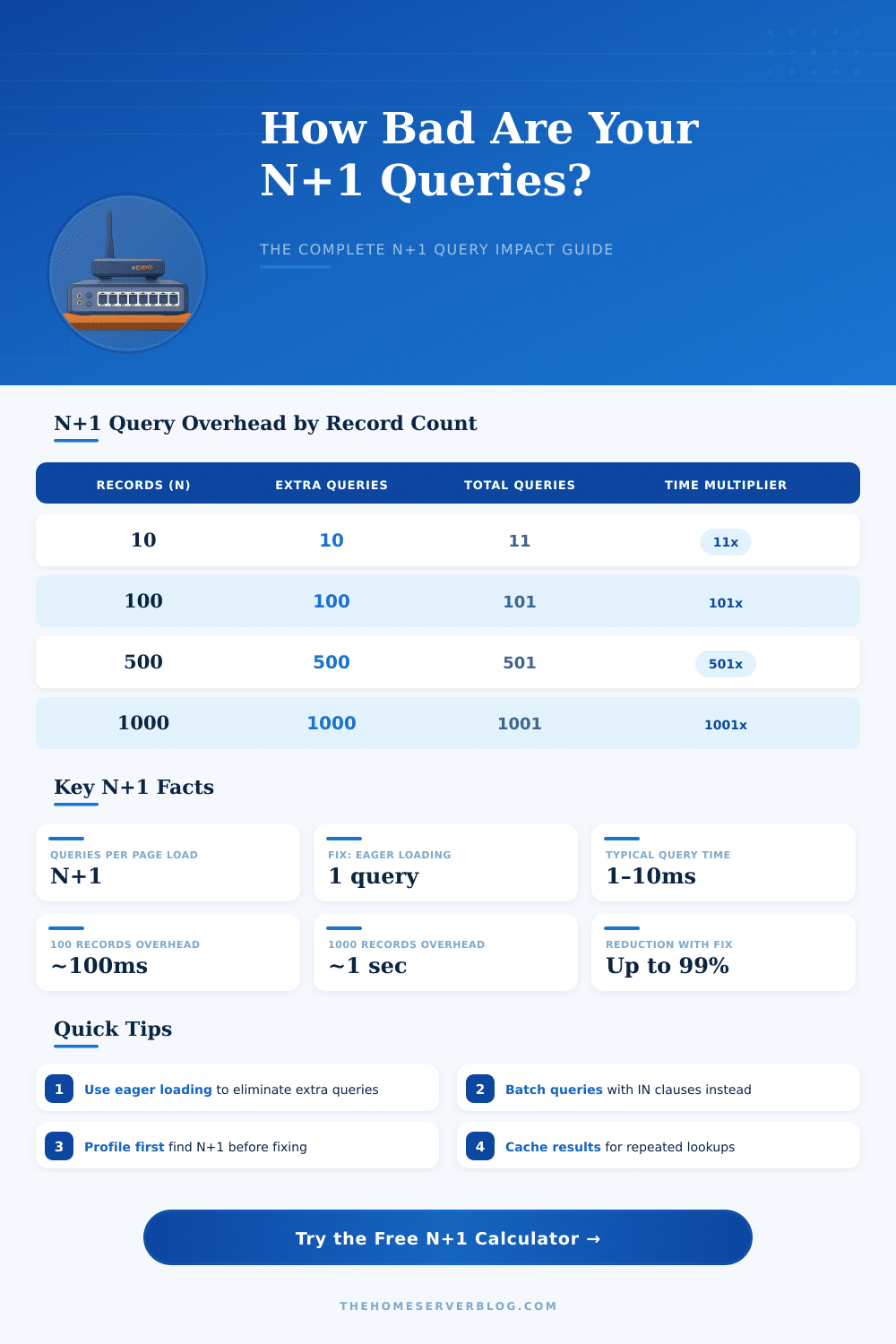
| Records (N) | Extra Queries | Total Queries | At 5ms/query | At 10ms/query | At 20ms/query |
|---|---|---|---|---|---|
| 10 | 10 | 11 | 55ms | 110ms | 220ms |
| 25 | 25 | 26 | 130ms | 260ms | 520ms |
| 50 | 50 | 51 | 255ms | 510ms | 1,020ms |
| 100 | 100 | 101 | 505ms | 1,010ms | 2,020ms |
| 200 | 200 | 201 | 1,005ms | 2,010ms | 4,020ms |
| 500 | 500 | 501 | 2,505ms | 5,010ms | 10,020ms |
| 1000 | 1000 | 1001 | 5,005ms | 10,010ms | 20,020ms |
| Concurrent Users | Req/min (100 rec) | Queries/min (N+1) | Queries/min (optimized) | Query Reduction |
|---|---|---|---|---|
| 1 | 60 | 6,060 | 120 | 98% |
| 10 | 600 | 60,600 | 1,200 | 98% |
| 50 | 3,000 | 303,000 | 6,000 | 98% |
| 100 | 6,000 | 606,000 | 12,000 | 98% |
| 500 | 30,000 | 3,030,000 | 60,000 | 98% |
| N (Records) | Depth 1 (N+1) | Depth 2 (N+N²) | Depth 3 (N+N²+N³) | Optimized (any depth) |
|---|---|---|---|---|
| 10 | 11 | 121 | 1,231 | 1–3 |
| 25 | 26 | 651 | 16,276 | 1–3 |
| 50 | 51 | 2,601 | 130,051 | 1–3 |
| 100 | 101 | 10,201 | 1,030,301 | 1–3 |
But sometimes your page load time will double for seemingly no reason at all. Your database indexes is solid and the code looks clean, yet it take seconds when it should only take milliseconds. In most cases this isn’t due to a server hardware problem. Instead its typically N+1 query problem.
Your application grab a list of records and then fires off an extra query for each and every item to pull out related data. When you do the math, ten records become eleven queries total. A thousand records becomes more than a thousand separate round trips to the database. Plug in your own latency figures and record counts into calculator and let it do heavy lifting. Save yourself from guessing, because you’ll often underestimate real cost, it happens to everyone.
The N+1 Query Problem
Here’s the problem: Out-of-the-box, Object-Relational Mappers sacrifice network efficiency for developer convenience. If I have a list of posts that I’m iterating through to render their authors, the ORM might only hit the database when I first request the author property on each post. That’s understandable while developing, the dataset is small enough where this seem like a harmless optimization. But under real user load, this breaks down.
The network overhead and connection handling cost of making separate queries for every object doesn’t scale linearally with performance; instead, it build up. One millisecond per query doesn’t sound so bad, until you realize that is that number multiplied by five hundred concurrent users trying to hit the same endpoint. That’s why you need to understand what you’re plugging into; which is a common mistake made by developers when guessing their inputs.
One input is the “base query time,” meaning the first time a resource is fetched, and another input is the “per-record query time” for all the lookups required to fetch any related data. Then there are network latency and processing overhead buffers. These are important considerations because they amount to your app’s invisible tax on each extra hop back to the database engine. Without considering them, you’ll make overly-optimistic performance estimates that fall apart in production. The reference tables provided with the tool explain how rapidly that cost scales up based off depth. Instead of just increasing at a steady rate, deeper nesting will make the issue grow much fasterer.
The solution to this is moving towards loading data all at once. Depending on your stack, you may refer to these as with, select_related, or includes; but most major framework include ways to do this explicitly. Rather than hundreds of little queries for each piece of related information, they’ll grab all of it at once, in one JOIN operation or perhaps a few well-optimized batches. This little bit of an architectural tweak will pay off hugely in terms of lower database CPU usage and higher throughput.
You pay for a bit of complexity up front in how the query looks, but you gets a dramatically less heavy handed load against the connection pool. The only way to find out about these leaks is to profile your code. And when you test locally with a reasonable load, everything looks fine, as long as you’re not looking at N+1 problems hiding behind apparently normal response times. Then once you get into production traffic, it’s easy for the sheer volume of concurrent connections and records to increase the inefficiencies.
What you don’t measure, you can’t improve. And even if you use database logs, those are usually far too noisy to try to parse by hand unless you has some kind of helper gem to detect the problem for you automatically. Because that kind of thing is so common and so expensive to ignore, there is automated detection gems/debug bars available for each of the major frameworks.
This isn’t only about slow pages loading. Higher numbers of queries also uses up database connection pools quicker, causing other application components to timeout and error out. They waste money on servers by requiring extra infrastructure to run a workload that should of been trivial. Often, query optimization lets you get away with fewer database instances or enables you to run the same amount of traffic off smaller servers. When multiplied over time and multiple team members, this add up to a lot of money.
In short, building a good database is less about how you write your code around it and more about keeping the database separate from your application’s logic. Time, money, stability, all of these are paid for every round trip. Catching this pattern early on will save you from accumulating technical debt later on. You’ll sleep easier knowing that your endpoints won’t collapse when traffic picks up slightly, but instead will scale smoothly.
This brings us back to the question: Why did things slow down for no reason? There is usually a very good reason buried deep within those thousands of needless queries. They are just waiting to be caught and fixed before they can do any damage.