HomeServerBlog retry backoff tool
Retry Jitter Calculator
Estimate how exponential backoff and jitter spread a retry storm across time, reduce synchronized collisions, and keep peak retry RPS under an API, queue, database, or origin rate limit.
1Retry jitter presets
2Retry storm inputs
Calculation breakdown
Retry risk signal
3Current model labels
4Attempt timing reference
| Attempt | Nominal delay | Jitter window | Expected clients | Estimated RPS | Rate-limit status |
|---|
This table is generated from the current inputs. Expected clients fall after each wave based on success recovery percent.
5Jitter strategy comparison grid
Full jitter
Best spike breakerChooses a random delay inside the full backoff envelope. It usually gives the largest collision reduction for API clients and fleets.
Equal jitter
Steadier latencyKeeps half the backoff delay, then jitters the rest. It spreads load without making retries as early as full jitter.
Decorrelated jitter
Storm dampingLets each retry wander from the previous delay. It works well when many clients share the same outage history.
Bounded percent
Tight SLO controlApplies plus or minus jitter around the nominal delay. Useful when you need predictable retry envelopes.
Normal-ish jitter
Smooth centerClusters around the nominal backoff with softer edges. Good for small clients, weaker for very large synchronized fleets.
No jitter
Highest collision riskAll clients retry at the same nominal delays. Use only for tiny systems or tests where synchronized retries are harmless.
6Reference tables
| Preset | Clients | Base delay | Multiplier | Mode | Why it fits |
|---|---|---|---|---|---|
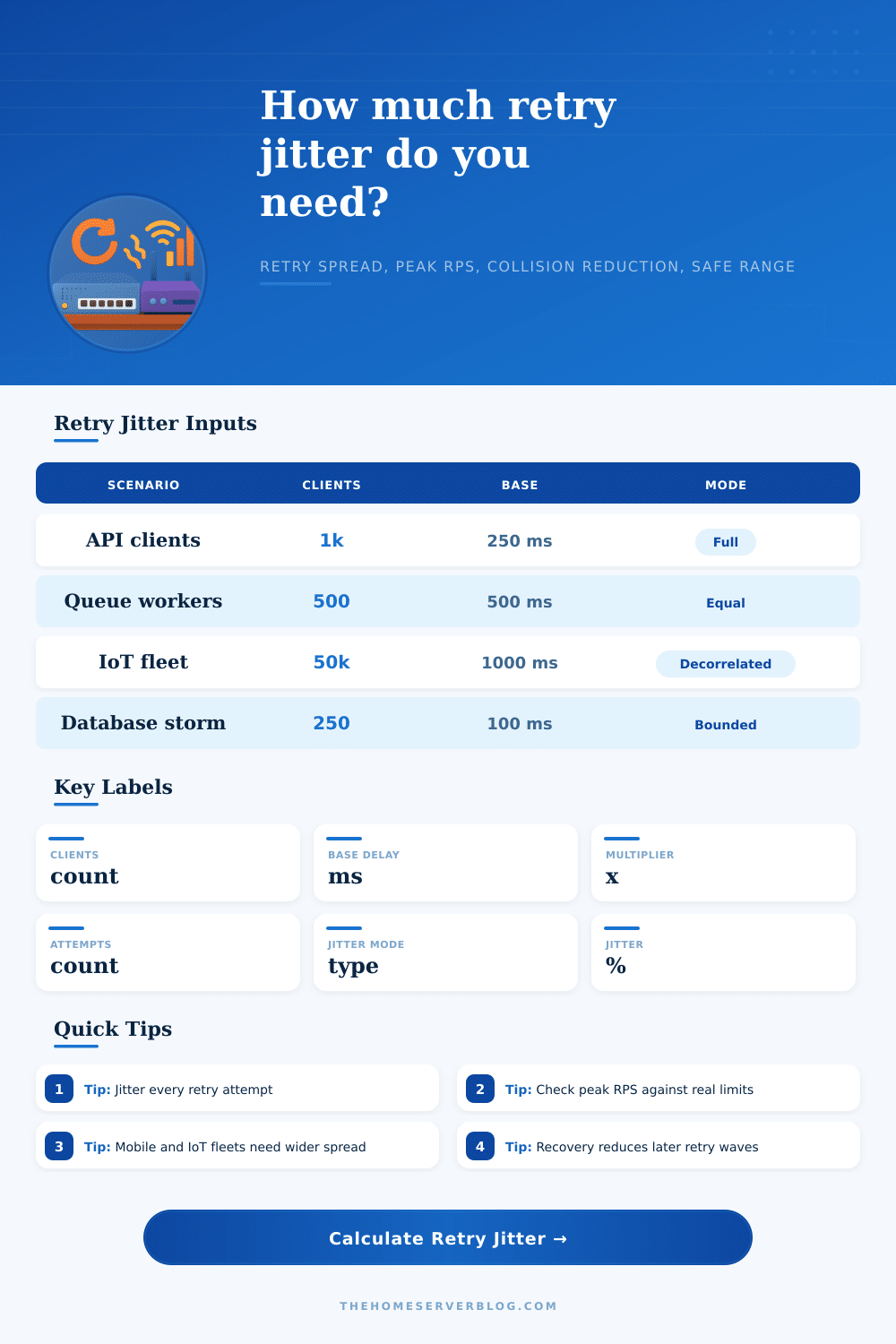
| Full Jitter API | 1,000 | 250 ms | 2.0x | Full | Client SDKs hitting an HTTP API after a short outage. |
| Equal Jitter Queue | 500 | 500 ms | 1.8x | Equal | Queue consumers that should not retry too early. |
| Decorrelated Jitter | 2,500 | 300 ms | 2.0x | Decorrelated | Large callers that need retry waves to drift apart. |
| Mobile Client Retry | 12,000 | 750 ms | 1.6x | Full | Phones reconnecting over uneven networks. |
| IoT Fleet Reconnect | 50,000 | 1000 ms | 2.0x | Decorrelated | Devices reconnecting after a broker or WAN event. |
| Database Retry Storm | 250 | 100 ms | 2.0x | Bounded | App workers protecting a small database pool. |
| Webhook Consumer Retry | 3,000 | 2000 ms | 2.0x | Equal | Webhook deliveries that tolerate slower retry recovery. |
| Kubernetes Client Backoff | 800 | 100 ms | 1.5x | Bounded | Controllers and pods retrying API server calls. |
| CDN Origin Retry | 5,000 | 150 ms | 2.2x | Full | Edge nodes retrying an overloaded origin. |
| Jitter mode | Mode envelope | Collision reduction | Latency tradeoff | Use when |
|---|---|---|---|---|
| Full jitter | Random across up to the full delay | Very high | Some clients retry earlier | Rate-limit safety matters more than tight retry timing. |
| Equal jitter | Half fixed delay, half random delay | High | Moderate | You want fewer early retries but still need spread. |
| Decorrelated jitter | Wide random drift from prior delay | Very high | Can create long tails | Fleet reconnects, brokers, controllers, and storm damping. |
| Bounded percent jitter | Plus or minus a percent around delay | Medium | Predictable | Databases, SLO-sensitive APIs, and tight client budgets. |
| Normal-ish jitter | Most retries near the nominal delay | Medium | Low | Small fleets where smooth timing matters. |
| No jitter | No random spread | None | Lowest per-client variance | Local tests or tiny systems only. |
| Peak retry RPS vs limit | Status | What it means | Typical fix |
|---|---|---|---|
| 0 to 60% | Comfortable | Retries have room for normal traffic and measurement error. | Keep the jitter, monitor real 429 and timeout rates. |
| 60 to 80% | Healthy | Retry load is near the planning target but still below the preferred ceiling. | Confirm production limits and leave a reserve. |
| 80 to 100% | Tight | Retries can consume most of the upstream allowance during an outage. | Increase jitter, raise base delay, or lower attempts. |
| Over 100% | Over limit | The retry wave can recreate the outage by exceeding the service limit. | Add stronger jitter, cap concurrency, or use retry budgets. |
| Safe jitter range clue | Lower bound | Upper bound | Notes |
|---|---|---|---|
| Small API clients | 20% to 50% | 100% | Full or equal jitter usually controls spikes without hurting UX. |
| Queue workers | 40% to 80% | 120% | Favor queue visibility timeout and worker concurrency limits. |
| IoT or mobile fleet | 80% to 150% | 200% | Large synchronized populations need wide reconnect windows. |
| Database callers | 15% to 40% | 70% | Pair jitter with pool limits and short retry budgets. |
7Retry jitter tips
What you might have observed is that one failing request will cause a chain reaction and take down whole service. Not just bad luck, but normaly it’s a synchronized retry storm: hundreds of client detect that the server are down simultaneously, so they all want to try again at the same moment. That generates another wave of traffic often bigger than the initial failure which keeps the server down longer.
The fix? Jitter. It is a nice way to say you are randomly delaying the retries, spreading them out so they come in as a gentle rain rather than flash flood. You don’t need to speculate about whether your delay will be sufficient; the calculator above do it for you when you enter how many clients you have and what level of backoff you want to apply.
How Jitter Stops Retry Storms
Engineers often think that throwing in a multiplier suffices (it doesn’t). Even if you use exponential backoff without jitter, all of the client still follow the exact same predictable path, which leads to jagged peaks even though each individual client is delaying. The key is to break synchrony.
How tightly do the original errors clump together? That’s your failure window. Is it near zero (a lockup in the database affects everyone all at once)? Or is it broader (the users are distributed across time zones and hit error gradually)? Narrower windows requires more jitter to reduce collisions.
You can choose between two modes: full jitter and decorrelated jitter. Full jitter chooses a random delay between zero and max backoff time, so it’s effective but aggressive in breaking spikes. Decorrelated jitter allows each retry to “drift” away from its predecessor. If multiple clients shares the same set of outage histories, they may fall into step again; this mode breaks them out off that.
Note the “peak requests per second” output, does it exceed your upstream limit? In other words, do your retries cause rate limiter to trip itself? That means you have recreated the problem instead of solving it. Decrease max attempts / increase base delay.
The page has a helpful reference table which shows the appropriate range for typical use-cases such as IoT fleet sizes and API clients. Ten servers reconnecting in sync may be okay with a 100 millisecond spread, while fifty thousand sensor probably aren’t.
A final input that folks frequently neglect is the recovery percentage: the number of client who drop out of the storm after successfully completing their first retry. This has a significant dampening effect on overall load, as clients is less likely to try the second or third retry if they know service comes back quickly. It’s a natural part of the process, and setting it too low will assume a permanent outage potentially skewing your risk assessment. Set it too high and you may underestimate the impact on subsequent waves. Keep it realistic to help anchor the model in real traffic pattern.
Another consideration is that strategies involves tradeoffs. Half the delay is fixed, the other half randomized with equal jitter which means you have steady latency (no one’s retrying right away) but lower spread than full jitter. Bounded percent jitter adds/subtracts a small percentage from the nominal delay, which is good if you want to adhere to strict service level objectives and don’t want too many requests taking too long. You’re trading off collision reduction in favor of predictability, what does that mean for your own workloads? Does it matter more that you never exceed the rate limit, or does it matter more that all responses takes the same amount of time?
Do a quick visual check to see if your configuration is going to trigger another outage in the recovery phase. A green light means you have enough headroom, while a red light means you are probably triggering another outage. It is a useful way to check everything is working before pushing a change into production.
Note that while jitter will spread out retries, it doesn’t limit the amount of work they do. You’ll also want some sort of budget or circuit breaker to stop clients from trying forever once server is actually down. The budgets halt the exhaustion, the jitter halts the storm.
So, finally, the point: Distributed systems has lots of subtle synchronization points, all those times where clients begin together, fail together, and try again together if you don’t do something about it. That’s a nasty spike; randomness smoothes it out into a more moddern curve, disrupting the beat that makes clients start together. It’s just enough math that you can’t do it in your head, but not so much math that you should of make a tool for it, when you’re scaling up. Do the jitter right and your system won’t collapse while trying to recover; instead, it will bounce back.