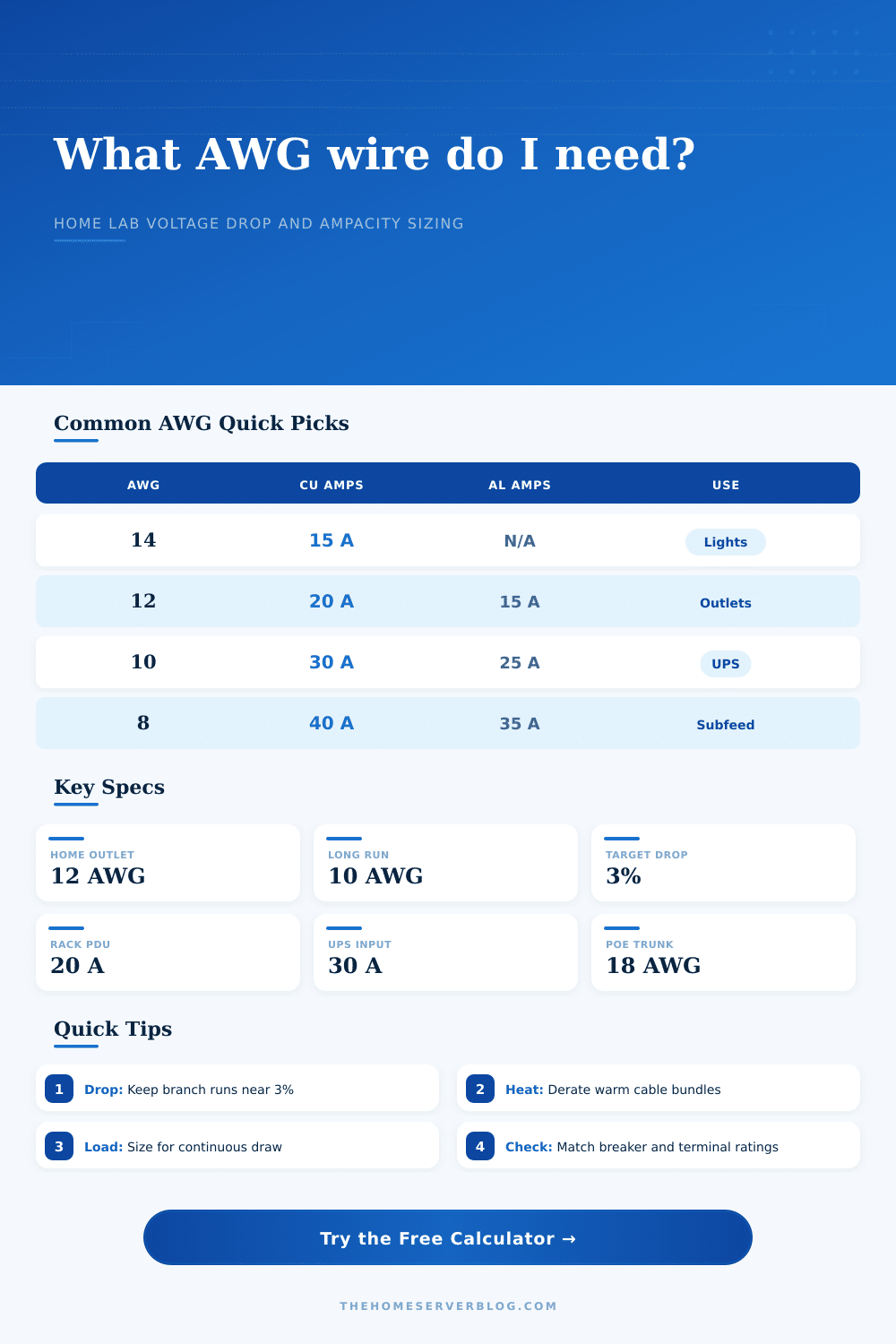
Wire Gauge AWG Calculator
Size copper or aluminum conductors for home server racks, UPS feeds, PoE power supplies, DC backup runs, and low-voltage lab circuits using ampacity and voltage-drop checks.
Wire Gauge Result
Full Breakdown
| AWG | Copper Ohms / 1000 ft | Aluminum Ohms / 1000 ft | Common Copper Circuit Use |
|---|---|---|---|
| 14 | 2.525 | 4.14 | 15 A lighting or light receptacle circuit |
| 12 | 1.588 | 2.60 | 20 A general outlets and small rack loads |
| 10 | 0.999 | 1.64 | 30 A UPS input, long 20 A branch runs |
| 8 | 0.628 | 1.03 | 40 A subfeed, high-current UPS or PDU feed |
| 6 | 0.395 | 0.65 | 50-60 A feeder where terminals allow it |
| 4 | 0.249 | 0.41 | Large feeder or long DC battery conductor |
| Install Condition | Derating Factor | Where It Appears | Why It Matters |
|---|---|---|---|
| Open air / tray | 100% | Short visible rack or bench wiring | Heat escapes easily, subject to cable listing |
| 3 current-carrying conductors | 100% | Typical branch circuit in conduit | Baseline for many small AC circuits |
| 4-6 current-carrying conductors | 80% | Shared conduit to rack or closet | Bundled conductors run warmer |
| 7-9 current-carrying conductors | 70% | Dense conduit with multiple circuits | May require larger gauge or fewer circuits |
| 10-20 current-carrying conductors | 50% | Large bundles, raceways, trays | Serious derating before breaker selection |
| Voltage Drop Target | Best Fit | Example | Practical Note |
|---|---|---|---|
| 2% | Sensitive electronics | Long UPS feed or DC radio gear | Reduces heat and keeps supplies happier |
| 3% | Branch circuit design target | Rack receptacle run from panel | Common planning target for final branch runs |
| 5% | Feeders or tolerant loads | Garage network closet feeder | Often acceptable when total system drop is checked |
| 10% | Accessory low voltage only | LED strip, relay, fan lead | Usually not appropriate for servers or UPS gear |
| Project | Typical Load | Starting Gauge | Secondary Check |
|---|---|---|---|
| Small home office rack | 6-10 A at 120 V | 14 or 12 AWG copper | Voltage drop on longer runs |
| PoE switch plus NAS | 8-14 A at 120 V | 12 AWG copper | Continuous load and UPS runtime |
| 30 A UPS input | 24 A continuous planning | 10 AWG copper | Terminal rating and receptacle type |
| 48 V DC battery shelf | 20-60 A DC | 8 to 4 AWG copper | Drop percentage dominates the choice |
| Detached garage closet | 12-24 A at 120 V | 10 or 8 AWG copper | Distance, grounding, feeder rules |
As you face that shiny new rack full of servers and you’re about to connect the UPS, your brain goes from being an engineer to a math guessing game. Yeah, that wire is pretty beefy…or so you think. But will it realy handle the run between the panels? Many home lab builders thinks of power as a pipe of water; make the connection and voila, it flows.
Nope. Most folks forget electricity doesn’t like to move and that friction transform itself into heat. Heat burns off insulation. Burned off insulation trips breakers. Or fire occurs.
How to Pick the Right Wire
Use the calculator above after specifying your path and let it do the work of figuring out what the heck to use instead of having to grunt through resistivity tables and temperature correction factors yourself.
It starts with the load. Not the load on the back of your switch (a.k.a. The nameplate). What about continuous draw? A PoE switch may state it’s pulling three amps. But if you feed it at peak capacity, such as with eight cameras and two access points, that number go up.
For this reason, the tool asks what your expected current will be, allowing a planning buffer, set to 10 percent by default. It is not arbitrary. That’s the difference between a wire sweating through a sustained load over an eight-hour period versus running comfortabley cool. You don’t want capacity, you want margin.
Next is distance. And here intuition falters. Is it six feet, from one side of a room to another? That’s nearly anything. Is it sixty feet, from the back door into a detached garage closet? Now we’re talking voltage drop. While most loads can tolerate up to a 5 percent drop in voltage at 120 volts, DC power supplies and other sensitive electronics loathe them. When they sag, those devices either brown out or reset randomly.
The calc compares that to your desired number, making sure you have sufficient thickness of wire so those electrons flow smoothly. They do not merely survives but flow cleanly.
Material also make a difference, primarily because of cost and secondarily because aluminum is difficult to work with. The gold standard in home labs is copper. It can handles tighter gauge sizes at the same ampacity, it does not “creep” under pressure, and terminates easily. Aluminum requires a significant bump in size. Your tool will account for this, but keep in mind that lots of newer UPS and rack PDU are terminated for copper only. Tucking aluminum into one of these will result in arcing and, eventually, oxidation. Unless you have some oxide paste and proper connectors, stick with copper.
It’s all about the heat. To make things neat, you bundle three or four cables into one conduit. That looks nice, but it sucks from a thermodynamic perspective. Bundled conductors cannot radiate heat, which reduces their actual capacity. Reduction factors is included in the calculator for such bundled situations.
Ambient temperature is relevant if you’re pulling a dense rack feed down a warm closet. A wire may be oversized for a hot attic run that would of been fine in a cool basement. It’s not just the metal; it’s also about the environment.
And don’t forget about the breaker size. It has to be rated correctly and able to carry the fault current long enough to allow the breaker to trip. For example you can’t use 14 gauge wire on a 20 amp breaker. That is the end of it.
This is where the tool comes into play; it checks your input against these hard limits. It provides a recommended gauge that meets all of these competing factors. It is a sanity check prior to buying the cable.
You should measure your run, calculate your worst case load, and trust those numbers to tell you what to do. Spend a few extra dollars for heavier gauge wire rather than troubleshooting mysterious reboots in a week.
Boring, solid, out-of-sight power infrastructure? Yes, please.