Cable Pull Force Calculator
Estimate pull tension, bend sidewall pressure, cable rating margin, and whether a home lab conduit run needs lubricant, a larger sweep, or a split pull.
Use manufacturer limits for final acceptance. This estimator models low-voltage home networking pulls and highlights when bend load or bundle drag deserves a second look.
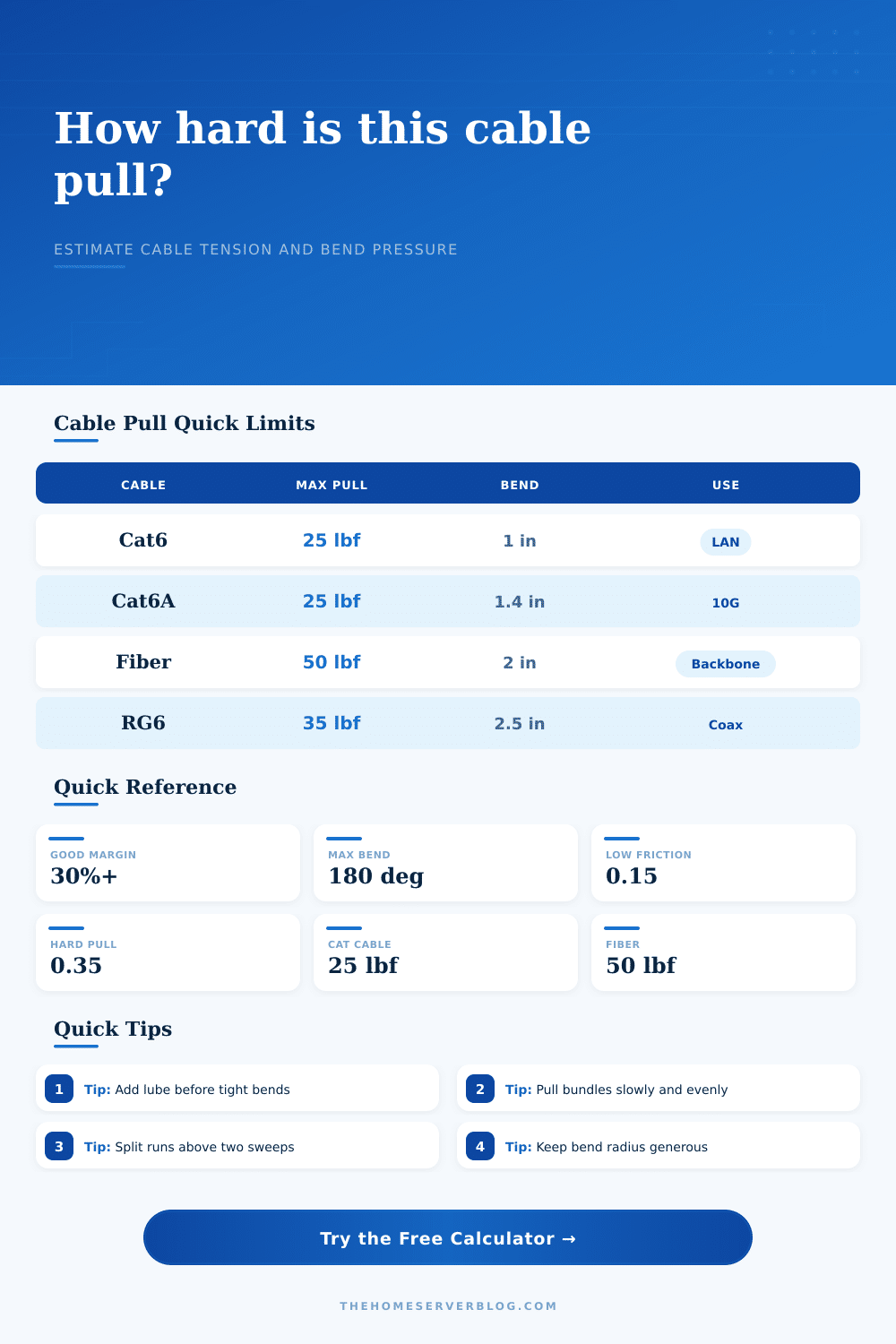
| Cable Type | Typical Max Pull | Minimum Bend Radius | Home Lab Use Case |
|---|---|---|---|
| Cat5e UTP retrofit | 25 lbf per cable | About 1.0 in | 1G drops, cameras, VoIP phones |
| Cat6 UTP 23 AWG | 25 lbf per cable | About 1.0 in | Structured LAN drops and PoE devices |
| Cat6A shielded 10G | 25 lbf per cable | About 1.4 in | 10G office, NAS, and switch uplinks |
| 2 strand indoor fiber | 50 lbf per cable | About 2.0 in | Garage, rack, or media room backbone |
| 12 strand preterm fiber trunk | 100 lbf per assembly | About 4.0 in | Home lab rack trunk and spare pairs |
| RG6 coax | 35 lbf per cable | About 2.5 in | MoCA, OTA antenna, cable modem |
| Condition | Friction Factor | What It Means | Practical Limit |
|---|---|---|---|
| Rated lube, clean conduit | 0.12 to 0.18 | Best case for long home runs | Still respect bend radius |
| Dry cable in smooth conduit | 0.22 to 0.28 | Common short retrofit estimate | Watch bundles over 90 degrees |
| Dusty or older conduit | 0.30 to 0.40 | Drag rises fast after the first bend | Use a pull box if possible |
| Corrugated flex route | 0.35 to 0.50 | Ribs add contact points and chatter | Keep cable count modest |
| Multiple sweeps | Capstan multiplier | Tension compounds around bends | Avoid more than 360 degrees |
| Configuration | Good Range | Metric Equivalent | Planning Note |
|---|---|---|---|
| Open joist or cable tray | 50 to 200 ft | 15 to 61 m | Low drag; support and separation matter more |
| PVC conduit with sweeps | 40 to 150 ft | 12 to 46 m | Use wide bends and rated cable lube |
| EMT retrofit with boxes | 25 to 100 ft | 8 to 30 m | Pull from the end with fewer bends |
| Flexible ENT wall drop | 10 to 60 ft | 3 to 18 m | Keep count low due to corrugation drag |
| Vertical riser or chase | 10 to 80 ft | 3 to 24 m | Elevation adds load to the pull end |
| Project | Typical Cable Count | Likely Pull Concern | Best Adjustment |
|---|---|---|---|
| Two camera attic run | 2 Cat6 | Heat, snagging, and insulation contact | Use smooth route and helper feed |
| Office 10G bundle | 4 Cat6A | Stiff jacket and bend pressure | Increase sweep radius |
| Garage fiber backbone | 1 fiber trunk | Connector and bend protection | Pull by strength member only |
| PoE AP ceiling drops | 3 to 6 Cat6 | Multiple turns above ceiling | Stage pull at access panels |
| MoCA coax refresh | 1 to 3 RG6 | Large cable diameter | Avoid tight staples and kinks |
Sometimes pulling Cat6A cables through conduit won’t work. Here’s what will happen: you start pulling a bundle of cables through with a rope and it stops. You continue pulling hard and the cable doesn’t budge. What happened? The jacket has been damaged. Now you have a costly issue on your hands.
The solution? Pull out the cable and repair it. How do you avoid this? Learn about the physics of running cable in a pipe. The tool figures out how much tension and bend pressure there is in your situation. It keeps you from having to guess if you’ll make the run or not.
How to Pull Cable Without Breaking It
Most pulls fail due to friction. But it’s not like friction on your kitchen floor; it is the friction inside the conduit. When you pull a cable around a corner, the friction multiplies. That’s what we call the capstan effect. For each degree you turn, there’s an exponentially increasing amount of resistance.
If a route has three sharp right angles, it will take several times the force that a straight line indicates. Lots of folks base their calculations off length and forget the turns. That’s where they gets into trouble.
In the calculator, look at the bend radius input. This is something that get missed on residential installs. There’s a minimum bend radius manufacturers list for a reason. If you exceed it you get sidewall pressure. That’s when the cable presses outward on the inner wall of the conduit.
When that happens the cable gets crushed against pipe. You don’t see any damage but months down the road, the link will fail as the signal starts weakening or crosstalk occurs. The calculator shows the pressure and lets you determine if your sweeps are too small. Using a bigger radius cuts back on the load dramatically.
Spending a little more time putting in wider sweeps can be well worth it when you avoid spending hours troubleshooting later. And here’s where we see it: the tool side of the friction coefficient. A dry jacket in smooth PVC might have a moderate drag. Add some proper pulling lube, and the number plummets.
Avoid oil or soap; they can is damaging to jackets and even leave behind a sticky residue. For cabling pulls, use a product made for that purpose. Soaping up may seem like an easy way out, but it isn’t.
The calculator demonstrates the impact of applying lube to a dry pull. This allows you to weigh whether the mess and expense of lube is worth it. For short, straight shots? Maybe no. Bends on a run? Non-negotiable.
The second trap many people fall into is ignoring bundle count. Four cables pulled together isn’t equivalent to four pulls of one cable. Each time you add a cable, friction increases because each cable rubs against the others and against the conduit wall. The calculator accounts for this bundle weight and friction.
If the maximum calculated pull exceeds the rated maximum (typically about 25 pounds for standard Ethernet) you’re flirting with trouble. Beyond the max, you risk damaging shielding, stretching internal conductors, etc. The calculator tells you what’s safe. It tells you how far from the brink of danger you sit.
If the margin is too small, split the pull or insert a pull box. This applies to basement runs or multi-story homes. In addition to length, elevation also matter. Pulling up hill adds gravity to the load. Going down hill subtracts from it.
Vertical drops are where cable accelerates too rapidly and can catch at the bottom. This is the real danger. Height factor into the calculation’s total force model. You can visualize the entire stress of the cable at the pull end.
Stress is handled well in a good install. You don’t want the cable struggling against its environment; you want it sliding easy along. Tables on the page set limits on different types of cables, from delicate fiber to beefy coax.
Bend radius matters with fiber, so give it some love. Don’t make sharp bends. Test your scenarios using the calculator. Adjust the bends. Apply lubrication. Divide up the bundle until you see something that looks safe.
Ten minutes spent understanding these forces will save you an afternoon fighting a ruined cable out of a wall. You will get a clean pull and a network that works like you expect for years to come.