HomeServerBlog cable planning tool
Cable Slack and Service Loop Calculator
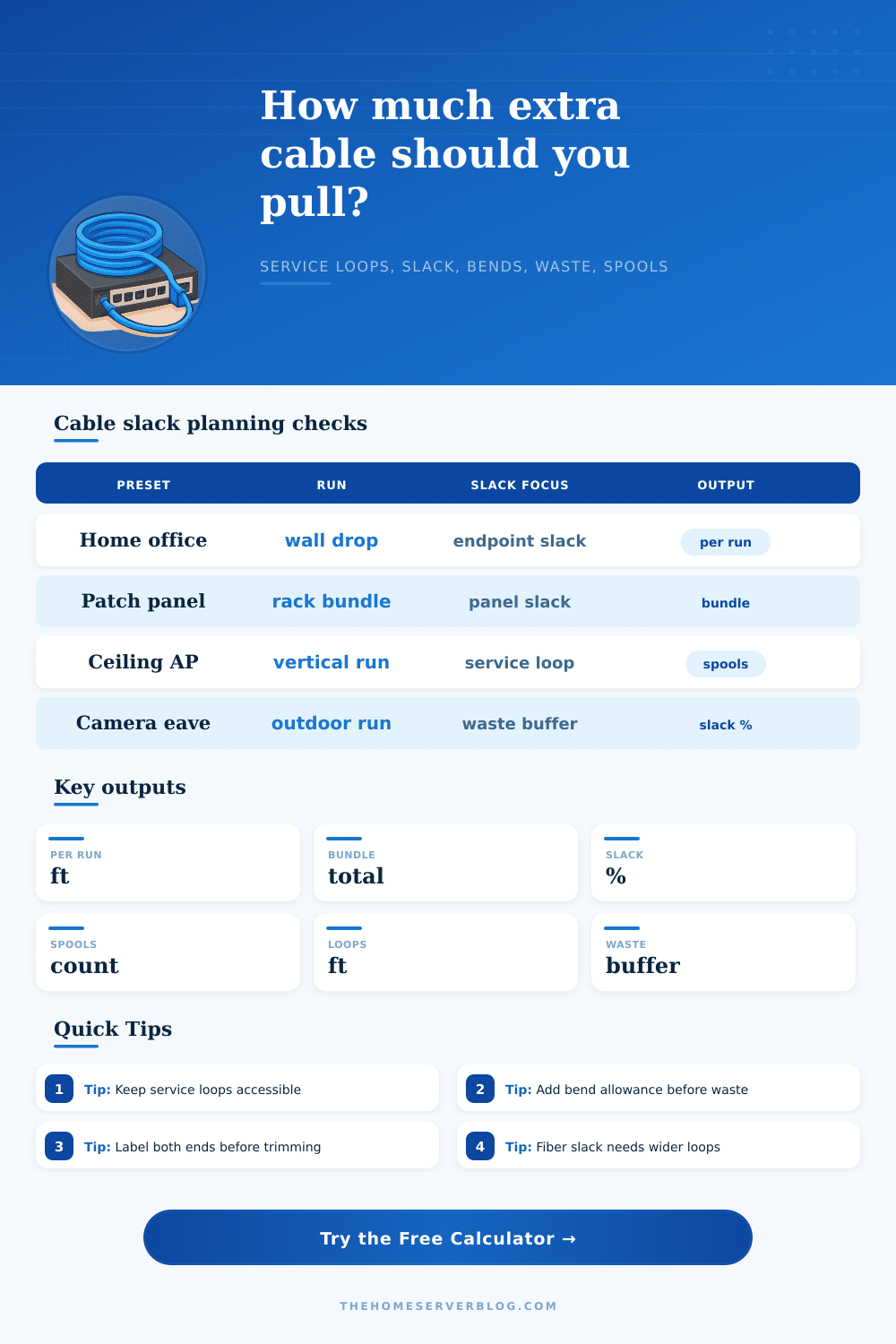
Estimate pull length per cable, total bundle footage, slack percentage, and 1000 ft spool count after rack loops, patch panel slack, endpoint slack, bend allowance, and waste buffer are applied in the right order.
1Presets
2Run Inputs
Breakdown
3Planning Labels
4Cable Type Comparison Grid
Cat6 UTP
8-15%Good for office drops and APs. Keep moderate service loops and avoid tight kinks behind patch panels.
Cat6A
10-18%Thicker cable benefits from extra bend allowance and gentler rack dressing, especially in 24 or 48 cable bundles.
Fiber Patch
15-30%Use larger loops, protect bend radius, and store slack where it cannot be pinched by trays or doors.
Outdoor Camera
12-22%Add eave service length for drip loops, weatherproof boxes, future camera swaps, and termination retries.
5Reference Tables
| Slack band | Typical meaning | Home lab action |
|---|---|---|
| Under 12% | Very lean run after measured route | Add service loop before pulling unless the cable is exposed and easy to replace. |
| 12-25% | Balanced for most copper drops | Good default for walls, APs, cameras, and home office runs. |
| 25-40% | Service-heavy or fiber-friendly | Useful for racks, patch panels, camera eaves, and optical slack storage. |
| Over 40% | Long loops or high waste reserve | Verify coil location, tray capacity, and airflow before pulling. |
| Service area | Common slack | Why it matters |
|---|---|---|
| Rack vertical manager | 4-10 ft | Lets you move switches, re-dress bundles, and replace panels without a re-pull. |
| Patch panel rear | 1-4 ft | Leaves room for punch-down mistakes, new keystones, and cleaner cable dressing. |
| Wall plate or desk box | 1-3 ft | Supports re-termination and device moves while staying inside the box or wall cavity. |
| Ceiling AP or camera | 3-8 ft | Allows device replacement below the ceiling tile or from the eave without stretching the run. |
| Preset | Route shape | Suggested review |
|---|---|---|
| Home Office Drop | Short wall or basement path | Check wall box depth and leave slack above the plate, not crushed behind it. |
| 24-Port Patch Panel | Many equal home runs | Stagger bundle dressing so all slack is not stacked in one tight coil. |
| Conduit Pull | Long or protected route | Add enough spare for fish tape connection, pulling grip, and damaged first inches. |
| 48-Port Switch Refresh | Dense rack refresh | Plan extra label time and avoid turning every spare foot into a hot airflow block. |
| Spool planning | Rule used here | Practical note |
|---|---|---|
| Standard copper box | 1000 ft per spool | Most home lab bulk copper purchases use this mental model. |
| Partial last spool | Ceiling of bundle / 1000 | The final box may have usable leftovers, but do not assume every cutoff fits the next run. |
| Long conduit | Add waste last | The pull tail and termination trim are easiest to underestimate. |
| Mixed cable types | Run separate estimates | Fiber, coax, Cat6A, and UTP should not share one slack percentage blindly. |
6Tips
Planning result only. Follow local electrical, firestop, plenum, bend radius, pathway fill, and structured cabling rules before installing cable in walls, ceilings, conduit, or outdoor locations.
Slide that final foot of Cat6 into jack box down the conduit…pull…and there it goes. You’re out by three inches. Now what? Can’t get the termination in, can’t get your patch over to connect, and now you need to fish another cable or deal with an inferior connection. And this happens often too.
Cable runs look neat and tidy as they appear on a blueprint; straight lines from point A to B. Measure A to B and move along. Reality’s not so clean. There’s depth to racks, walls has texture, and humans make mistakes. They come at a price.
Why You Need Extra Cable Length
So how much do we need? It’s not so much a math question anymore, it’s an insurance question. Use the calculator above. It separate the physical route from service needs. Why does this matter? Because a “one size fits all” approach to extra cable is a recipe for bad decisions. Add 10% extra for whole system maybe? Maybe you’ll find out later there wasn’t realy any slack in your void. Or, you might of overdone it, making your rack too tight.
The tool makes distinction between explicit service slack and bend allowance. Bend allowance is for the fact that cable bends naturaly around corners. Explicit service slack is reserved space left next to devices in case you ever need to work on them again. Knowing this help prevent spending a bunch of money on excess copper. And knowing this ensures you has enough rope to tie a knot just in case.
The bend radius. Until it’s too late, most amateurs don’t remember it exists. Fiber is unforgivingly stiff. Cat6A is thicker than standard Cat6. The cable stretch slightly on the outside of a tight corner where you’ve pulled it through a rigid conduit elbow or around a tight turn in a ceiling joist space. On the inside of a curve? It compresses. Not just physics, but data integrity. Crush a twisted pair against a sharp edge or kink a fiber patch cord and your signal will degrade. The bend allowance input in the planner handles this physical reality by adding length before calculating any slack. It makes sure the cable can actualy make the turn without forcing itself into a shape that violates its own specifications.
And then there’s the slack that goes into the service loop. That is the coiled extra length hanging near either the endpoint device or in the middle where patch panel is located. Consider it your network reserve fund. You have enough slack so if one of your switch ports croaks you can move the cable over to an available port without having to pull the whole run back through the wall. Or maybe one of your cameras got bumped out of place. You want to adjust its position but don’t want to tighten up the cable and put tension on it. You has enough room to adjust its position.
The table on the page spells it all out: it will suggest various quantities depending on whether you’re dealing with a simple home office drop or a dense rack environment. Two feet might be plenty of slack if it’s just a home office drop and the cable reaches from the modem to your desktop. But for a server rack with forty-eight ports, you want several feet per cable so you can dress and re-terminate it.
The not-so-glamorous side of this work: You’re going to cut things short. You’re going to strip away more insulation than necessary. You’ll misplace your scissors then accidently clip a good connector. The waste buffer added here, again, at the tail-end of the equation, is a sign of human imperfection. And it’s less costly to purchase a small amount of excess cable today than it is to visit the shop again tomorrow.
Visualizing how things will look when done is the key. How much space is left between two adult-sized sofa so I can plug something in on the far side? Can I get my hand back into the box and terminate again if needed? If the answer is no then you were too short even if your tape measure says otherwise.
Building out slack isn’t just about not being too short. It’s about designing a network that can survive both time and change. It must also survive the inevitable minor disasters that occur with every IT project. When you do it right the excess feet of cable lay quietly in the rack. They wait for the day they are needed. The quiet reserve is what makes an install professional or just a temporary fix.