Discontiguous Wildcard Mask Calculator
Test ACL-style wildcard matches, expose sparse address gaps, and compare the target against the full bit pattern before you deploy.
Full Breakdown
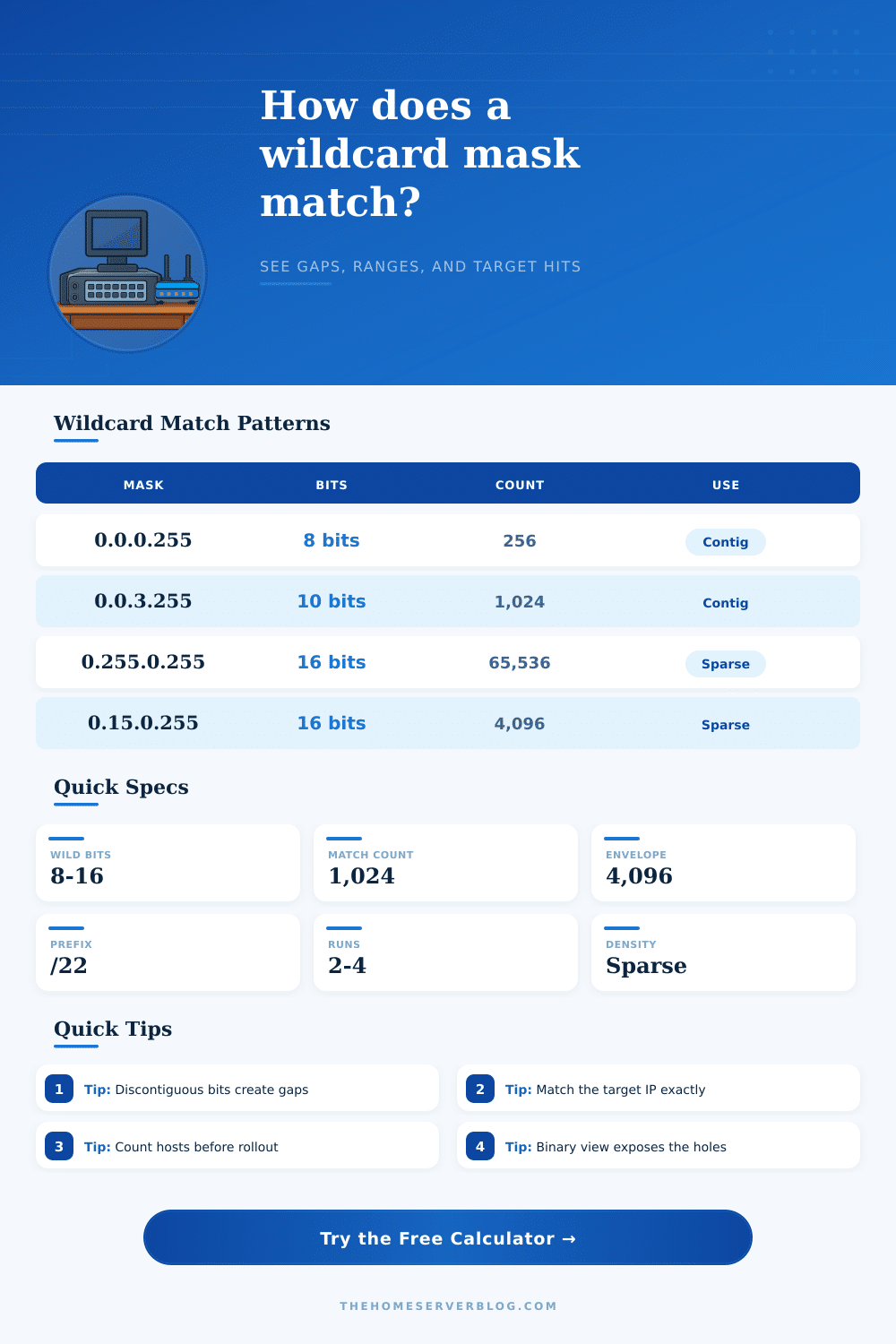
| Wildcard pattern | Wild bits | Match count | Shape |
|---|---|---|---|
| 0.0.0.255 | 8 | 256 | Contiguous |
| 0.0.3.255 | 10 | 1,024 | Contiguous |
| 0.255.0.255 | 16 | 65,536 | Sparse |
| 0.15.0.255 | 16 | 4,096 | Sparse |
| Rule context | Typical mask | What it matches | Why it matters |
|---|---|---|---|
| Standard ACL | Source only | Admin sources | Protect the control plane |
| Extended ACL | Source and dest | Traffic tuples | Filter flows more tightly |
| OSPF network statement | Interface range | Area membership | Add interfaces to the process |
| EIGRP network statement | Interface range | AS membership | Join routed interfaces to the AS |
| Mask type | Prefix fit | Address span | Result |
|---|---|---|---|
| All fixed | /32 | 1 host | Exact match |
| Single octet float | /24 | 256 hosts | Clean block |
| Two-octet float | /16 | 65,536 hosts | Large block |
| Mixed float bits | None | Sparse set | Discontiguous |
| Check | Formula | Meaning | Signal |
|---|---|---|---|
| Match count | 2^wild bits | Total matched addresses | Capacity |
| Envelope size | High - low + 1 | Numeric span | Potential holes |
| Density | Count / span | How sparse it is | Gap indicator |
| Slack | Count - need | Headroom after planning | Enough or short |
This calculator keeps the match set, numeric envelope, and host planning separate so discontiguous wildcards stay readable instead of looking like a fake subnet.
A wildcard mask is use to determine which parts of the IP address must match a specific value. The wildcard mask can be contiguous which use a series of ones followed by zeros in the mask, or it can be discontiguous where the mask contains multiple series of ones and zero. A discontiguous wildcard mask create gaps in the IP addresses that should be permitted to match the rule.
Therefore, IP addresses that fall within the lowest and highest addresses indicated in the mask will not match the rule. In order to avoid errors in the network, it is important for network engineer to understand how a discontiguous wildcard mask work. With a contiguous wildcard mask, all of the IP addresses within a specific range will match the rule.
Wildcard Masks and IP Address Gaps
With a discontiguous wildcard mask, however, there will be IP addresses within the range that will not match the rule due to the gaps in the wildcard mask. Therefore, engineers must take this into consideration when setting up rules for a network. For instance, if a network engineer intend to permit a range of IP addresses for a specific group of computers, but the discontiguous wildcard mask leave gaps within those IP addresses, then there will be computer in that group whose IP addresses will not permit them to access the resources of the network.
In order to properly plan out a network, engineers should calculate how many hosts will be required for the network. In addition to calculating the number of hosts required, engineers should plan for the future growth of the network by adding a buffer to account for additional host that may be added in the future. Engineers can determine if they have enough addresses by calculating the slack of the network.
If the slack is a positive number, then the network has enough addresses for the current and future hosts. However, if the slack is a negative number, then there are not enough addresses for the network and the engineer will have to change the wildcard mask to include more addresses. Engineers can test a specific target IP address to ensure that the wildcard mask will work as intend.
In order for the wildcard mask to permit a target IP address, the target IP address must align with the base address and the wildcard mask. The use of the wildcard mask can differ between protocols. For instance, in OSPF, the wildcard mask is used to group interface into an area.
In EIGRP, the wildcard mask is used to define the autonomous system that the router belong to. Additionally, in extended access control lists, the wildcard mask is used to filter specific type of traffic. Many people may believe that all wildcard masks are the same than a CIDR prefix.
However, the wildcard mask is not always a CIDR prefix. With a contiguous wildcard mask, the wildcard mask acts as a CIDR prefix because it maps to a single prefix. With a discontiguous wildcard mask, however, there are multiple runs of ones in the mask which means that it does not act as a CIDR prefix.
During the design of a network, engineers should convert the wildcard mask to its view in binary. In this binary view, engineers can see any isolated ones in the mask which may create gaps in the permitted addresses. Engineers can also count the number of wild bits in the mask to determine the capacity of the wildcard mask.
Additionally, engineers should look at the envelope of the mask to determine the span of the addresses, and check the density of the wildcard mask to ensure that the engineer is not wasting any IP address. By reviewing these aspects of the wildcard mask, engineers can ensure that their deployment of the network is accuracy. Engineers must determine the gaps in the discontiguous wildcard mask prior to deploying the wildcard mask to ensure that the network function as the engineers have intended.