⚡ HP Server Power Consumption Calculator
Calculate total power draw, heat output, and electrical capacity for HP ProLiant servers — with cooling and circuit planning included.
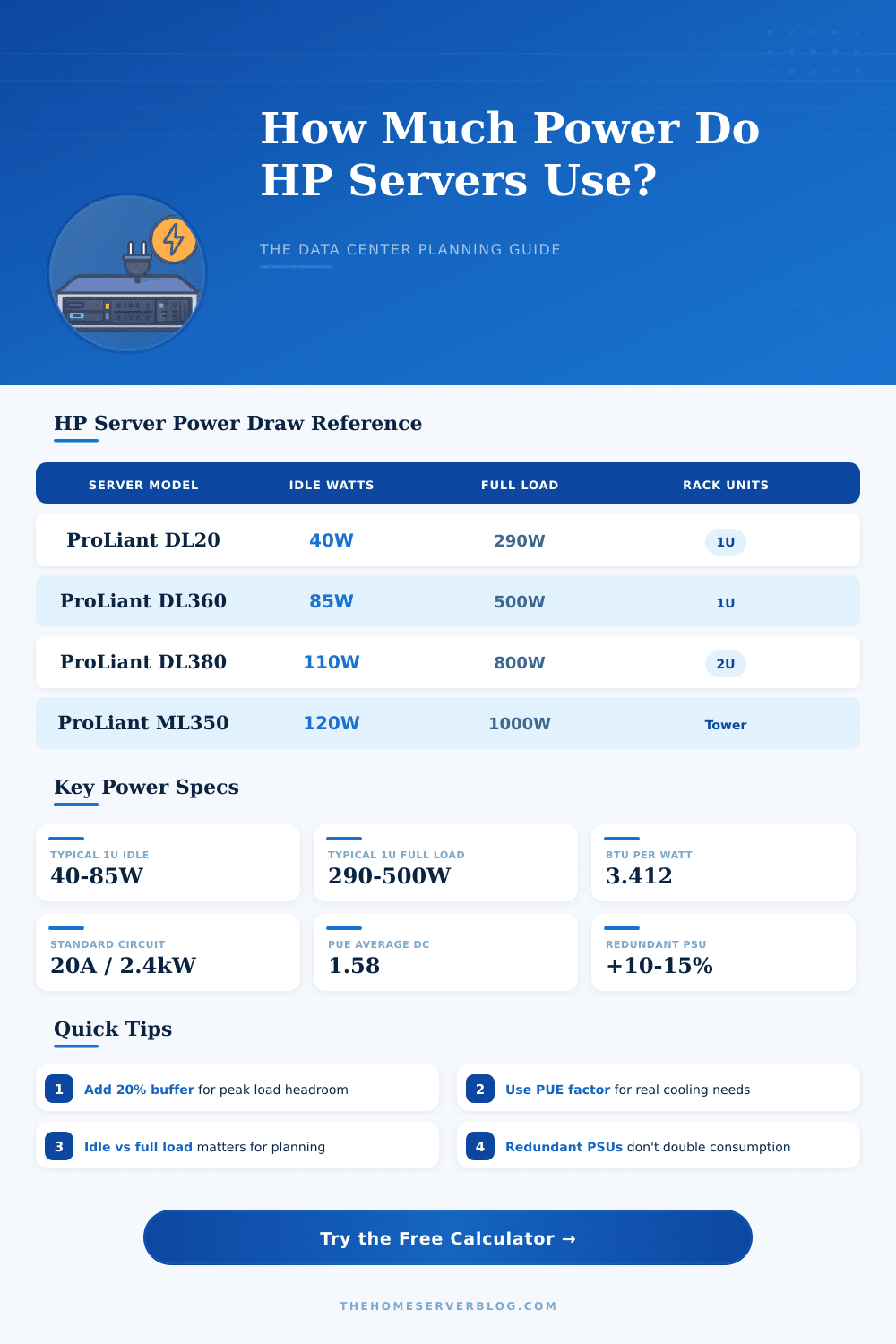
| Server Model | Form Factor | Idle Power | Max Power | PSU Rating | BTU/hr (Max) |
|---|---|---|---|---|---|
| ProLiant DL20 Gen10 | 1U Rack | 40W | 290W | 290W | 989 BTU/hr |
| ProLiant DL160 Gen10 | 1U Rack | 55W | 380W | 500W | 1,297 BTU/hr |
| ProLiant DL360 Gen10 | 1U Rack | 85W | 500W | 500W / 800W | 1,706 BTU/hr |
| ProLiant DL380 Gen10 | 2U Rack | 110W | 800W | 800W / 1600W | 2,730 BTU/hr |
| ProLiant DL560 Gen10 | 2U Rack | 180W | 1,200W | 1200W / 2400W | 4,094 BTU/hr |
| ProLiant DL580 Gen10 | 4U Rack | 250W | 1,600W | 1600W / 3200W | 5,459 BTU/hr |
| ProLiant ML350 Gen10 | Tower | 120W | 1,000W | 500W / 1000W | 3,412 BTU/hr |
| Circuit Breaker | Voltage | Max (100%) | Usable (80%) | Typical Servers |
|---|---|---|---|---|
| 15A Breaker | 120V | 1,800W | 1,440W | 3-5 x DL20 |
| 20A Breaker | 120V | 2,400W | 1,920W | 4-6 x DL20 |
| 30A Breaker | 120V | 3,600W | 2,880W | 3-5 x DL360 |
| 50A Breaker | 240V | 12,000W | 9,600W | 12 x DL360 |
| 60A Breaker | 240V | 14,400W | 11,520W | 14 x DL360 |
| Deployment | Servers | Approx. Watts | Heat (BTU/hr) | Cooling Tons Required |
|---|---|---|---|---|
| Single DL20 Home Lab | 1 | ~175W | ~597 BTU/hr | 0.05 tons |
| Small Rack (4 x DL360) | 4 | ~1,600W | ~5,460 BTU/hr | 0.46 tons |
| Mid Rack (8 x DL380) | 8 | ~5,280W | ~18,015 BTU/hr | 1.50 tons |
| Full Rack (10 x DL380) | 10 | ~6,600W | ~22,519 BTU/hr | 1.88 tons |
| High-Density (4 x DL580) | 4 | ~5,800W | ~19,790 BTU/hr | 1.65 tons |
The power supplies of HP servers design for heavy tasks. HPE Flex Slots of energy reach up to 96 percent efficiency. Some models from them bear the 80 Plus Titanium label.
That grade of efficiency lowers the energy demand for servers and reduces costs because of wasted energy in data centers. Also the Platinum Plus and Titanium versions back the HPE Smart Discovery Service that intends to expand the computing density while it reduces breaks in data centers.
HPE Server Power Supplies and Efficiency
Those power supplies offer various choices of watts. One presents them below 400 watts, between 500 and 599 watts, up to 900 watts and even bigger. A common model is the hot-plug Flex Slot unit in 1000 watts, that operates on AC 200-240 volts.
For instance, the HPE ProLiant DL360 Gen9 uses a 500-watt Flex Slot Platinum hot-plug supply. The server DL380p Gen8 usually comes with two backup power supplies, each in 750 watts. Some setups have two 1000-watt spare supplies.
A big difference exists between the maximum capacity, that a supply can handle, and the actual power consumption of a server. HP gives a calculator for power, where you enter your particular parts and receive the precise maximum power consumption for your system.
The 1200-watt supplies deliver 60 amps of pure energy from a small two-phase plug. At input of 200-240 volts it reaches the full 1200-watt ability, but at 120 volts the limit drops to only 900 watts. That is around a 20-percent loss of capacity because of the lower voltage.
Sometimes folks reuse those server power supplies for other targets. Breakout boards are available for models HP of 1200 and 750 watts, and shops on various websites offer compatible versions with different makers.
About power consumption HP servers a lot range. For instance, the HP DL380e with one low-power CPU, 16 GB RAM and 11 hard drives uses around 90 watts in idle state. Home HPE gear usually consumes between 90 and 100 watts.
Those devices design for full load all day in a data center, so they work well in those settings. On the other hand, smaller devices like the HP EliteDesk 800 G2 use 10 watts idle, wile the HP T630 thin client consumes only 7 watts.
About levels of efficiency, platinum power supply beats the silver by less then 0.666% at two-thirds of the maximum load. HP supplies with silver rating work well too. In 2019 testing compared HPE ProLiant 800-watt Platinum and Titanium supplies, adding same virtual machines toobserve difference of efficiency under small loads.