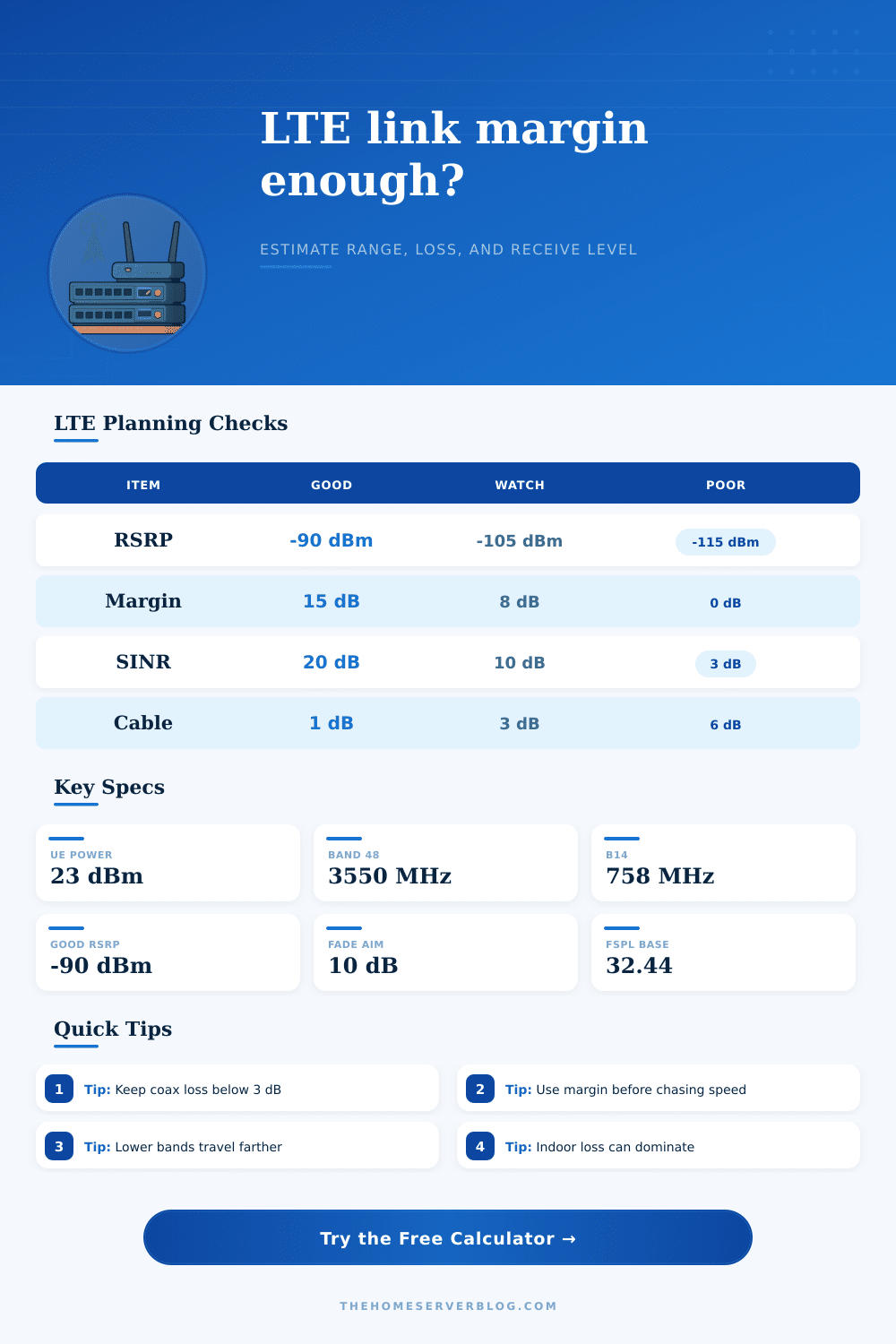
LTE Link Budget Calculator
Estimate EIRP, free-space path loss, received power, fade margin, uplink margin, and practical range for private LTE, fixed wireless, or antenna planning.
| Equipment Type | Typical Gain | Typical Loss | Planning Use |
|---|---|---|---|
| Outdoor LTE CPE panel | 8 to 12 dBi | 1 to 3 dB | Fixed wireless link |
| Indoor LTE router | 0 to 3 dBi | 4 to 12 dB | Window or room install |
| Mobile handset | -3 to 0 dBi | 3 to 8 dB | Phone edge testing |
| LTE IoT modem | 0 to 2 dBi | 1 to 6 dB | Sensor or gateway node |
| Directional Yagi client | 10 to 15 dBi | 1 to 4 dB | Rural point link |
| Lab SDR receiver | -2 to 6 dBi | 2 to 8 dB | Bench validation |
| LTE Band Example | Frequency | 1 km FSPL | Practical Note |
|---|---|---|---|
| Band 12 lower 700 | 707 MHz | 89.4 dB | Strong rural reach |
| Band 14 public safety | 758 MHz | 90.0 dB | Good building entry |
| Band 3 mid band | 1800 MHz | 97.6 dB | Balanced capacity |
| Band 7 capacity | 2600 MHz | 100.8 dB | Shorter range |
| Band 48 CBRS | 3550 MHz | 103.4 dB | Private LTE common |
| Margin Result | RSRP Expectation | Likely Modulation | Action |
|---|---|---|---|
| 20 dB or more | Excellent | 64QAM likely | Capacity tuning |
| 10 to 20 dB | Good | 16QAM to 64QAM | Normal design target |
| 3 to 10 dB | Marginal | QPSK to 16QAM | Add antenna gain |
| 0 to 3 dB | Edge | QPSK only | Reduce loss or range |
| Below 0 dB | Unreliable | May fail attach | Redesign link |
| Project | Typical Band | Key Loss | Design Margin |
|---|---|---|---|
| Home lab CBRS cell | Band 48 | Indoor walls | 10 to 15 dB |
| Farm LTE router | 700 to 900 MHz | Foliage fade | 15 to 25 dB |
| Warehouse private LTE | 1800 to 3550 MHz | Racks and aisles | 12 to 18 dB |
| Rooftop fixed CPE | 1800 to 2600 MHz | Coax length | 10 to 20 dB |
| Mobile edge survey | Carrier band | Body loss | 6 to 12 dB |
A link budget are the calculation of the gains and losses that occur within a wireless communication system. A link budget allows you to keep track of the signal power that is added to the signal and the signal power that is lost by the signal. It is essential to understand the link budget because signal strength dont necessarily indicate that the link is working proper.
Signal strength could be high, but if there are issues with noise or timing, the link will not be able to function properly. By focusing on the link budget, the receiver will recieve a signal power that is more higher than its sensitivity. The sensitivity of the receiver is the power that the receiver need in order to maintain the connection.
Link Budget Basics and Why It Is Important
If the power of the signal that is recieved is equal to the sensitivity of the receiver, then the connection may fail due to other environmental factors. The margin is the difference between the power of the signal that is received and the sensitivity of the receiver. This margin provide a safety net for the signal to account for any interference or obstacle between the transmitter and the receiver.
Effective isotropic radiated power (EIRP) is the total power that is radiated from the antenna after accounting for the losses in the coaxial cable that connect the antenna to the transmitter. People often make mistake with EIRP because they use a poor-quality coaxial cable. If a thin or cheap coaxial cable is used, the signal can be lost before it even reach the antenna.
Free space path loss is another calculation that must be accounted for in the link budget. Free space path loss is the natural loss of signal strength as the signal travel through space. The free space path loss is dependent upon the frequency of the signal.
Lower frequencies such as 700 MHz will experience less loss in signal strength as the signal travels through space and will pass through walls more easy. Higher frequencies, such as 3.5 GHz, will lose more signal strength and will be easily blocked by walls, trees, and human beings. Higher frequencies will allow for a higher data speed but will provide less range to the signal.
The type of antenna that is used will impact the link budget. A directional Yagi antenna will focus the signal power in one direction and is use to target a signal to a distant point. An omnidirectional antenna will emit its signal power equally in all directions and is used for application like covering a warehouse floor.
Use a directional antenna for linking to a distant point from the rooftop. Use an omnidirectional antenna for covering a large indoor area. Another consideration for the link budget is the uplink and downlink.
The downlink is the signal from the base station to the device. The uplink is the signal from the device to the base station. Many times, engineer focus only on the downlink because the base station has high-quality power and antenna.
However, the device may have a small battery and antenna. Therefore, the uplink signal may be weak. Even if the device can receive the downlink signal from the base station, the base station may not be able to receive the uplink signal from the device.
Therefore, the engineer must also check the uplink margin in the link budget calculation. Finally, use the margin to determine the performance of the network connection. If there is a large margin between the received signal power and the receiver sensitivity, high-order modulation can be used for the signal transmission.
High-order modulation allow for the signal to reach the maximum data speed. If the margin is small, the data connectivity will be slow. Small margin can also result in the connection between the device and the base station to flicker.
Ensure that the link budget is design to allow for the worst-case scenario. Fade margins and penetration loss must be accounted for in the link budget to allow for the signal to remain connected despite any environmental change.