Minimum Spanning Tree Calculator
Estimate the lightest loop-free set of network links that still connects every node, then compare it with the requested edge pool and a full mesh.
| # | Endpoint A | Endpoint B | Weight | Reason |
|---|---|---|---|---|
| Run the calculator to list the selected tree edges. | ||||
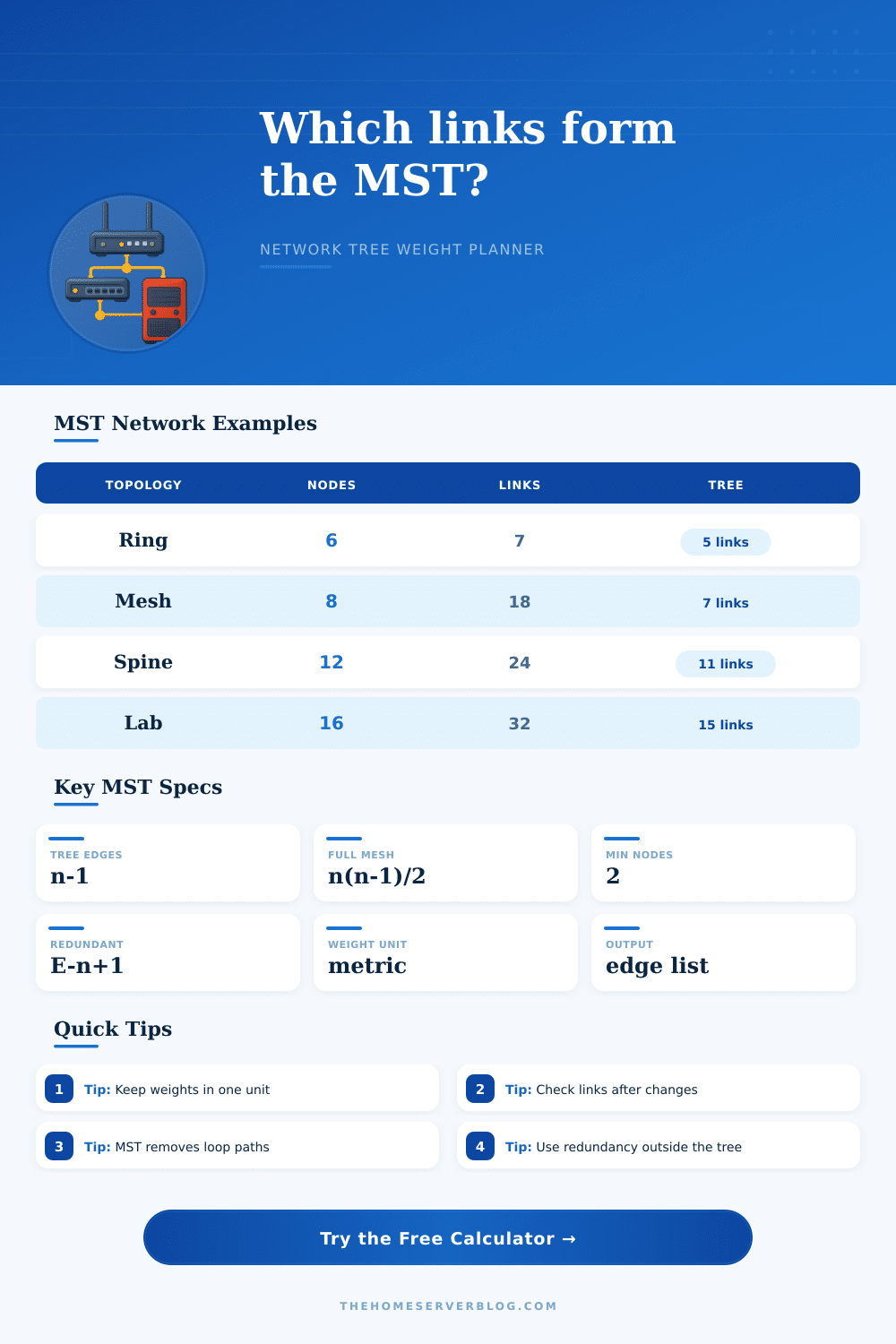
The tree uses exactly node count minus one links when the graph is connected.
| Rank | Link | Weight | Status | Network note |
|---|---|---|---|---|
| Candidate edges will appear after calculation. | ||||
| Topology type | Typical edge count | MST behavior | Home lab use |
|---|---|---|---|
| Ring with cross links | n to 2n | Drops loop segments | Closets or rooms |
| Partial mesh | 1.5n to 3n | Keeps low-weight routes | Switch uplinks |
| Spine leaf fabric | 2n to 4n | Chooses fabric backbone | Rack clusters |
| WAN sites | n to 2.5n | Minimizes path score | VPN or SD-WAN |
| Measure | Formula | Meaning | Planning note |
|---|---|---|---|
| Tree edge count | n - 1 | Links selected | Only if connected |
| Redundant links | E - n + 1 | Edges outside tree | Can carry standby paths |
| Full mesh edges | n(n - 1) / 2 | All pair links | Grows quickly |
| Weight savings | Full - tree | Avoided link weight | Compare same metric |
| Scenario | Nodes | Candidate links | Tree links |
|---|---|---|---|
| Small home rack | 5 to 8 | 6 to 14 | 4 to 7 |
| Wireless backhaul | 8 to 12 | 12 to 24 | 7 to 11 |
| Lab switching fabric | 10 to 18 | 20 to 45 | 9 to 17 |
| Multi-site VPN | 12 to 30 | 18 to 70 | 11 to 29 |
Think back to your initial computer setup with a mess of wires in the background. Not only is that an eyesore, it’s also inefficient and prone to failure. One loose cable here or there could leave you without a working network. This would of been a nightmare for debugging issues.
The idea behind the minimum spanning tree addresses this issue. How do we link up all of our devices in most efficient way possible? It must be done without any loops. In a stable network, loops are bad news. Without careful management from something like STP, they can lead to routing confusion or broadcast storms.
What is Minimum Spanning Tree?
Spanning trees removes the excess connections until you’re down to minimum needed to be connected. And it ensures every node can reach every other node. And it does that using as little cost, latency, or wiring as possible. It’s basic math. If there are 10 switches, then you need precisely nine links to connect ’em all together. Anything more then nine is redundant.
It’s good to have redundancy, but it comes at a price. Each additional cable must be purchased, run, and maintained. If you plug your number of nodes and average edge weight into the calculator, it will spit out an answer. How you use that answer is up to you. That could be a measure of physical distance (in meters), latency (in milliseconds) or some other kind of risk score across unstable links.
The key here is consistency. Unless you first convert all these things into shared unit, you’re mixing apples and oranges; one is now just as good as a guess. You can then play around with different topologies. You can use anything from six nodes forming a ring to eighteen densely connected switches. Why is that relevant? Because actualy networks do not necessarily follow the textbook version. Your home lab could be closer to a star, where everything connects back to one central switch. Your campus network might look more like a hierarchical tree. When you apply the spanning tree algorithm, each of these topologies will behave different.
How does the spanning tree algorithm work? The algorithm selects the lowest weight edges first. Then it skips over links that would result in cycles and continues building the tree from there. That makes sense; it’s a greedy algorithm. In this particular mathematical setting, the local best decision also lead to the global best.
The calculator flags redundant links and most folks just blow it off as a waste. Wrong! Redundant links aren’t waste; they’re a safety net. You don’t want a single cable on a primary path to be the only thing keeping your computers running. If someone cuts that wire or a switch fail in a production environment, your business could go down. That’s why there should be a backup path always standing by.
How do we know? The calculator tells us how many are outside of the main tree. Zero means no resilience at all. Your entire network is now a single point of failure everywhere. A healthy design finds the right balance between efficiency (the spanning tree). It also need redundancy (enough redundant edges to survive something like real life).
Consider as well the cost of a full mesh. Sure, connecting each node to every other node looks good, but how does that scale? For only twenty nodes, a full mesh takes close to two-hundred links. That’s too many in just about any situation. A spanning tree reduce it to nineteen. And it isn’t merely the question of saving on cable runs. It’s a matter of management. Less active paths is simpler to troubleshoot, making it easier to see how traffic flows.
And you have to consider how adding that extra design margin affects total weight. You never know with real installs. Conduits will twist more then planned. Walls will be thicker than expected. Signal degrades over distance. Fifteen percent reserve or even ten percent reserve accommodates those realities of physics. This keeps your plan rooted in what can realistically happen instead of what might happen in theory in a vacuum.
Without getting too technical, building a network is about figuring out which way to go in order to maintain connectivity while minimizing the distance. How many links do you need? Too few and it’s vulnerable to a disaster; too many and you lose track of what you have connected.
Enter the spanning tree. What does it do? It strips away the noise, leaving only what’s important. It gives you a clear picture of what binds your digital world.