Origin Shield Offload Calculator
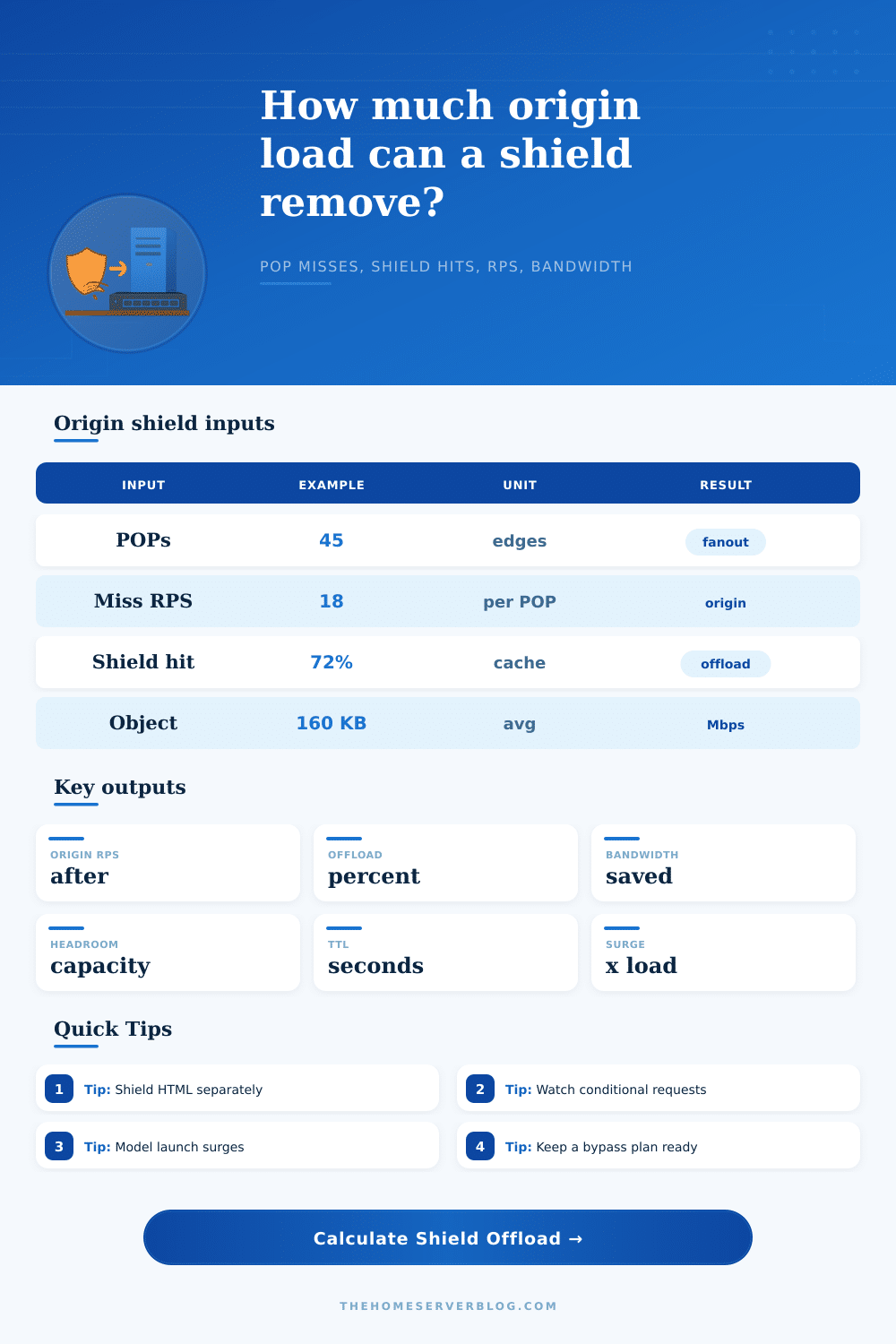
Estimate how a single shield layer collapses multi-POP cache misses into fewer origin requests, lower origin bandwidth, and more RPS headroom during normal traffic or launch surges.
Edge POPs multiplied by per-POP miss rate before a shield layer collapses duplicate object fetches.
Requests that miss at the shield and require a complete object response from the origin tier.
Conditional checks counted as request load, with a much smaller bandwidth effect than full fetches.
The time window where one origin response can serve repeated misses across many edge locations.
The calculator treats shield hits as edge misses absorbed by the shield cache. Revalidation requests count against origin RPS, while their bandwidth uses a lightweight metadata ratio.
Central Shield
High Duplicate collapseOne regional or global shield protects origin from repeated POP misses for the same cache key.
Regional Tiering
Medium Latency balanceMultiple regional parents reduce origin load while keeping cache fill paths closer to users.
API Shielding
TTL bound Short cacheUseful when responses are cacheable for seconds or minutes and conditional requests are cheap.
Failover Shield
Critical Origin safetyModels surge and regional rerouting so standby origins are not surprised by multiplied miss traffic.
| Shield Pattern | Typical Shield Hit | Best Fit | Watch Metric |
|---|---|---|---|
| Single origin shield | 55% to 85% | Static assets, media, package files | Shield miss RPS and origin 5xx rate |
| Regional tiered cache | 40% to 75% | Global sites with regional freshness needs | Parent cache fill latency |
| Short TTL API cache | 20% to 60% | Read-heavy API endpoints and catalog pages | Revalidation rate and stale response rules |
| Failover shield | 35% to 70% | Regional origin failover and DR events | Standby origin headroom under reroute |
| TTL Band | Expected Reuse | Risk | Practical Note |
|---|---|---|---|
| 0 to 30 seconds | Low | Origin still sees many checks | Use for rapidly changing API responses |
| 1 to 10 minutes | Moderate | Freshness rules need care | Good for home pages and catalog fragments |
| 30 to 120 minutes | High | Invalidation discipline matters | Good for images, bundles, and downloads |
| 1 day or longer | Very high | Bad cache keys linger | Use versioned URLs and immutable assets |
| Scenario | POPs | Miss RPS/POP | Why Shield Helps |
|---|---|---|---|
| WordPress news burst | 30 to 70 | 5 to 25 | Many POPs request identical HTML and image variants at once. |
| Package mirror | 20 to 80 | 10 to 60 | Large files create expensive duplicate origin fills. |
| Image transform service | 40 to 120 | 15 to 90 | Derivative images can be reused across regions after first render. |
| API read cache | 15 to 50 | 3 to 20 | Short TTLs still absorb duplicate reads during traffic spikes. |
| Result Band | Offload Percent | Headroom | Interpretation |
|---|---|---|---|
| Constrained | Under 35% | Under 15% | Origin is still exposed to fanout or surge pressure. |
| Useful | 35% to 60% | 15% to 35% | Shielding helps, but capacity plans still matter. |
| Strong | 60% to 80% | 35% to 60% | Most duplicate misses are absorbed before origin. |
| Excellent | Over 80% | Over 60% | Origin sees mostly first fills and validation traffic. |
You’ve launched a site and the traffic is spiking. Your server is protected by an origin shield that sits between your database and your edge locations. When duplicate requests hits, the shield soaks them up so they don’t swamp your backend. How does it work? On paper, the math is easy. In reality, not so much. You must be able to model it.
The primary issue that shields solve is called “cache fanout.” Think about it: You’ve got forty-five edge servers spread across the globe. They’re all missing on the same popular image simultaneously. That means forty-five of them will hit your origin all at once with an identical request. Unless you have a shield in place to handle this, those requests will pile up, consuming both your capacity and bandwidth at the same time.
How Origin Shields Protect Your Website
When equipped with a shield, only one edge server hits the shield (and the shield hits the origin). The other edge servers grabs their copy from the shield instead. This collapses duplicate traffic and creates headroom in your infrastructure when unexpected bursts occur.
To get a sense whether this will work for you, don’t just rely on the hit ratio. To help you out, calculator above does all that math for you (no guesswork at coefficients needed) but it relies on you plugging in your own miss rates and population sizes. What those numbers say is something about how your architecture is designed.
How many edge points of presence do you have? You’d be surprised; more than you think matter. The more content you serve from the same content, the larger your potential fanout and thus the higher the percentage of requests you should see offloaded by any given shield layer. So if you run a small network with only five locations, shielding may not help much. But if you have fifty-plus globally, duplicate requests really start to add up.
Then there’s the matter of defining what a “hit” is. Is it a cache hit, where the object is found in the intermediate cache and avoids doing any work at the origin? Or is it a revalidation, where an object is cached but the server sends checks to see if it has been updated? This also touches the origin and thus counts against your request capacity. When designing for scale, you need to consider this overhead.
If your objects have a really short TTL, you’ll end up with a lot of revalidations that keep the origin loaded more than pure misses imply. So part of the trick here is knowing exactly what’s being counted: It’s not just the number of bytes you’re saving… It’s the amount of request load you’ve reduced.
Another is bandwidth. If your shield provides a cached response, then there’s never any traffic from your origin server to your shield or anywhere else. It saves bandwidth on that priciest connection. You can observe this by looking at capacity differences in the reference table on the page.
Static assets like JavaScript bundles or images are reused more often when they have longer times to live. Dynamic API responses may has shorter times to live, though you still gain from collapsing duplicate reads during peak hours. Consider surge events too. The traffic pattern of a launch day, viral post, or security incident will be nothing like your typical day.
You should of model a surge multiplier and understand whether your origin can breathe with the heat turned up. You only have fifteen percent headroom under a two-times traffic load. Then you’re probably going to run out before long. Most folks don’t realize this until they read an incident report. People plan for average load, but they forget that caching efficiency shifts during spikes due to increased key duplication and hotter keys.
At its core, this comes down to control. When traffic acts different than expected, you have a lever to pull. Your cache keys becomes standardized, and your freshness rules makes sense. Duplicate requests die at the regional level rather than reaching your main database.
Before deploying, you can use the calculator to check that your assumptions make sense. But it is more valuable during planning time. This forces you to describe how your definition of success affects your starting capacity. Do you really want to discover you’re vulnerable to fanout once the monitors start crying?
Installing a shield is simple. Knowing how much load you’re trying to deflect so you can tune it to protect your back end under attack, that’s hard.