Password Entropy Calculator
Estimate search space, entropy bits, online and offline crack time, dictionary penalties, reuse risk, and target-year safety for home servers, NAS boxes, VPNs, and admin consoles.
Password Strength Results
| Attack profile | Typical rate | Where it applies | Primary defense |
|---|---|---|---|
| Strict web login | 1 guess/s | Admin panels with lockouts | MFA, rate limits |
| Normal web login | 10 guesses/s | Small services without strict lockout | Lockout policy |
| Weak API throttle | 1,000 guesses/s | Exposed endpoints or bad WAF rules | API limits |
| bcrypt cost 12 | 100k guesses/s | Modern app database leak | Long unique secret |
| GPU fast hash | 1B to 1T/s | NTLM, SHA, unsalted hash dumps | High entropy |
| Large cracking rig | 1P/s | Well-funded offline cracking | 90+ bit target |
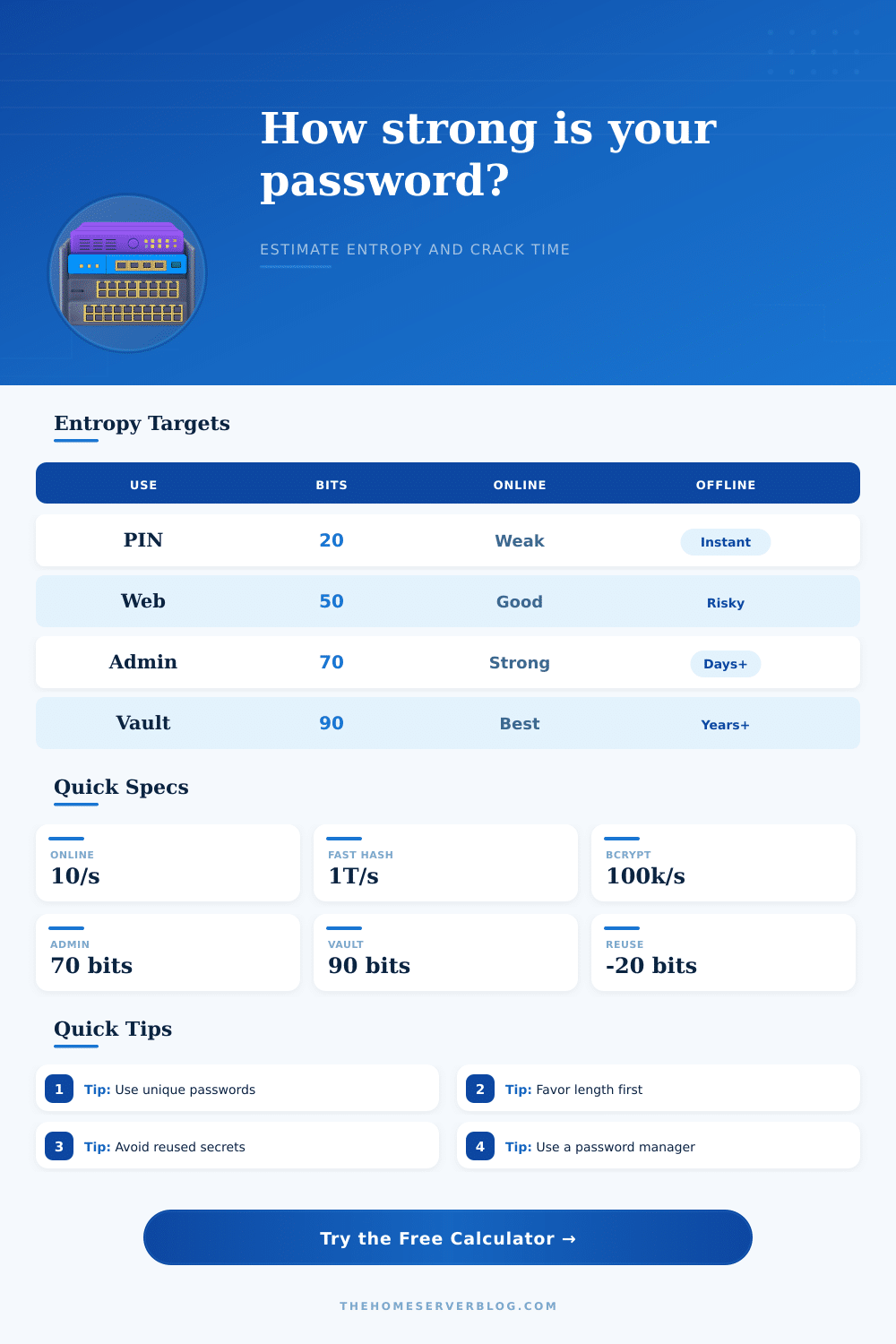
| Use case | Minimum bits | Preferred bits | Home lab example |
|---|---|---|---|
| Local PIN or lab demo | 20 | 35 | Temporary console |
| Personal web login | 45 | 60 | Wiki, dashboard |
| Admin account | 65 | 80 | Router, NAS, hypervisor |
| Password vault | 80 | 100+ | Manager master password |
| Shared WiFi key | 55 | 75 | Guest SSID passphrase |
| Hash type | Calculator rate | Risk profile | Practical note |
|---|---|---|---|
| Argon2id / modern KDF | 25k/s | Best offline resistance | Memory-hard settings matter |
| bcrypt cost 12 | 100k/s | Good web app baseline | Increase cost over time |
| PBKDF2 strong iterations | 500k/s | Depends on iteration count | Prefer modern settings |
| SHA-256 / NTLM class | 1T/s | Fast offline cracking | Needs very high entropy |
| Legacy MD5 class | 10T/s | Severe legacy risk | Upgrade storage immediately |
| Risk factor | Penalty range | Why it matters | Better practice |
|---|---|---|---|
| Dictionary words | 10 to 35 bits | Crackers try wordlists first | Use random words or generated strings |
| Known pattern | 8 to 24 bits | Format narrows the search space | Vary length and structure |
| Password reuse | 12 to 50 bits | Credential stuffing bypasses entropy | Unique secret per service |
| No online lockout | 10 bit online hit | Attackers can keep guessing | MFA, throttling, alerting |
If you’ve ever configured your own home lab, you probably spent hours getting every bit of storage array optimized, tuning your networks to perfection, but when it comes to passwords? Meh. You reuse them. They’re easily guessed. You use patterns. It feels secure, right? But what makes something truly secure is entropy, which measures just how unpredictable a given secret actualy is.
How hard would it be for an attacker to guess it before giving up? Asking that question change everything about how we approach security. Entropy is simply a way to measure search space; each additional character increases the set of possible combination exponentially. For instance, an all-lowercase, 12-character password has about eighty bits of entropy. Adding a mix of upper- and lowercase, plus digits, will increase that more considerabley. The calculator does all the math for you, transforming unclear ideas into practical risk estimates. You don’t have to understand the math behind it to get benefits. Just learn how the inputs correspond to real world.)
How to Create Strong Passwords
Long is good. Long beats smart every time, and substituting an ‘@’ sign for an ‘a’ wont help much if resulting word is still obvious. Attackers know about those tricks, and their dictionary lists includes common substitutions, they just skip past easy stuff. A random series of letters/numbers or a passphrase made up of several unrelated word makes the attack surface too large to breach rapidly. No pattern.
But half the equation of raw entropy are context: how does the password get used? Is it a password on a web login which is strictly rate limited, or is it a password hashed and sitting in a nice neat hash dump on disk somewhere? The former is slow and throttled online… But fast and relentless if someone steals your database and goes off line. This is the type of thing the tool consider by allowing you to specify attack rate and types of hashes. Slow down the enemy. Using something like bcrypt rather than MD5 isn’t some purely aesthetic preference; it’s a conscious decision to buy you time that randomness would of otherwise not give you.
Strong passwords aren’t a cure-all; what kills them is reuse, which renders even a highly-entropic secret worthless. It’s possible that you use a 90-bit secret as your password for your personal e-mail address, but if you also use it as your NAS at home, that secret has an effective strength of zero bits. A credential stuffing attack doesn’t care how mathematically unlikely your choice of secret was. They’ll try every breach they know until one hits. That’s reflected in the penalty section of the calculator. Re-using a secret will subtract huge amounts of value from your security standing, and render a locked door an open window.
A lot of people gets hung up on complexity requirements, throwing in numbers and symbols without thinking about length or randomness. They create predictable patterns (e.g., “add ‘1!’ at the end of each password”) that makes them easy to spot through pattern matching and drop their entropy significanty. The tool lets you specify any known pattern penalties for this exact reason: to force you to recognize how far apart your password’s theoretical strength is from its actual use. Cleverness wont help you beat a dictionary attack, only raw volume of possibilities will outlast it.
For example, the site include a series of reference tables with helpful benchmarks for various levels of security. If you’re setting up a temporary demo console, maybe a PIN is OK, but when it comes to a vault master key, how long should it resist an offline cracking attempt? Knowing those tiers can help you spend your time and efforts according. Not everything has to be as secure as possible, only what’s controlling your whole digital life, for sure.
In the end, perfecting your home lab isn’t really about getting things right; it’s about reducing risks. There’s no password you can create that an attacker with unlimited resources and time won’t be able to crack, but there are many thing you can do to increase the cost of cracking such that it’s simply not worth their effort. Moddern hashing algorithms combined with enough length and uniqueness in your secret is just about all it takes to increase that price beyond reasonable limits. Your job is to use the calculator to see where you land on that curve and turn that abstract anxiety into useful information.
Create long, unique secrets. Let the math do the rest. This is how you’ll stay safe… and sane.