Database concurrency planning
Transaction Isolation Cost Calculator
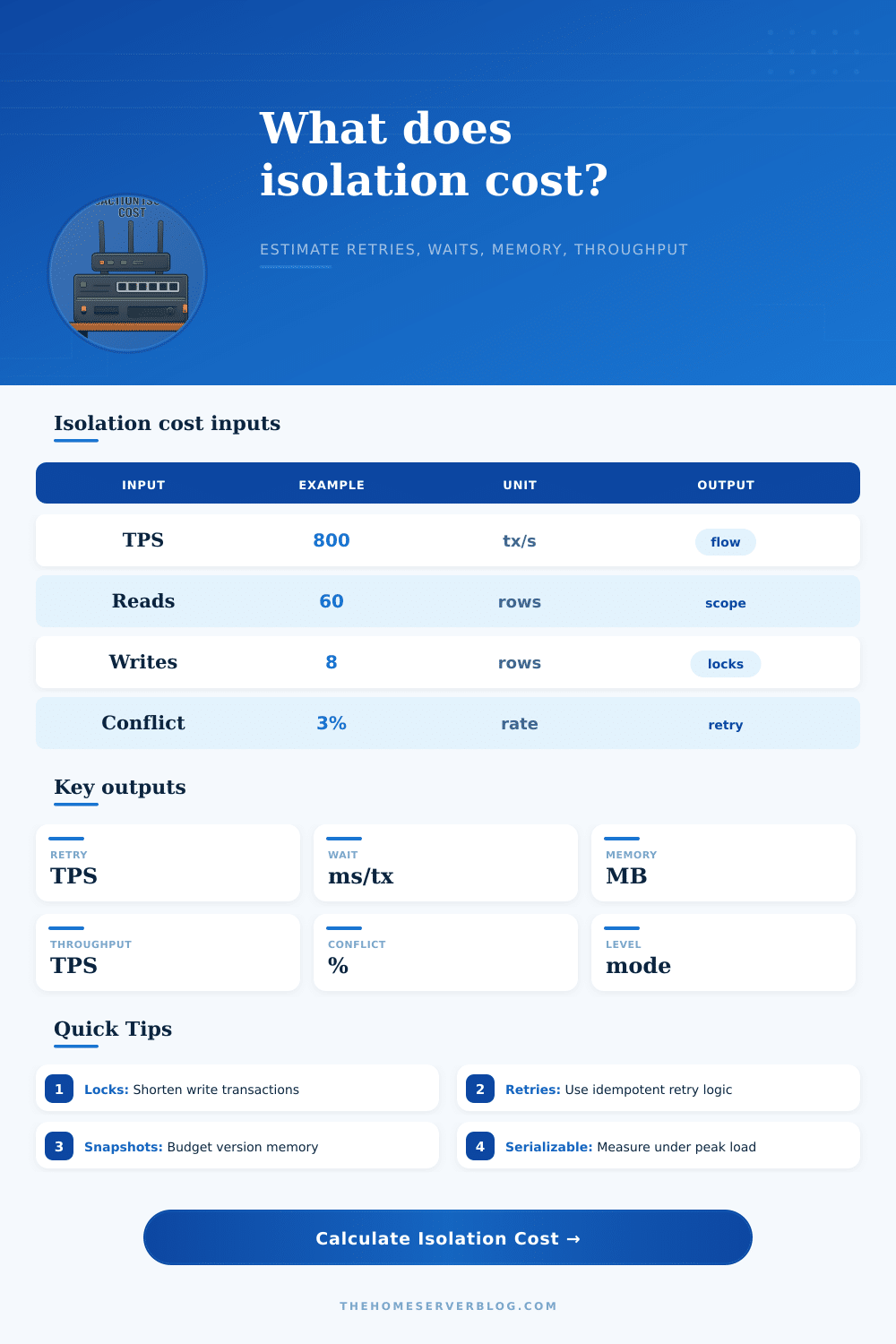
Estimate retry pressure, lock wait overhead, snapshot memory, and effective committed throughput from TPS, row touch size, duration, conflict probability, retry cost, wait time, and isolation level.
Calculation Breakdown
Concurrency Pressure
3Isolation Comparison Grid
4Isolation Planning Cards
Retry Surface
Serializable and snapshot workloads need idempotent retry paths because conflicts can be discovered late, often near commit.
Lock Footprint
Rows written matter more than rows read for blocking, but wide reads can expand predicate, gap, or validation ranges.
Version Budget
Long transactions multiply snapshot memory because old row versions remain visible until active readers finish.
Throughput Shape
Higher isolation often protects correctness by trading raw TPS for retries, waits, and more predictable anomalies.
5Reference Tables
| Isolation Level | Primary Protection | Common Cost | Best Fit |
|---|---|---|---|
| Read Committed | Prevents dirty reads | Lower repeatable-read guarantees, lower version pressure | APIs, dashboards, ordinary CRUD with targeted writes |
| Repeatable Read | Stable reads inside a transaction | Longer snapshots, more next-key or range lock exposure | Reports, batch reads, inventory checks with bounded writes |
| Snapshot Isolation | Consistent point-in-time view | Version store growth and write-write conflict retries | Analytics readers, mixed read/write services, replicas |
| Serializable | Equivalent to serial ordering | Predicate conflicts, validation work, retry spikes | Ledger, checkout, reservations, correctness-critical flows |
| Preset | Typical Level | Pressure Driver | Planning Note |
|---|---|---|---|
| Read Committed API | Read Committed | Short hot row updates | Keep transactions small and move remote calls outside BEGIN. |
| Repeatable Read Reports | Repeatable Read | Long read snapshots | Watch version retention and report duration during peaks. |
| Serializable Checkout | Serializable | Cart, stock, payment predicates | Design retries before increasing checkout concurrency. |
| Inventory Reservation | Serializable | High write contention on SKU rows | Shard hot SKUs or reserve by bucket where business rules allow. |
| Banking Ledger | Serializable | Account balance invariants | Prefer correctness, bounded transactions, and audited retries. |
| Queue Claim Workers | Read Committed | Competing claims on ready jobs | Use SKIP LOCKED style patterns when supported. |
| Analytics Snapshot | Snapshot Isolation | Long readers and version memory | Run readers on replicas or schedule them away from write bursts. |
| Admin Bulk Edit | Repeatable Read | Wide update ranges | Chunk changes and commit between batches. |
| Multi-Tenant Writes | Repeatable Read | Tenant-local hot keys | Partition by tenant and avoid global counters in the write path. |
| Metric | Low Signal | Watch Zone | High Risk |
|---|---|---|---|
| Adjusted conflict | Under 2% | 2% to 8% | Above 8%, retry storms can appear during bursts |
| Lock wait overhead | Under 5 ms/tx | 5 to 25 ms/tx | Above 25 ms/tx, p95 latency usually moves visibly |
| Snapshot memory | Under 128 MB | 128 MB to 1 GB | Above 1 GB, version cleanup and temp pressure need monitoring |
| Effective throughput loss | Under 10% | 10% to 25% | Above 25%, revisit isolation, indexes, or transaction shape |
| Tuning Lever | Reduces | Tradeoff | Where To Start |
|---|---|---|---|
| Shorten transaction duration | Concurrency, locks, snapshots | More application coordination | Move network calls, rendering, and queue waits outside transactions. |
| Add covering indexes | Rows read and predicate checks | More write IO and storage | Index WHERE, JOIN, and ORDER BY columns used inside hot transactions. |
| Chunk writes | Lock footprint and rollback cost | More commits and partial progress handling | Use bounded batch sizes for admin edits and imports. |
| Partition hot keys | Conflict probability | More routing and aggregation logic | Split by tenant, SKU bucket, account shard, or queue lane. |
| Use optimistic retry | Blocking wait time | More retry logic and duplicate protection | Make commands idempotent and record retry reasons. |
6Transaction Isolation Tips
Now you are doing a big marketing push and your web app is frozen because multiple transaction is trying to hit the same rows at the same time. It’s not because there isn’t room on disk; it’s because it has created a log jam in your database that has brought system to a halt. In this case, transaction isolation are a real cost. You’re trading off performance against consistency, and math shows how much each trade costs. After you plug in your estimated throughput and row scope, it calculate your effective committed throughput, snapshot memory usage, lock wait overhead, and retry pressure.
Engineers tend to pick their isolation level by habit; they should of instead select it based off their workload. If you have a simple read-heavy API, then Read Committed might suffice. For financial ledgers, even a single cent error cannot be tolerated. You are willing to pay the price of higher latency, which means you must has Serializable guarantees. Everything ripples throughout the system so consider the inputs carefuly.
Choosing the Right Database Isolation Level
When calculating lock contention, the number of rows read doesn’t matter as much than the number of rows written. For example, if a transaction reads one row but updates ten thousand rows, it still block other transactions from writing to those rows. By contrast, if a transaction locks a wide range of empty space, no transaction can insert into that space concurrenty. To help you determine this, the calculator consider both write volume and conflict probability.
You’re in danger territory when your conflict rate exceeds eight percent. At that point, retry storms are likely and throughput plunge as the database spends more time resolving deadlocks than running queries. A lot of today’s apps want something in between: snapshot isolation. That gives you protection against non-repeatable reads without requiring that you hold locks throughout your whole transaction.
And the cost? Memory. Each concurrent transaction hold a version of the data it saw when it started. Row versions kept around by long-running transactions (like bulk imports or complex report job) consume memory. Depending on activity levels, this can cause temp tablespace/undo log space to run out fast. The tool reports an estimated memory usage from knowing how many active transaction there are and their typical duration.
If you’re seeing a growing number, that suggests your workload has a lot of reading happening which starves the writing side. The most correct level of isolation come at a high performance cost: Serializable isolation (with predicate locking). Predicate locking means that the database locks not just existing rows but also the absence of future rows in a range. That will protect you from phantoms, but at a significant cost to your parallelism. As the chance of conflicts increases so does the decrease in effective throughput output.
Know when you truly need this level of isolation. If your application is designed well with proper retry logic, it do not need to use Repeatable Read or even Snapshot Isolation. This allows for more parallelism. You can handle concurrency conflicts with idempotency. Your app will need to retry transactions that fail. Ideally, it can do so safely (i.e., without accidentally creating duplicate side effects). That moves the workload from blocking wait time to fast retries.
The calculator’s retry TPS estimate account for this. High retry counts aren’t always a bad sign: lower-cost individual retries can compensate for higher numbers. Trouble occur when retries get out of hand and bog down the connection pool. The key is to find the right balance in your isolation plan. There’s no such thing as having perfect consistency with zero locking, no limits on concurrency, and infinite speed. Choose two of these three and optimize the remaining one.
Compare your architecture to the presets in the reference tables. Reserving inventory and taking an analytics snapshot are different kinds of workloads that apply different pressures to your system. The former needs perfect consistency immediately across the hottest set of keys; the latter can live with some degree of old data if it means massive read performance. Knowing this will help prevent over-building simple CRUD and under-sizing critical financial flow.
First, measure how long transactions take to run, and which rows is touched. Don’t assume anything; let the numbers tell you what’s best. You want the system to be responsive when it needs to be, and avoid any data corruption. Once you match your isolation strategy to the actual shape of your workloads, the bottleneck described earlier typicaly vanishes.