Whole Home Generator Sizing Calculator
Estimate required generator kW from running watts, motor starting surge, load diversity, reserve margin, fuel derating, and transfer switch limits.
⚡Named whole-home presets
🔧Generator and transfer switch inputs
🔌Appliance and circuit loads
Load and equipment breakdown
📊Generator/load spec grid
📘Typical appliance starting and running watts
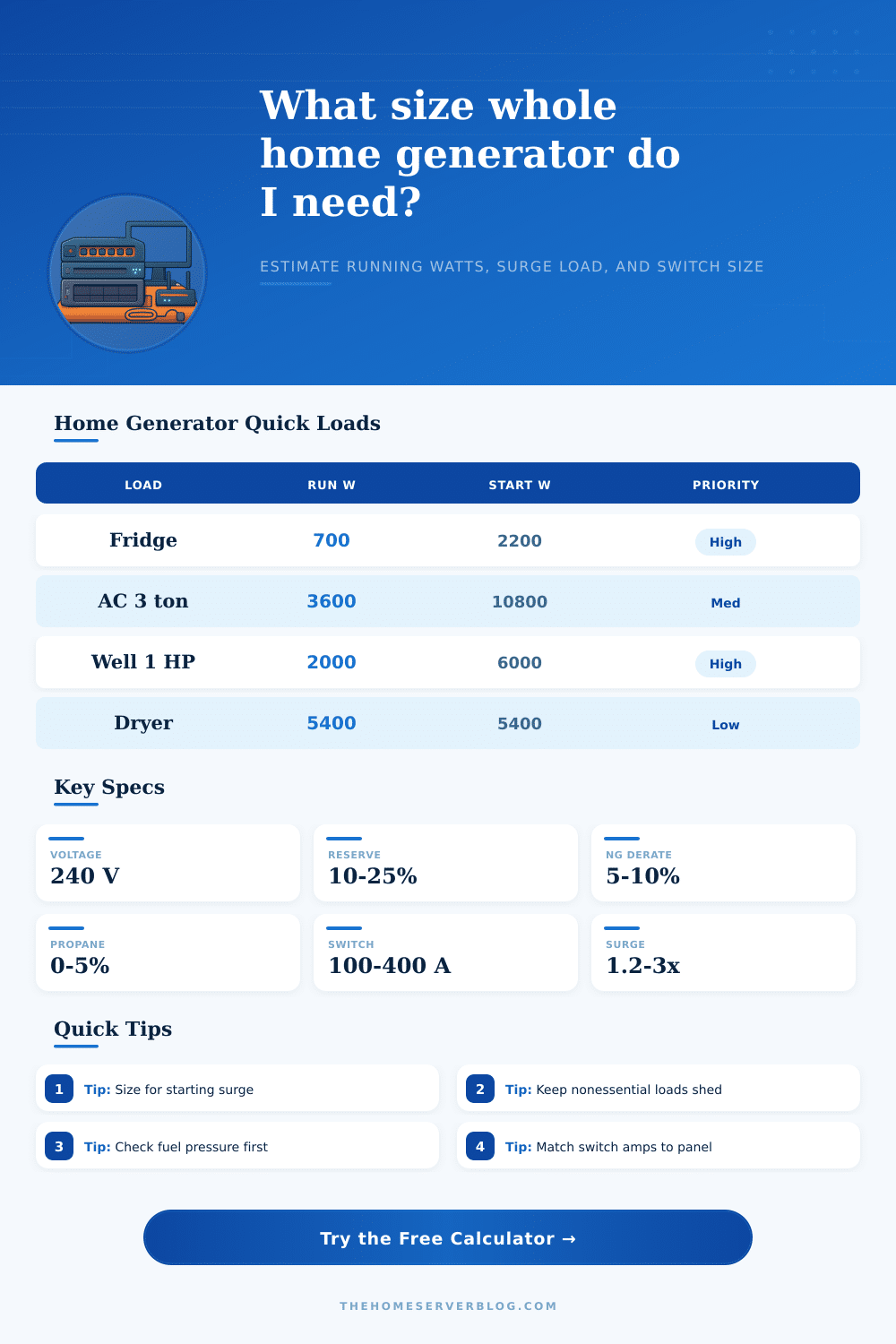
| Appliance or motor load | Running watts | Starting watts | Sizing note |
|---|---|---|---|
| Refrigerator or freezer | 500-800 W | 1,500-2,400 W | Count compressor surge |
| Central AC, 3 ton | 3,200-4,200 W | 9,000-13,000 W | Soft start can lower surge |
| Well pump, 1 HP | 1,800-2,400 W | 5,000-7,200 W | High priority if no water storage |
| Sump pump, 1/2 HP | 800-1,100 W | 2,000-3,200 W | Often cycles during storms |
| Electric water heater | 4,500-5,500 W | Same as running | Usually managed or shed |
| Electric dryer | 5,400-6,600 W | Same as running | Schedule manually on generator |
⛽Fuel and derating considerations
| Fuel type | Typical sizing effect | Runtime planning | Whole-home note |
|---|---|---|---|
| Natural gas | Often 5-10% less output than LP rating | Utility supply dependent | Verify meter and pipe capacity |
| Propane | Usually near nameplate rating | Tank size limits outage duration | Cold weather vaporization matters |
| Diesel | Strong motor starting response | Stored fuel needs maintenance | Common for larger standby systems |
| Gasoline portable | Manual transfer and lower duty cycle | Frequent refueling required | Best for critical circuits only |
🔋Transfer switch and panel fit table
| Switch rating | Approx. kW at 240 V | Best fit | Load management note |
|---|---|---|---|
| 60 A | 14.4 kW theoretical | Critical-load subpanel | Manual selection is common |
| 100 A | 24 kW theoretical | Essential or medium home | Shed AC, range, dryer as needed |
| 150 A | 36 kW theoretical | Large managed home | Good with staged HVAC |
| 200 A | 48 kW theoretical | Common whole-home service | Still check generator kW limit |
| 400 A | 96 kW theoretical | Large estates or dual panels | Often needs engineered design |
🏠Common whole-home generator project sizes
| Scenario | Likely generator range | Loads covered | Common constraint |
|---|---|---|---|
| Essential gas home | 8-14 kW | Fridge, furnace, lights, IT, sump | Small switch or manual circuits |
| Comfort home with 3 ton AC | 18-26 kW | Most loads plus one compressor | Starting surge without soft start |
| Well pump rural home | 16-24 kW | Water, refrigeration, furnace, outlets | Pump surge and voltage dip |
| All electric managed home | 26-38 kW | HVAC plus selected resistance loads | Water heater, dryer, range shedding |
| Large whole-home backup | 38-60 kW | Multiple HVAC zones and appliances | Fuel delivery and service equipment |
💡Practical sizing tips
Choosing a whole home generator requires that you considers the electrical loads that must be supplied. A whole home generator must supply electricity to a refrigerator and a freezer, a well pump, a furnace blower, and an air conditioner. Since both the air conditioner and the well pump include motor, each of these motors will require a high amount of starting surge power in order to turn on the appliances.
If the generator that is selected is only sized for supplying running watts to the electrical device in the house, the voltage will dip if either of these motors attempt to start up, which could cause the motors to stall. The calculator that is offered here will provide a recommended kilowatt figure that considers each of these factor: starting surge power, diversity, reserve margin, and fuel derating. The starting surge of the motors of appliances is one of the major factors to consider when choosing a whole home generator.
How to Choose the Right Whole Home Generator
For instance, an air conditioner might only use 3,600 watt while it is running, but when the air conditioner starts up, it will draw three times that amount of power. Thus, if the generator is only sized to supply power according to the running watts of the appliances, there may be a dip in the voltage that is supplied to the generator, which will cause the other appliance to flicker. Thus, the calculator will ask you to consider the largest motor in your house and will size the whole home generator to supply the starting surge of that particular appliance.
Thus, an 18 kilowatt generator might be suggested for a home with only kitchen appliances, but due to the motor that is present in the air conditioner, a 22 kilowatt generator might be required. Fuel type is another of the factors that will impact the performance of the whole home generator. For instance, natural gas is a common fuel for these generators.
However, the natural gas pipe and meter that is present in the home might not provide enough pressure to operate both the furnace and the whole home generator. Propane is an alternative fuel type, however the propane tank might not be large enough to supply the generator for the length of the power outage. Finally, diesel generators exist but will require specific maintenance.
The fuel derate input will ensure that the kilowatts that are calculated include the expected performance of the generator with fuel rather than the performance that is seen with the generator under laboratory conditions. One technique for maximizing the power of a smaller whole home generator is to implement load management. Load management permits for a whole home generator with fewer kilowatts to start up and power a larger house.
In load management, you can turn off appliances like water heaters or dryers when the air conditioner starts up. Once the air conditioner has started up and reached running wattage, the water heater or dryer can be turned back on. This load can be entered into the calculator, which will automatically adjust for the diversity factor for those appliances.
Thus, load management can be used to provide a more accurate estimate of the performance of your generator without any manual management of the appliances in the house. Another factor to consider is the size of the transfer switch. While a 200-amp transfer switch can handle 48 kilowatts of power, it may not be able to handle the continuous load of the generator.
Thus, the calculator will compare the kilowatt recommendation to the size of the transfer switch that you choose for your house. If the recommendation is too close to the size of the switch, the generator will be flagged in the calculation so that you dont purchase a generator that cannot utilize the switch that you own. Finally, the goals that you have for your backup generator will impact the size of the generator that you need.
If your only goals are to power essential items like refrigerators, you might only need an 11 kilowatt generator. However, if you wish to power your entire house, including appliances like dryers and ranges, you will need a generator with at least 25 kilowatts of power. Thus, the calculator allows you to select essential mode, comfort mode, or whole-home mode.
Thus, the generator will calculate three different kilowatt recommendations according to these three mode. Finally, the altitude and temperature of the location of the generator will impact the amount of power that the generator can output. For instance, if the generator is rated for sea level, but is located at high altitude or in a location with high temperatures, the generator might not be able to provide its rated power.
This derate can be entered into the calculator to ensure that you do not purchase a generator that will not have enough power to operate the appliances in your house. Once you have the kilowatts recommended for your house, you might be able to adjust the appliances that are to be powered by the generator to lower the amount of kilowatts that will be required of the generator. For instance, you can install soft-start kits on air conditioners to reduce the amount of starting surge power that is required of the generator.
Similarly, a larger pressure tank can be installed for the well pump. After calculating the needs of the house, hire a licensed electrician to ensure that the fuel supply for the generator is sufficient and that the transfer switch will handle the amperage of the generator. A licensed electrician will ensure that the installation is safe and that the generator meets all local permitting requirements.
You should of checked the house size first. Its important to get the right furnitures for the setup. If you want a luxurius setup, you’ll need alot of power.