Erlang B Calculator
Size SIP trunks, PRI channels, analog gateway ports, and PBX voice capacity from busy-hour traffic and blocking targets.
⚙Traffic Presets
📞Busy-Hour Inputs
Capacity Results
📊Codec and Trunk Reference
📘Blocking Grade Table
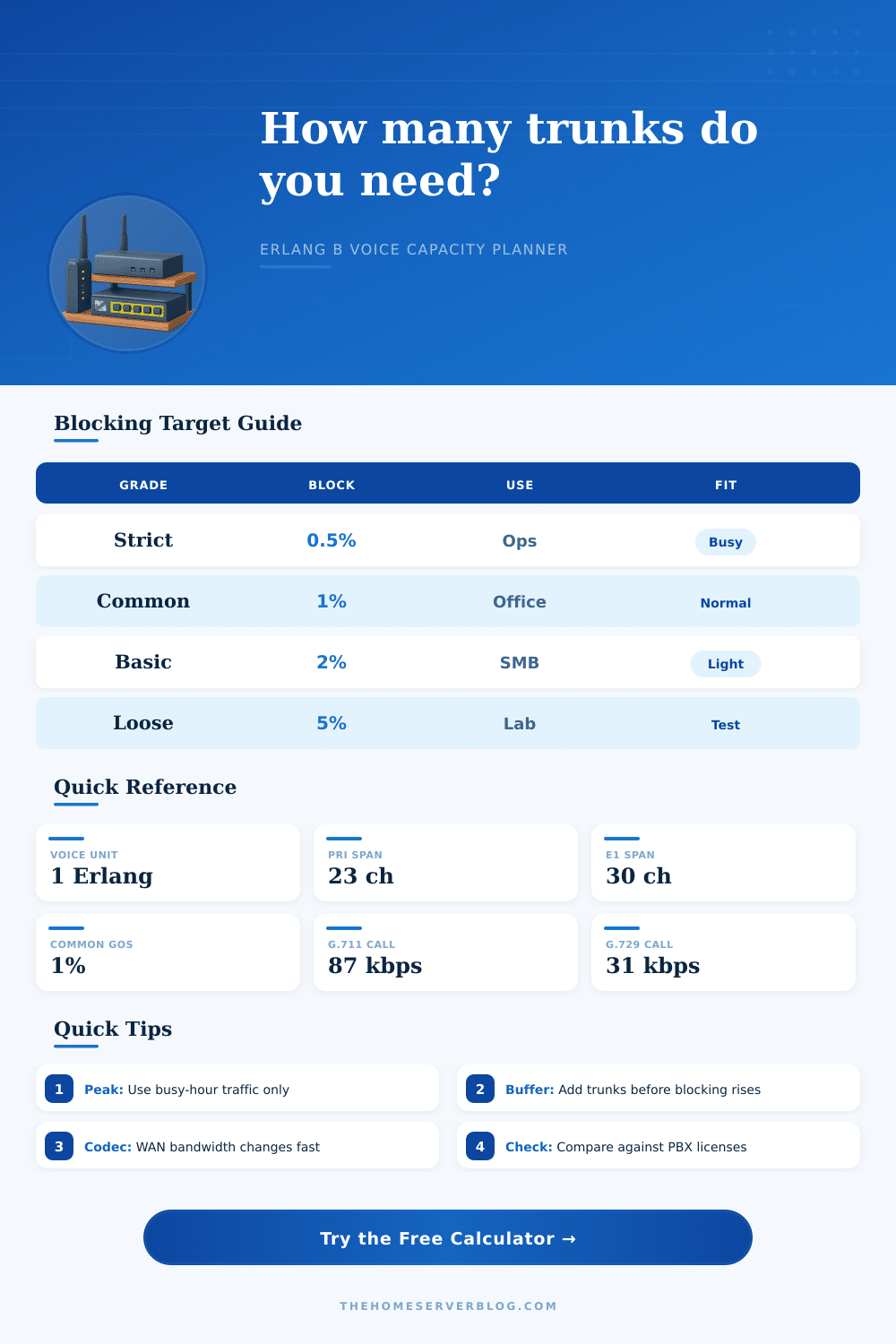
| Target grade | Blocking probability | Typical use | Planning note |
|---|---|---|---|
| Strict operations | 0.5 blocked calls per 100 | Reception, health, dispatch | Useful where missed calls matter immediately |
| Common business | 1 blocked call per 100 | Office PBX and SIP trunking | Often used as a practical voice GoS target |
| Typical SMB | 2 blocked calls per 100 | Small office or branch lines | Balances channel count and occasional busy signals |
| Noncritical lab | 5 blocked calls per 100 | Home lab, demo PBX, test rigs | Acceptable for experiments and overflow testing |
🖧Voice Media Bandwidth Table
| Codec profile | Approx kbps per call | 20 channels | Best fit |
|---|---|---|---|
| G.711 with 20 ms packets | 87 kbps | 1.74 Mbps | LAN, fiber, high quality SIP trunks |
| G.711 with 30 ms packets | 80 kbps | 1.60 Mbps | Lower packet rate with similar audio quality |
| G.729 with 20 ms packets | 31 kbps | 0.62 Mbps | Constrained WAN links and branch offices |
| Opus voice payload estimate | 56 kbps | 1.12 Mbps | Modern softphone and WebRTC style systems |
| iLBC with 30 ms packets | 38 kbps | 0.76 Mbps | Loss-tolerant low bandwidth voice paths |
💾Common Voice Project Sizes
| Project | Busy-hour traffic | Suggested GoS | Useful check |
|---|---|---|---|
| Home PBX with family extensions | 0.2 to 0.8 Erlangs | 2% to 5% | Analog gateway ports may matter more than SIP count |
| Small office hosted PBX | 2 to 6 Erlangs | 1% to 2% | Compare trunks to concurrent-call licenses |
| Clinic or front desk group | 4 to 10 Erlangs | 0.5% to 1% | Use stricter blocking during morning spikes |
| PRI migration to SIP | 10 to 20 Erlangs | 1% | One T1 PRI carries 23 bearer channels |
| Contact center pilot | 8 to 25 Erlangs | 0.5% to 1% | Queueing behavior changes the user experience |
💡Planning Notes
A busy signal is experienced when a person try to make a phone call, but all of the communication channels is currently in use. If you are the manager of an office, a busy signal from the SIP trunks or PRI channels mean that all of the communication lines are occupied. You may have many licenses for the number of users that you have in your office, but if the communication channel between your office and the outside world is narrow, then you will have issues with the number of calls that can be accommodated.
Call volume will not be a steady streams of calls that your office must answer daily. Instead, call volume will be a series of high volumes of calls that your office will receive over a short period of time. The Erlang B model is a mathematical method of calculating the number of channels that a person will need to ensure that the very few call that produce a busy signal are less than a predetermined number.
How to Plan Phone Lines to Avoid Busy Signals
In analyzing call volume, the statistic that you will use is not the average number of daily calls that your office will receive. The average daily call volume will smooth out the high volume of calls that your office will receive during a specific time period. Instead, the statistic to analyze is the high volume of calls during the busy hour.
During this time period, your phone lines will be under the most amount of stress during the telecommunication day. This statistic will be used to size your communication channels correct. When building a voice communication system for a business, the Grade of Service must be defined.
The Grade of Service for a telecommunication system is the failure rate of the system. This percentage of calls will be blocked due to a lack of available communication channels. For instance, an emergency dispatch center will have a low Grade of Service to ensure that every call gets through.
For this example, the dispatch center will have a blocking rate of zero point five percent of calls. This rate will require the communication channels to purchase more communication channels then they will normaly need on a daily basis. For a small business, a blocking rate of five percent may be acceptable to balance the cost of purchasing more communication channels with the frustration of callers that will be placed on hold waiting for the represented agent to respond.
The Erlang B calculator will calculate the probability of call blocking for a system, avoiding the complex recursive formulas that you could use to calculate such a value. First, you must plug the call attempts and the average duration of the calls into the calculator that will tell you how many Erlangs of traffic your business will receive. One Erlang represent one person on the phone for one hour.
Alternatively, sixty people on the phone for one minute each will also equal one Erlang. The Erlang is the unit of measurement for all voice networks. The other consideration is the codec that will be used for the calls.
While the Erlang B math will tell you how many channels you will need, it will not tell you if your internet connection can handle that many channels. For example, a high-quality G.711 codec will use more bandwidth than a G.729 codec. So, if you calculate that you need twenty different sessions for your phone system to maintain a low blocking rate, your internet connection must be able to support that many sessions.
If your Wide Area Network (WAN) cannot support the number of sessions you require, your system will fail. For example, if you need to support thirty SIP phone system sessions, but your upload speed will only allow for ten to be active at the same time, your thirty SIP system will not work properly. Carriers will also impact your phone system.
Carriers rarely sell individual phone system channels. They sell blocks of channels or specific hardware spans. For example, if the Erlang B calculator indicates that your system will need twenty-four channels, but the available blocks of channels has a capacity of only twenty-three channels, you will be required to purchase the next available block of channels.
If you buy a larger block, you will have some channels that sit idle. These channels will allow for growth in the number of phone system channels your company requires. Without having this additional capacity, your system will not be able to handle the growth in your company’s traffic.
This additional capacity will allow you to avoid having to upgrade your phone system too soon if your company experiences growth in the number of channels you require. Finally, voice planning takes into account the changes in human behavior. If you plan your system with the theoretical number of channels you will require, human behavior may change.
For example, you may have planned for a certain number of phone system channels for your clients. However, if the number of clients who call your company changes at any time, your system will need to be able to handle that change in the number of channels. You want to find a balance in which you are not paying for channels that you will not use, but your clients may need to make calls to your company.
By planning for these variables, you can create a connection that will remain wide enough to include any number of spikes in the number of calls your company will receive.