Erlang B Traffic Calculator
Size PBX trunks, SIP channels, contact center lines, and voice gateways from busy-hour call arrivals, average holding time, offered traffic, and target grade of service.
☎PBX and Contact Center Presets
📊Traffic Inputs
Erlang B Capacity Results
📞Telephony Capacity Grid
📘Erlang B Reference Tables
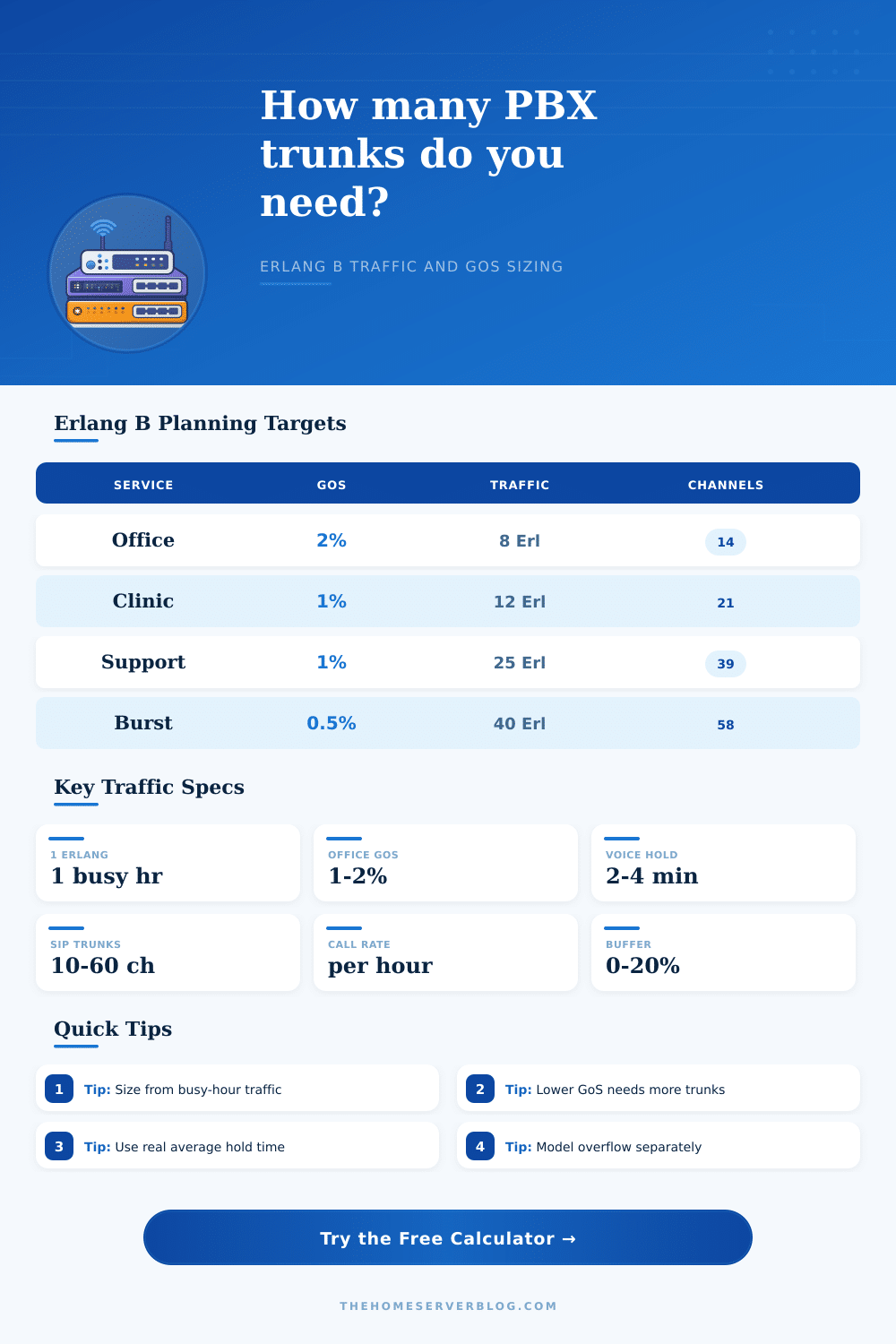
Typical blocking probability targets by trunk group
| Telephony Group | Common GoS | What It Means | Planning Note |
|---|---|---|---|
| Small office PBX | 1% to 3% | 1 to 3 blocked attempts per 100 | Often acceptable when voicemail or mobile fallback exists. |
| Inbound support queue | 0.5% to 1% | Very low busy treatment | Use when callers should wait in queue rather than redial. |
| Retail or sales line | 1% to 2% | Low abandoned opportunity risk | Peak campaigns may need a seasonal traffic factor. |
| Outbound dialer | 2% to 5% | Some blocking may be tolerable | Dialer pacing should adapt to trunk occupancy. |
| Critical switchboard | 0.1% to 0.5% | Almost no busy treatment | Add route diversity, not just more channels. |
Erlang B trunk capacity guide at about 1% blocking
| Channels | Approx Traffic | Busy Minutes / Hr | Example Use |
|---|---|---|---|
| 8 channels | 3.1 Erlangs | 186 minutes | Small branch or low-volume PBX. |
| 12 channels | 6.6 Erlangs | 396 minutes | Office with a shared SIP trunk group. |
| 24 channels | 16.6 Erlangs | 996 minutes | Single PRI-size group or medium queue. |
| 48 channels | 33.9 Erlangs | 2034 minutes | Busy support center or multi-site trunk. |
| 96 channels | 74.1 Erlangs | 4446 minutes | Large contact center trunk aggregate. |
PBX and contact center busy-hour examples
| Scenario | Calls / Hour | Avg Hold | Offered Traffic |
|---|---|---|---|
| Small office PBX | 90 | 150 sec | 3.75 Erlangs |
| Medical clinic | 180 | 210 sec | 10.5 Erlangs |
| IT help desk | 300 | 240 sec | 20 Erlangs |
| Retail call queue | 420 | 150 sec | 17.5 Erlangs |
| Hospital switchboard | 680 | 135 sec | 25.5 Erlangs |
Traffic terms and conversion reference
| Term | Formula | Unit | Use In Sizing |
|---|---|---|---|
| Offered traffic | Calls/hr × hold sec / 3600 | Erlangs | Traffic demand before blocking. |
| Carried traffic | Offered × (1 - blocking) | Erlangs | Traffic actually handled by trunks. |
| Grade of service | Blocked attempts / offered attempts | Percent | Target busy probability. |
| Busy-hour traffic | Peak 60-minute offered load | Erlangs | Primary trunk sizing input. |
| Trunk occupancy | Carried Erlangs / channels | Percent | Average channel utilization. |
💡Traffic Engineering Tips
Traffic engineers use an Erlang B formula to determine the number of trunk or SIP channels required for a phone system. Traffic engineers use the Erlang B formula because the mathematical calculations is simple. To use the Erlang B formula, engineers must input the amount of traffic that will be expected during the busiest hour of the phone system and the amount of blocking that the system can tolerate.
Based off these two inputs, the Erlang B formula will calculate the number of trunks or SIP channels that are require to allow callers to successfully reach the called parties and avoid encountering busy signals. The Erlang B formula does not consider the time of day and the day of the week when calculating the number of channel required. However, the Erlang B formula does consider the single peak sixty minutes of traffic and the probability that all available trunks will be occupy during that one hour.
How to Use Erlang B to Find How Many Phone Lines You Need
Busy-hour traffic is the most important factor to consider when building a new trunk group for a phone system. Call traffic does not even itself out throughout the day. The busiest hour will determine how many trunks is required for a phone system.
If a trunk group cannot handle the busiest hour of calls, then callers will encounter blocking during the calls. A calculator can be used to calculate the number of trunks required with the systems measured call arrivals and average hold time. Using a calculator to complete these mathematical calculations will save engineers the trouble of having to use printed tables to determine the coefficients for the formula.
The average hold time for calls is a critical part of the Erlang B formula. Many engineers and technicians will underestimate the impact that average hold time have on the formula. A three-minute call will consume three times the resources of a one-minute call.
If the average hold time increases, then the number of channels will increase. If thirty seconds reduce the average hold time, then an entire trunk can be freed up in the phone system. This can be tested by changing the hold time field in a calculator to test how the number of trunks required change.
The phone system will dictate the grade of service that will be provided and the grade of service input into the Erlang B formula. A one-percent grade of service will allow for one blocked call every hundred calls attempted. If the grade of service is changed to a half-percent, three or four additional trunks will be required to handle the same amount of traffic.
If the grade of service is changed to three percent, the number of trunks can be freed up but calls will have to be redialed to reach the called parties. In addition to the factors that is considered in the Erlang B formula, real traffic can differ from the assumptions that is presented in most textbooks. If callers encounter a busy signal, they will generally attempt to redial the called party.
These redial calls are not reflected in the statistics collected from the phone system. Additionally, many telecommunication systems are designed with seasonal campaigns and product launches that result in traffic spikes for a few days a year. These traffic spikes require the system to have sufficient channel capacity.
Additionally, many organizations reserve some of their communication channels for priority traffic to guarantee that executives, for example, do not have to wait on callers. In these instances, the required number of channels will be more high than that calculated with the Erlang B formula. Reference tables exist to show the different industries and their balance of cost of trunks versus caller experience.
For instance, a small business may accept the two or three percent rate of callers waiting on the telephone system for their calls to be serviced, as the callers can access their voicemail messages or use their mobile phones to reach the called parties. However, a contact center that loses a callers appointment if their call is not pick up will require a blocking rate closer to one percent. Reference tables do not provide the answer for any given organization, but the tables do provide information regarding how other organizations have balanced these issue.
Another common mistake is calculating the number of trunks based on the average daily or weekly traffic to the telephone system. The true busy hour may have significantly higher traffic. For example, a system might average twelve Erlangs daily; however, there might be an eight-hour busy period where the system receives eighteen Erlangs.
In this case, calculating the number of trunks based on a concentration factor for busy periods will provide a better understanding of the true number of required trunks. If an organization does not use a concentration factor for busy periods to calculate the number of trunks it need, their system may fail during those busy periods. Another mistake is assuming that the overflow traffic that is sent to a secondary route or the public network is free capacity.
The calls that are sent to these alternate routes use up the same resources as the primary trunk group. Additionally, the overflow traffic may cost more per minute than the primary trunk groups traffic. By using a tool to calculate the percentage of calls that will overflow, an organization can understand how much headroom they would like to provide for primary traffic and how the cost of the overflow traffic would impact their system.
The Erlang B formula assumes that any calls that are not answer by the called parties are lost calls for the calling organization. If the system uses the Erlang B formula, the formula assumes that calls are not queue up. The Erlang B formula is most effective for systems that connect directly to the called parties.
For systems that queue calls, the Erlang B formula is less effective. A calculator that determines the size of the trunk group can calculate the blocking of calls, the number of required channels, and the maximum traffic that can be sent through the system. The goal of sizing a telecommunication systems phone lines is to ensure that there is a low blocking rate for callers and a high blocking rate that does not result in the organization buying additional lines for idle capacity.
A calculator will give the organization the numbers for the system sizing, but the organization must decide the level of friction for the caller and how much their budget will afford for system sizing. By finding the balance between caller friction and system cost, the communication channel becomes a reliable background service.