Fiber Optic Count Calculator
Plan active strands, spare capacity, and the next standard cable size for home labs, risers, and backbone links.
Full Breakdown
| Pattern | Active Strands | Round To | Why It Helps |
|---|---|---|---|
| Simplex run | 1 | 1 | Single-fiber taps and monitoring |
| Duplex link | 2 | 2 | Standard device uplinks and pairs |
| MPO trunk | 12 | 12 | Matches ribbon blocks cleanly |
| PON feeder | 1 | 1 | Splitter math reduces feeder count fast |
| Family | Pack | Use Case | Note |
|---|---|---|---|
| OS2 simplex | 1 | Camera tap | One fiber, one path |
| LC duplex | 2 | End device | Most common home-lab pattern |
| MPO-12 | 12 | Spine trunk | Groups counts into ribbon blocks |
| MPO-24 | 24 | Core trunk | Useful when the count jumps higher |
| Capacity | Ports | Typical Panel | Best Fit |
|---|---|---|---|
| 12F | 6 duplex | Small wall box | Short access runs |
| 24F | 12 duplex | 1RU panel | Small office ties |
| 48F | 24 duplex | 2RU tray | Backbone blocks |
| 96F | 48 duplex | High-count tray | Campus interconnects |
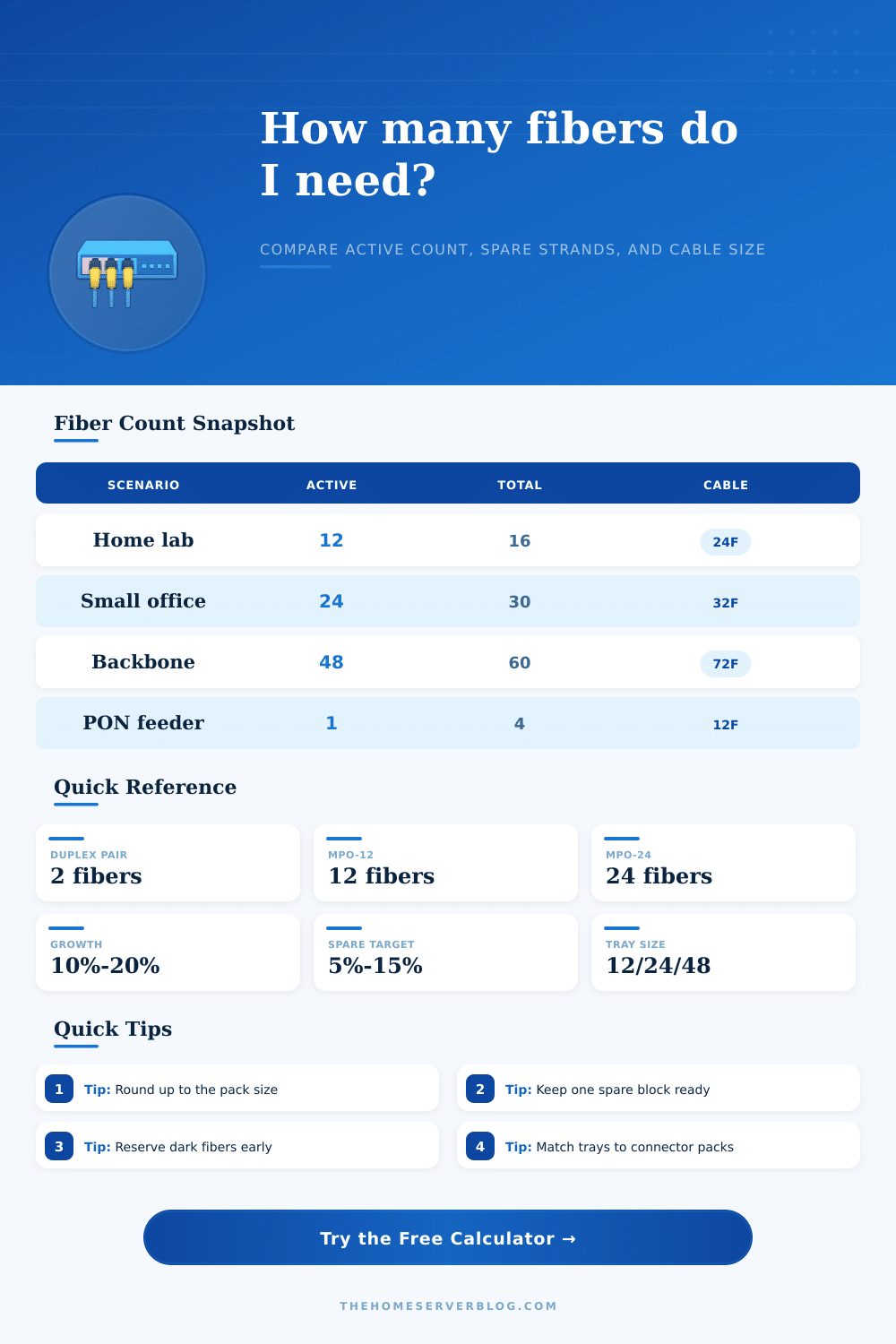
| Scenario | Active | Total | Cable |
|---|---|---|---|
| Home lab | 12 | 16 | 24F |
| Small office | 24 | 30 | 32F |
| Riser spine | 48 | 60 | 72F |
| Campus tie | 72 | 96 | 96F |
This calculator keeps service strands, growth reserve, and spare capacity separate so the final cable count is easy to audit.
To calculate teh total number of fiber strands that will be required for the fiber optic cable installation, many people makes the mistake of underestimating the total number of fiber strands that will be required to fulfill the needs of the network. Fiber strands is used for a variety of purposes within the network. Therefore, in order to ensure that the fiber optic cable installation is successful, it is also necessary to account for active strands, redundancy strands, and spare strand.
Active strands are the number of strands that will carry data across the network. A duplex link require two strands of fiber optic cable, and there will be a number of duplex links required for each uplink in the network. The number of duplex links that they’re required can be multiplied by the number of service group to determine the total number of active strands of fiber that are required.
How to Calculate the Number of Fiber Strands Needed
In addition to the active strands, there need to be redundancy in place for the backbone of the network. Redundancy ensures that there is a second path for the data to take in the event that a fiber strand fail. For this reason, the installer will need to double the number of active strands.
In addition to the number of active strands, it is also necessary to provide for future growth of the network and for spare strands of fiber optic cable. Ten percent can be reserved for future growth, and an additional 10 to 15 percent can be allowed for spare strands of fiber optic cable. Spare strands of fiber optic cable are necessary for being able to make change to the network without having to install new fiber optic cable.
Additionally, spare strands of fiber optic cable are necessary for being able to replace a fiber strand that may fails at a splice in the network. The type of fiber optic connectors that the technician will use for the network will also play a major role in determining the total number of strands of fiber optic cable that will be required for the network. For example, LC duplex connectors use fiber strands in pair.
An alternative to duplex connectors are MPO connectors, which bundle 12 or 24 strands of fiber optic cable into one unit. Because fiber optic cables come in fixed increments, the technician will need to round the total number of required strands up to the nearest standard fiber optic cable size. Any less than the total number of strands that are calculate will lead to unused fiber optic cable.
In addition to the considerations regarding active strands, redundancy, future growth, spare strands, and the type of connector, there are other considerations for the fiber optic cable installation. For example, management fiber strands are use for out-of-band access to the network, and the management of the network equipment. Furthermore, the length of the fiber optic cable will need to account for slack in the fiber optic cable, as the length that is installed into the network will be longer than the length of the fiber optic cable that is measured between the two installation point.
The capacity of the fiber trays will also need to be considered. For instance, if a fiber optic cable with a capacity of 48 strands of fiber is installed into a tray that can only hold 12 strands of fiber, the number of fibers that enters the network will overwhelm the tray. Additionally, the conduit fill limit and the bend radius limits for the fiber optic cable will need to be considered when planning the installation of the fiber optic cable.
If the technician calculates the number of active strands, adds the number of strands for redundancy, adds the future growth and spare strands, and if the technician rounds the total number of strands to the nearest standard fiber optic cable size, then the calculated number of strands will be the most adequate number of strands of fiber optic cable that will be required for installation.