HomeServerBlog backup power planner
Generator Fuel Runtime Calculator
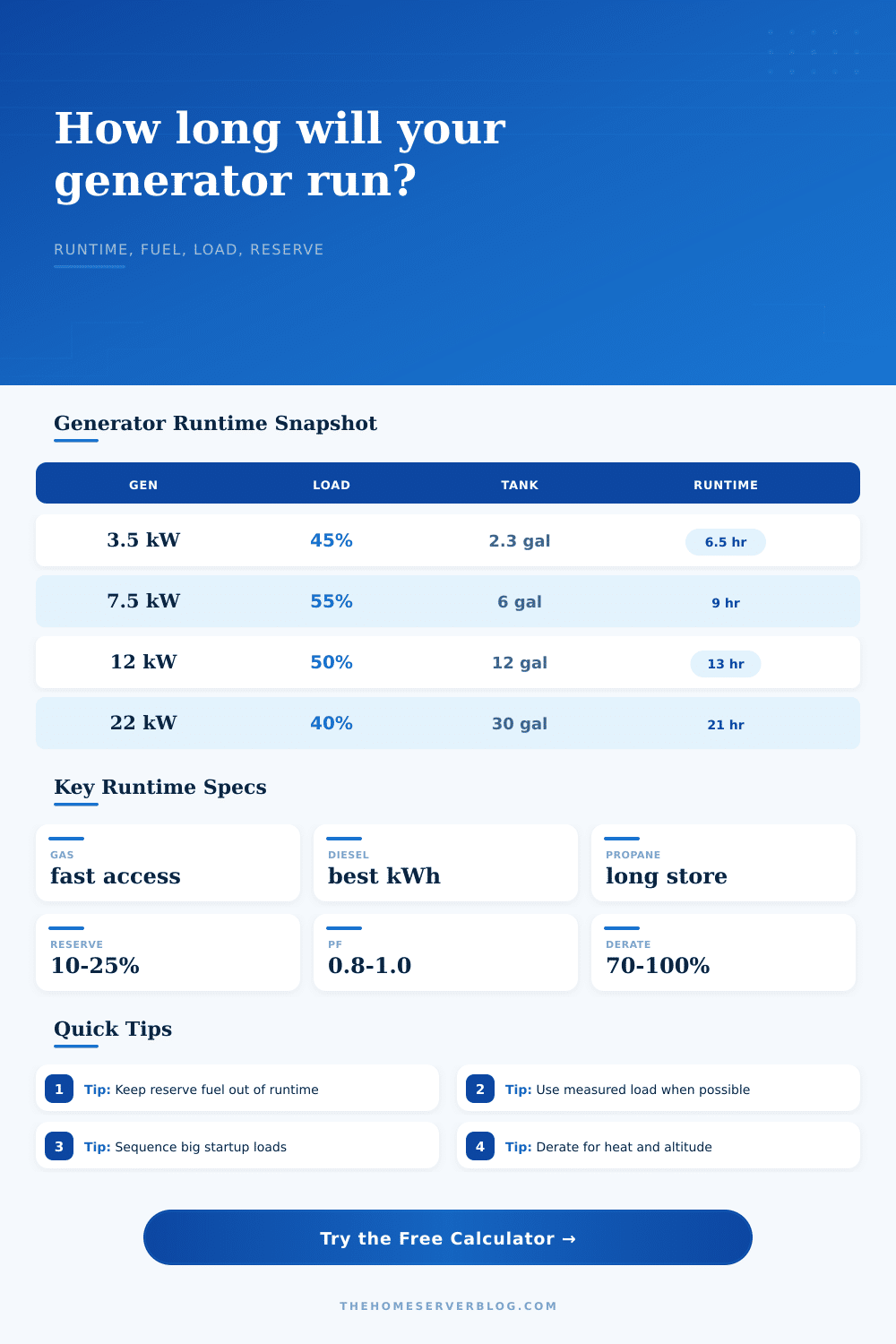
Estimate generator runtime from generator kW, load percent, fuel tank gallons or liters, fuel type, burn curve, power factor, derate, reserve fuel, startup load, runtime target, and maintenance reserve.
★Generator presets
⚙Runtime inputs
Fuel and runtime breakdown
Load and reserve checks
📊Live planning cards
Generator rating after derate.
Fuel needed before fixed reserves.
Positive means the target is covered.
Estimated energy over usable runtime.
⛽Fuel type comparison grid
📋Generator reference tables
| Curve | 25% load | 50% load | Use case |
|---|---|---|---|
| Portable | 38% of full | 58% of full | Conventional open-frame generator with fixed-speed engine. |
| Inverter | 30% of full | 52% of full | Small electronics, router, fridge, and light home office loads. |
| Diesel | 34% of full | 55% of full | Larger standby, towable, and long-duration equipment room use. |
| Standby | 42% of full | 62% of full | Residential or small commercial standby sets with transfer switch loads. |
| Fuel amount | Typical generator | Planning window | Reserve note |
|---|---|---|---|
| 1 to 3 gal | 1 to 4 kW inverter | Router, modem, laptop, small fridge window. | Keep at least one short restart reserve. |
| 5 to 8 gal | 4 to 8 kW portable | Fridge, lights, sump pump, light server stack. | Reserve matters because burn rises sharply near full load. |
| 12 to 30 gal | 10 to 24 kW standby | Critical circuits, rack, HVAC fan, well pump sequencing. | Use a day tank or planned refuel interval. |
| 50 gal+ | 25 kW+ diesel | Small data room or extended outage support. | Maintenance stops and fuel polishing can matter. |
| Load band | Runtime effect | Electrical note | Practical action |
|---|---|---|---|
| Under 25% | Long runtime but poor fuel efficiency. | Some engines dislike long light-load operation. | Add only if the manufacturer allows it. |
| 25% to 60% | Usually the best runtime and noise balance. | Good margin for cycling loads. | Ideal target for home lab backup. |
| 60% to 85% | Fuel burn rises quickly. | Check voltage dip and heat derate. | Reduce noncritical loads during outage mode. |
| 85%+ | Runtime drops and surge margin is limited. | Startup loads may trip or bog the generator. | Use load shedding or a larger set. |
| Reserve item | Typical range | Why it matters | Calculator input |
|---|---|---|---|
| Bottom-tank reserve | 10% to 20% | Avoids counting stale, unusable, or contaminated fuel. | Reserve fuel percent. |
| Maintenance reserve | 3% to 10% | Warm-up, cooldown, test run, and service interruption fuel. | Maintenance reserve percent. |
| Startup load margin | 110% to 180% | Captures refrigerator, pump, compressor, and UPS charging pulses. | Startup load percent. |
| Runtime target | 4 to 72 hr | Turns burn rate into a refueling or stored-fuel requirement. | Runtime target hours. |
💡Two generator runtime tips
Your backup generator kicks on and the grid goes down. The lights, router, and fridge are up. Your system seem solid. For the initial hour.
But then your fuel runs low. You glance at the gauge and it ticks down. How much fuel do you have? Until what time? Will you have to go outside during this storm to top off?
Why Runtime Is More Important Than Watts
That’s why runtime trumps peak watts. Anybody can purchase a generator with a big number on it. Ensuring that the number lasts is another matter entirely.
The calculator above take out the guesswork. It keeps your most critical system powered.
The nameplate rating is what most folks see. Then they apply some sort of linear mathematics to the mix. “If this thing burns a gallon an hour on full load, then it must burn half a gallon an hour at half load.”
Uh-uh. Not so much. When you change the load or even the engine speed, that’s not how it works. A gas portable engine isn’t like a diesel engine. And a diesel engine isn’t like an inverter system.
That’s where the calculator steps in. You input your engine type and the percentage load. Based off real world data, it will adjust for the burn rate. It does not just divide by two.
Burning at twenty percent might not be as efficient than burning at fifty percent. The curve makes all the difference between ten hours and six hours of run time.
Storage is another trap that catches people off guard. Wrong. You got a twenty gallon tank? Good luck getting twenty gallons out. Gasoline ages and varnishes on the walls of tanks. Carburetors gets gunked up.
You’ll be asked about a reserve percentage. Reserve 15 to 20 percent of what your tank holds. Not only will this save you from using the end of a bad tank of gas, but it will also protect you against power surges.
When things like well pumps and refrigerators need to start they demand a big jump of current. A bigger one than just running loads. If you are already running near capacity, that startup kick can trip the breaker or bog engine down. Or the engine might stall. Reserving enough for the surge will keep the lights on.
The runtime of fuel depends on environmental variables. Are you at a high altitude with thin air? Your engine operates at higher altitudes. To get fuel moving through the engine require more work.
Is it extremely hot? The engine’s cooler pushes hard. The generator will throttle back to cool down. These conditions is included in the derate input of the calculator. Live in a hot high altitude place? You may see a ten percent reduction in output.
Guess what happens if you don’t account for this reduction? Your runtime is wrong. This is just a minor adjustment to the inputs. This is a way to prevent errors when you need them most, such as during a heatwave.
Then there’s different fuel. How will it change your strategy? For example, diesel stores well, is very efficient when loaded down, and good for an extended outage. Gasoline starts quickly, but deteriorates quicker. It requires rotation and stabilization. Propane lasts forever. It has less energy density (meaning you’ll use more volume to get the same amount of power).
The calculator works with all those fuels. Plan based off what fuel you have on hand. It’s not just about how much fuel you keep, but how much energy that fuel delivers. Your conditions are unique.
Fuel logistics are about planning for an outage. Maybe you’ve got a strong transfer switch. What good is that if your tank runs dry in four hours? Try matching your fuel with what you need. Don’t let fear drive that decision.
Plan for the surge on startup. Plan for the derate while running. Plan for the reserve. Now you’re no longer hoping it will last, you know it will.
The run times give you confidence. You hunker down and ride out the storm. You stop watching the gauge and start thinking about when the power will come back on. The peace of mind is worth the effort.