JWT Token Size Calculator
Estimate JWT bytes across base64url expansion, signature algorithm choice, cookie or Authorization transport, token pairs, proxy header limits, and compression buffers.
⚡Named Auth Scenarios
📋Token Payload Inputs
JWT Size Breakdown
🔐Algorithm Signature Grid
| Algorithm | Raw Signature | Encoded Segment | Size Note |
|---|---|---|---|
| HS256 | 32 bytes | 43 chars | Smallest common JWT signature; symmetric key management matters. |
| RS256 | 256 bytes | 342 chars | Large signature; common for OIDC and public-key verification. |
| ES256 | 64 bytes | 86 chars | Compact public-key option when client and library support is reliable. |
| EdDSA | 64 bytes | 86 chars | Compact Ed25519 signatures with modern JOSE stack support. |
📐Header and Proxy Reference Tables
| Carrier | Added Bytes | Practical Limit | Planning Note |
|---|---|---|---|
| Authorization Bearer | 22 plus token | Proxy buffer | Usually clean for APIs because one token is sent intentionally. |
| Cookie request | Name and semicolons | Often 4 KB per cookie | Every matching request sends the cookie, including static paths. |
| Set-Cookie response | Attributes per cookie | Browser dependent | Path, Secure, HttpOnly, SameSite, Domain, and Max-Age add up. |
| Nginx-style buffer | All headers | 8 KB or 16 KB | Large cookies plus JWTs can trigger 400 or 431 responses. |
| CDN edge headers | Forwarded metadata | Vendor specific | Tracing, geo, device, and origin headers reduce available room. |
| Scenario | Claims Pattern | Recommended Alg | Size Control |
|---|---|---|---|
| Lean SPA | sub, iss, aud, exp, scope | ES256 or EdDSA | Keep profile data out of access token. |
| RBAC Gateway | roles and permissions | RS256 or ES256 | Use role IDs rather than long permission strings. |
| Cookie Session | access and refresh | ES256 or EdDSA | Watch 4 KB cookie and 8 KB header thresholds. |
| Enterprise SSO | groups and tenants | RS256 | Move group expansion to server-side lookup. |
| IoT Device | device identity | EdDSA | Short claim keys reduce repeated network overhead. |
💡JWT Size Tips
Without changing any code, you adds a new claim to your JSON Web Token and suddenly requests coming into your production dashboard get rejected by the reverse proxy. Nothing about the user or the application have changed. Why did this happen? Most likely it’s due to token bloat.
Developers tend to think of tokens as being small things, but in reality, if you look at them as raw data, they can easily grows beyond infrastructure limits. To most engineers, tokens is not bytes; they’re abstract keys. The size blowup in base64url encoding can be tracked on a calculator, but knowing why the bytes matter is more useful.
Why Big Tokens Break Your App
Every time you serialize a JSON object to a token, you’re shipping that data along every hop in your network. As millions of request fill their headers with unneeded characters, latency grows fast.
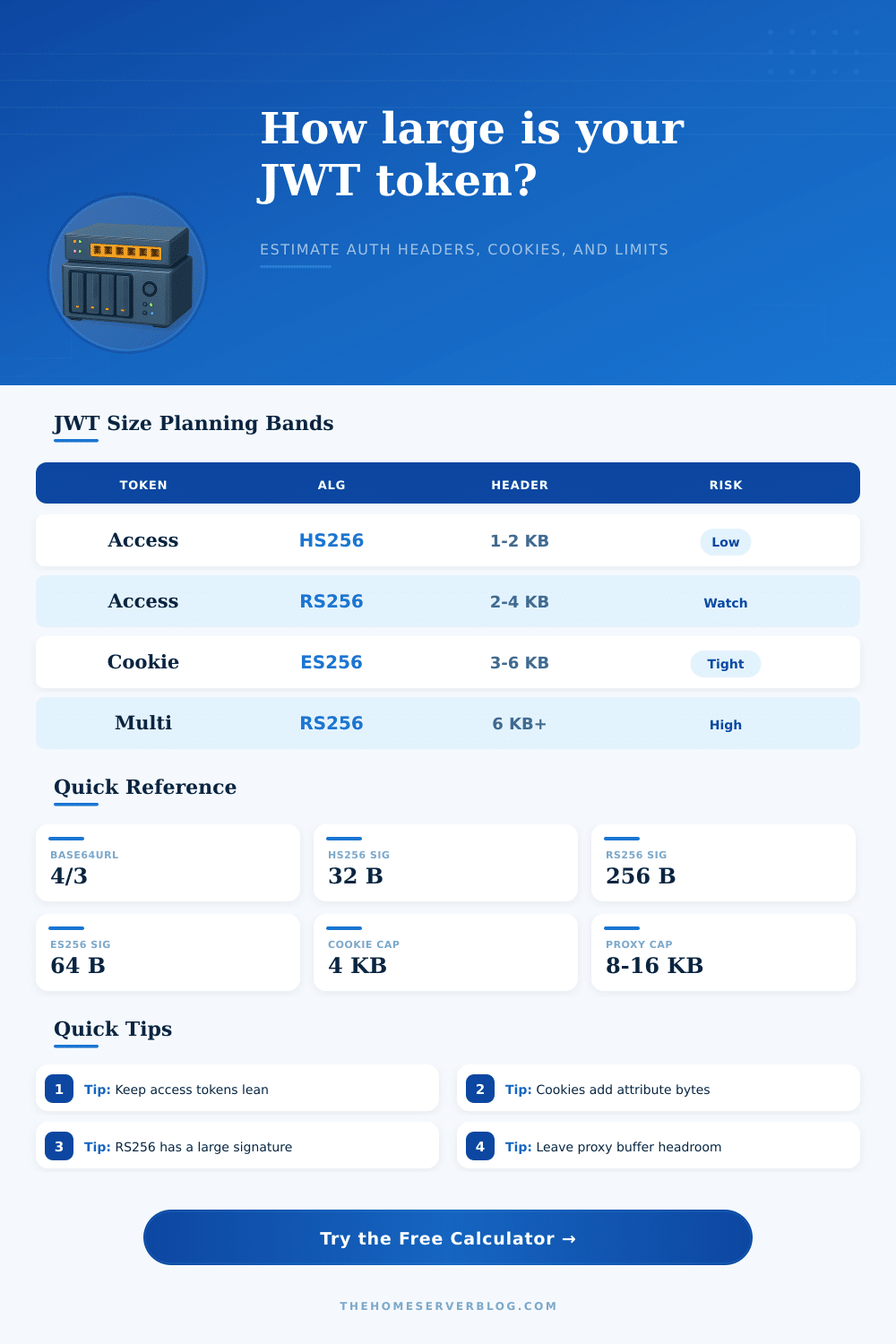
Surprisingly, the choice of signature algorithm are actualy the most common source of unexpected bloat. A compact 32-byte signature from a symmetric algo like HS256 is efficient when key sharing is considered secure. An asymmetric algorithm like RS256 offers more security isolation during public verification, but produces a 256-byte signature. That’s eight times biggerer, before you even consider encoding. Base64 encoding will tack on more than 300 chars onto your token string. When you add a CSRF marker, a refresh token, and a cookie for that token, you are nearing the four kilobyte limit many browsers impose. Reference tables shows how RS256 shoves tokens into the danger zone versus EdDSA or ES256 which maintain tight signatures with public keys.
However, this alters the size calculation completely depending on how it’s transported. Transporting the token as an authorization header is clean and predictable, just tack on a little prefix string and you’re done. Transporting it via cookies makes things all messy: name strings, separator strings, path attribute strings, etc… Every single relevant cookie are sent back to the browser along with every request made to that domain (including font requests, image requests, etc…) When that means you’re paying bandwidth tax on every load of CSS files when token is bloated. This is super important if your user base is mobile and has a metered connection.
You may gain some milliseconds from putting more information into the token during server side parse, but those will be lost a dozen times over in network transmission overhead. Standard JWTs don’t benefit much from compression, there’s no way to make their short headers compress well. And most proxies will remove compression headers before forwarding them upstream. Don’t fall into the trap of relying on payload compression; just cut down on your claims count.
Eliminate verbose role descriptions, avatar URLs, and display names from your access token completely. Use opaque ids instead, then have the server look up bulky information from a local database or cache once it verifies the signature. Prove minimal scope and identity; don’t turn the token into a portable user profile.
Keep an eye on proxy buffers as well; Ingress controllers such as Nginx set the default header limit to eight kilobytes. Anything larger than this buffer will drop your connection instantly with no retry attempt. When designing claims, shoot for less than a kilobyte (a conservative estimate) if at all possible so you leaves lots of room for growth while keeping your infrastructure stable.
It’s good practice to be disciplined about how you design your claims. Storage size isn’t the only thing that matter; there’s also a latency tax for it! Every extra byte on a token increases costs for everyone. Pick algorithms carefully, trim unneeded data early, and keep in mind the capacity of your network pipes. If you follow this advice, then your proxy will be able to handle any traffic spikes thrown its way.