📡 Parabolic Antenna Gain Calculator
Calculate dish antenna gain (dBi), beamwidth, and aperture efficiency for any frequency
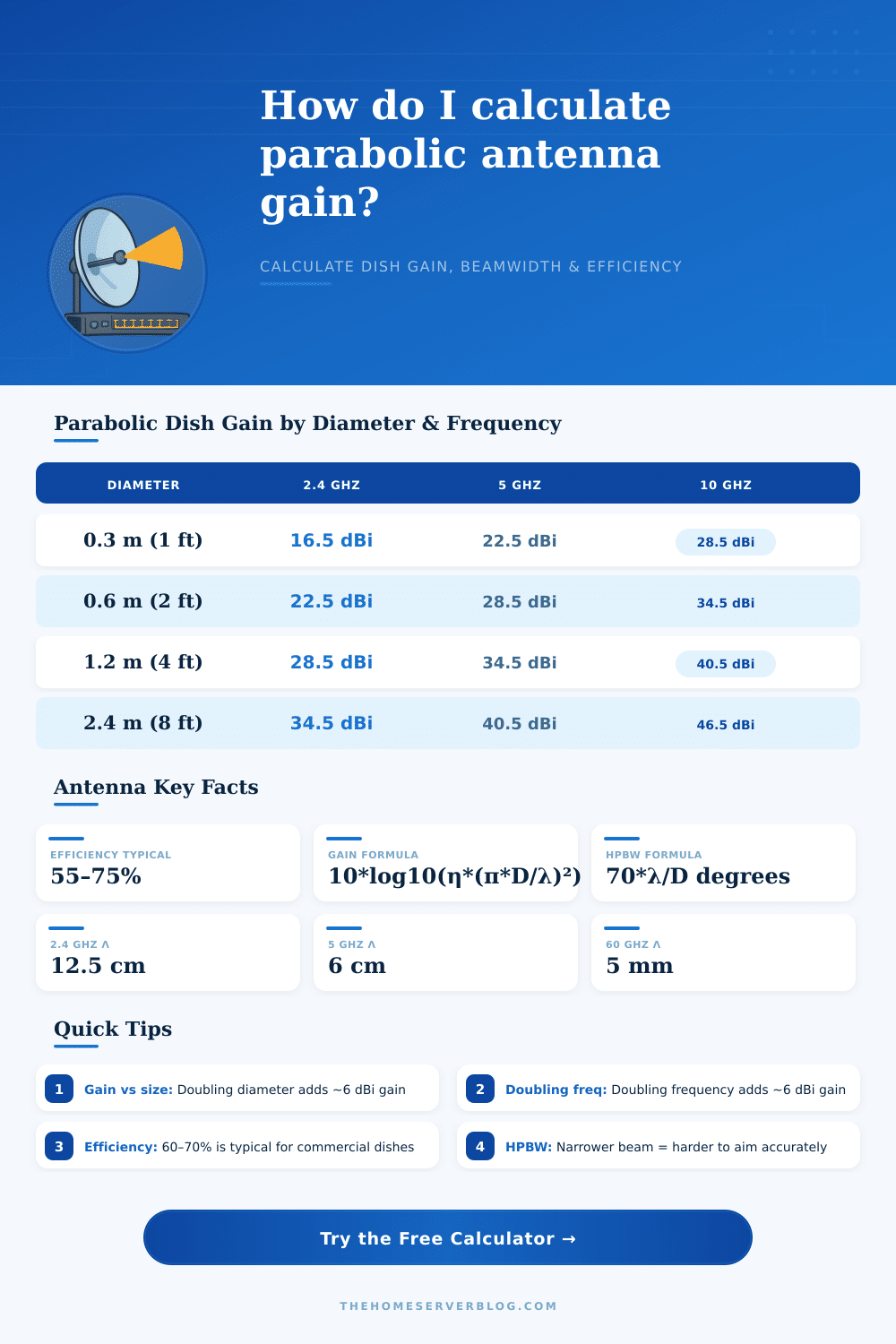
| Diameter | 900 MHz | 2.4 GHz | 5 GHz | 10 GHz | 60 GHz |
|---|---|---|---|---|---|
| 0.3 m (1 ft) | 10.3 dBi | 16.5 dBi | 22.5 dBi | 28.5 dBi | 44.1 dBi |
| 0.6 m (2 ft) | 16.3 dBi | 22.5 dBi | 28.5 dBi | 34.5 dBi | 50.1 dBi |
| 0.9 m (3 ft) | 19.4 dBi | 25.6 dBi | 31.6 dBi | 37.6 dBi | 53.2 dBi |
| 1.2 m (4 ft) | 22.3 dBi | 28.5 dBi | 34.5 dBi | 40.5 dBi | 56.1 dBi |
| 1.8 m (6 ft) | 25.4 dBi | 31.6 dBi | 37.6 dBi | 43.6 dBi | 59.2 dBi |
| 2.4 m (8 ft) | 27.3 dBi | 33.5 dBi | 39.5 dBi | 45.5 dBi | 61.1 dBi |
| 3.0 m (10 ft) | 28.9 dBi | 35.1 dBi | 41.1 dBi | 47.1 dBi | 62.7 dBi |
| Application | Frequency | Dish Size | Typical Gain | Beamwidth |
|---|---|---|---|---|
| WISP CPE | 5 GHz | 0.3–0.6 m | 22–28 dBi | 5–12° |
| WISP Tower | 5 GHz | 0.9–1.2 m | 31–34 dBi | 2–4° |
| Point-to-Point | 5.8 GHz | 0.6–0.9 m | 28–32 dBi | 3–6° |
| Satellite TV | 11–12 GHz | 0.6–0.9 m | 36–40 dBi | 1–2° |
| Amateur Radio | 2.4 GHz | 1.2–2.4 m | 28–34 dBi | 2–5° |
| 60 GHz Backhaul | 60 GHz | 0.3–0.6 m | 44–50 dBi | 0.5–1° |
A parabolic antenna, commonly called a dish antenna, is a kind of directional antenna with high gain, that uses a parabolic reflector. It works similarly to the reflector of searchlights or torches, to send radio waves in a narrow beam or receive them from one particular direction. Those antennas reach some of the highest gains between all types so they can create the narrowest beams.
Gain of an antenna outlines the ratio between the signal strength of the antenna and that of a standard antenna. For parabolic reflector antennas you count it regarding an isotropic source. A dipole antenna has 2.14 dBi.
How Dish Antennas Work
That value counts only in the distant field, in the near field it will be lower. You know them also as dish antennas, and they reach until 30 dBi or even more.
The radiation pattern of a parabolic antenna has a main lobe along the propagation axis, together with several small side lobes. With this reflector type you can reach very narrow beams. The gain results from the change of the pattern: it drops in some directions, to improve in one diretcion.
The bigger you make the dish, the higher gain it gets and the narrower the beam becomes. This is a simple result of energy conservation. Because with parabolic reflectors the bigger surface gives higher gain, if the feed lights up the whole reflector.
A 2.4-meter diameter parabolic antenna at C-band frequencies around 4 GHz reaches almost 40 dBi, while the same reflector at Ka-band frequencies near 30 GHz can surpass 55 dBi. For WiFi dish antennas the gains range from 18 dBi to 40 dBi between 2.4 GHz and 6.5 GHz, depending on the exact frequency range and diameter of the reflector.
For small beam widths, doubling the beam width you reach by halving the antenna diameter by a factor of 0.5. If you use 1.5-meter diameter instead of 3 meters for both sides, the need for power grows by a factor of 4 for both sides.
The key to very high gain on parabolic reflectors is the accuracy of curvature and focal position of the feed, which limits the maximum efficiency of the antenna. For satellite communication you use antennas with reflectors four high gain in long-range signal sending. That system mainly consists of a feeding antenna and a parabolic reflector, optimized for best performance.
Helical antennas work well as feeds for parabolic antennas and are relatively simple to build. The reflector shape stays parabolic for high frequencies, for maximum gain in horizontal and vertical and also circular planes.
You can design both parabolic and Yagi antennas with any gain and narrow beams. With Yagi it would be very long, with parabolic very wide. It is also possible to arrange several dish antennas on a frame, so that they move together.
But for EME applications the best way is simply to build abigger dish for bigger aperture and gain.