S3 Lifecycle Savings Calculator
Estimate storage class savings, expiration impact, monitoring overhead, transition payback, minimum duration exposure, and retrieval risk before changing an S3 lifecycle rule.
📌Lifecycle presets
⚙S3 lifecycle inputs
📊Lifecycle savings results
🧮Lifecycle impact summary
Rates vary by region, storage class, request type, object size, and retrieval tier. Use the calculator with the rates from your own AWS region and workload.
💾S3 storage class reference table
| Storage class | Best fit | Minimum duration | Retrieval profile |
|---|---|---|---|
| S3 Standard | Hot objects and unpredictable access | None | No retrieval processing charge in this model |
| S3 Standard-IA | Large objects with infrequent but fast reads | 30 days | Retrieval charge often matters above light access |
| S3 One Zone-IA | Recreatable data stored in one availability zone | 30 days | Similar access caution as Standard-IA |
| S3 Intelligent-Tiering | Unknown access patterns and automation | None for frequent tiers | Monitoring overhead matters for many small objects |
| S3 Glacier Instant Retrieval | Archive data needing milliseconds access | 90 days | Low retrieval % is important |
| S3 Glacier Flexible Retrieval | Archive data with minutes-to-hours restores | 90 days | Retrieval tier and restore volume drive risk |
| S3 Glacier Deep Archive | Long retention and rarely restored data | 180 days | High restore friction for active datasets |
📋Lifecycle comparison grid
| Lifecycle policy | Typical transition | Savings driver | Watch item |
|---|---|---|---|
| Logs to Standard-IA | 30 to 60 days | Warm logs stay searchable at lower storage rate | Frequent analytics scans |
| Backups to Glacier Instant Retrieval | 30 to 90 days | Backup sets become cheaper after restore window cools | Minimum 90-day storage |
| Archive to Flexible Retrieval | 90 to 180 days | Lower monthly storage for compliance archives | Restore speed and retrieval volume |
| Deep Archive retention | 180+ days | Very low storage rate for long-term records | Early deletes and restore delays |
| Expire staging objects | 7 to 30 days | Eliminates temporary build artifacts | Accidental deletion of active objects |
| Intelligent-Tiering | Automatic | Hands-off tier movement for uncertain access | Per-object monitoring overhead |
🔧Planning tips
There’s a folder on a project that went out of existence three years ago. There’s a backup of a server that was shut down last year. Perhaps there are a few terabytes of log files from an app no one cares about anymore. Cheap object storage gets realy expensive after a while. The problem is that people treats S3 as infinite free storage instead of what it is: a utility bill that accrues with every second.
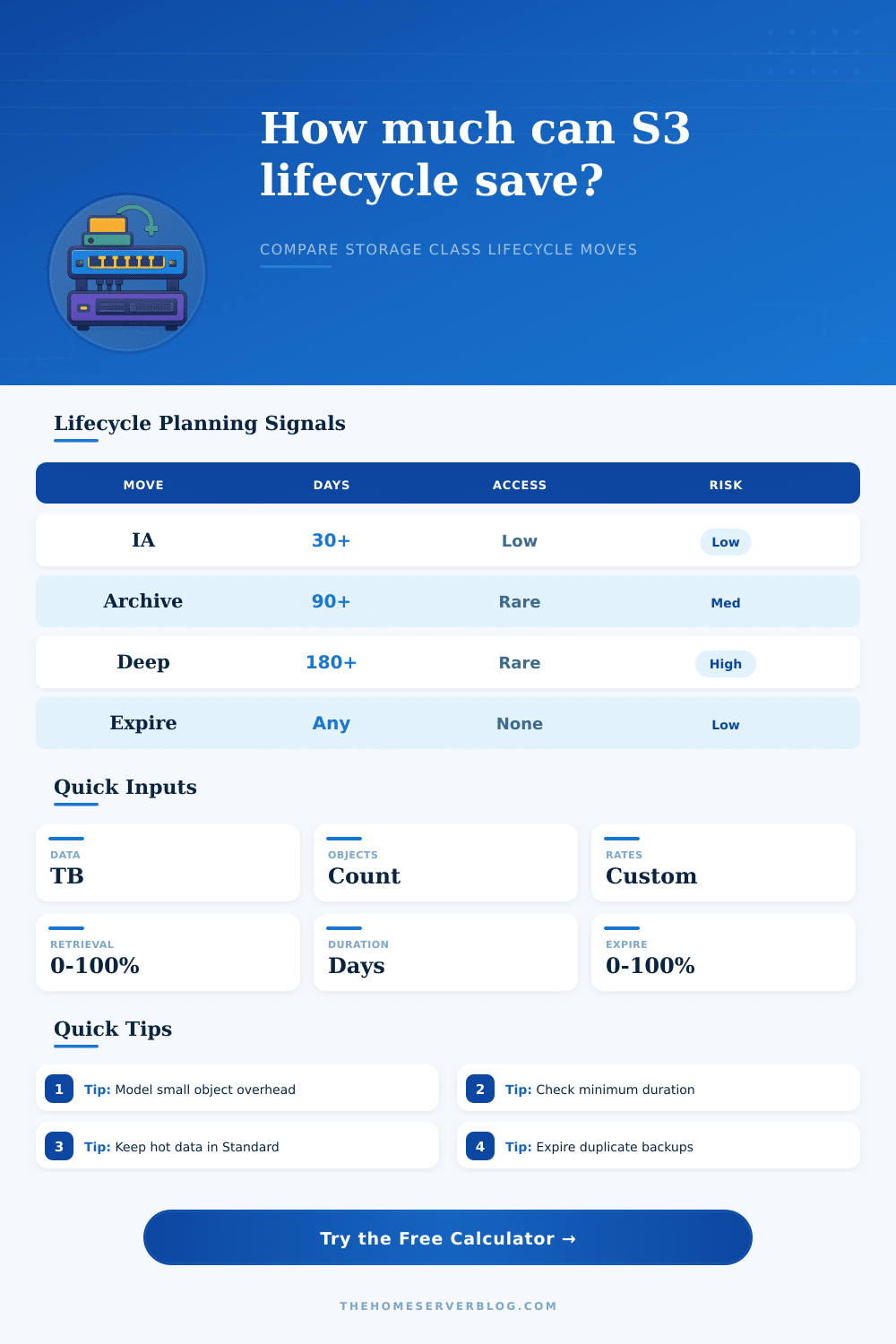
What most teams do is write a policy stating that cold data will be moved to some kind of archive storage, they then never calculate how this conflicts with their real-world access patterns and the fine print regarding retrieval fees and minimum duration. If you plug those values into the calculator above it’ll do the math for you, but how these numbers affects each other is what matters most.
The Real Cost of Cloud Storage
And here’s where folks get tripped up: they consider the price-per-month storage discount alone. On paper, moving from Standard to Glacier Deep Archive appears to be a huge savings (the per-gigabyte price drop significantly). But if you have 10,000 small objects rather than 100 large ones, that price savings vanish. You’re charged based on the number of objects, not their size. So even though the storage cost less, each transition request you make and every time someone has to monitor or access that data, it’s a per-thousand-objects fee. If you’ve chopped up your data into a million little files then that admin fee could far outweigh any storage savings.
The tool knows this, so you can input both your total terabytes as well as the number of objects to account for this. That object count and size difference is where so many budget quietly start to drain away. The other invisible variable is time. Many archive classes has a minimum length of storage, so even if you move something into an archive class but then delete it quickly, you’ll still get charged for the entire 90 or 180 day period. That’s a penalty area where lots of engineers gets caught on fast iteration cycles.
If you’re working on projects whose scope constantly shifts, you may save money deleting older items early before you incur both the minimum storage cost and switching penalty. By accounting for the percentage deleted and the assumed age when they’re removed, the calculator will illustrate the cost/benefit of expiration vs. Tiered storage policies.
And then there’s the human factor (the danger of having to retrieve it). You can model it all you like with a perfect access pattern, where no one touches the data once it moves to deep archive. Real life happens: Someone somewhere has to get at that log file from two years ago because it turns out that was the key piece they needed for the critical incident. When urgency sets in, the costs for restore time and data retrieval starts adding up fast.
That’s what the reference table on the page is getting at, matching storage classes against retrieval profiles so you can assess if millisecond access is required or your team can live with minute-long waits. This isn’t just about dollars saved, it’s about operational sanity. Then take into account smart tiering and the strategy changes yet again. Manual lifecycle rules are static, and while your data’s usage may be dynamic, it’s usually unpredictable. That’s why automatic tiering removes the guesswork from predicting cold data even though it adds some monitoring overhead.
Even though the base storage rates may appear higher at first glance, it’s worth plugging in the numbers for this one. Automation can saves you from having to pay high retrieval fees any time your hot data happens to get touched. At the end of the day, saving money on cloud storage isn’t about which bucket cost least. It’s about making sure that the lifecycle of your data matches its business value.
If no one reads your data, then it has zero business value…regardless of what it costs to store. More often than not, deleting old files pays off more different than complex tiering logic. With the calculator, you can put those abstract fears of over-provisioning into concrete numbers you can project on a monthly basis. It cuts through the disorderr that naturaly occurs within this system.
Now that you know what your digital junk actualy costs, letting go would of been the clear answer. Your data strategy finally grows along with your infrastructure. This stops your storage bill from continuing to grow.