🌐 Supernet Calculator
Aggregate multiple subnets into a single summarized route to reduce routing table size
🌐 Supernet Aggregation Results
255.255.0.0
255.255.128.0
255.255.192.0
255.255.224.0
255.255.240.0
255.255.248.0
255.255.252.0
255.255.254.0
255.255.255.0
| Input Networks | Supernet Result | Total Hosts | Waste IPs |
|---|---|---|---|
| 192.168.0.0/24 – 192.168.3.0/24 | 192.168.0.0/22 | 1,024 | 0 |
| 10.0.0.0/24 – 10.0.7.0/24 | 10.0.0.0/21 | 2,048 | 0 |
| 172.16.0.0/24 – 172.16.15.0/24 | 172.16.0.0/20 | 4,096 | 0 |
| 10.0.1.0/24, 10.0.2.0/24 | 10.0.0.0/22 | 1,024 | 512 |
| 192.168.1.0/25, 192.168.1.128/25 | 192.168.1.0/24 | 256 | 0 |
| 10.1.1.0/26 – 10.1.1.192/26 | 10.1.1.0/24 | 256 | 0 |
| 172.20.0.0/24 – 172.20.31.0/24 | 172.20.0.0/19 | 8,192 | 0 |
| CIDR Prefix | Subnet Mask | Wildcard Mask | Total Hosts |
|---|---|---|---|
| /16 | 255.255.0.0 | 0.0.255.255 | 65,536 |
| /17 | 255.255.128.0 | 0.0.127.255 | 32,768 |
| /18 | 255.255.192.0 | 0.0.63.255 | 16,384 |
| /19 | 255.255.224.0 | 0.0.31.255 | 8,192 |
| /20 | 255.255.240.0 | 0.0.15.255 | 4,096 |
| /21 | 255.255.248.0 | 0.0.7.255 | 2,048 |
| /22 | 255.255.252.0 | 0.0.3.255 | 1,024 |
| /23 | 255.255.254.0 | 0.0.1.255 | 512 |
| /24 | 255.255.255.0 | 0.0.0.255 | 256 |
| /25 | 255.255.255.128 | 0.0.0.127 | 128 |
| /26 | 255.255.255.192 | 0.0.0.63 | 64 |
| /27 | 255.255.255.224 | 0.0.0.31 | 32 |
| /28 | 255.255.255.240 | 0.0.0.15 | 16 |
| Scenario | Networks Combined | Resulting CIDR | Route Reduction |
|---|---|---|---|
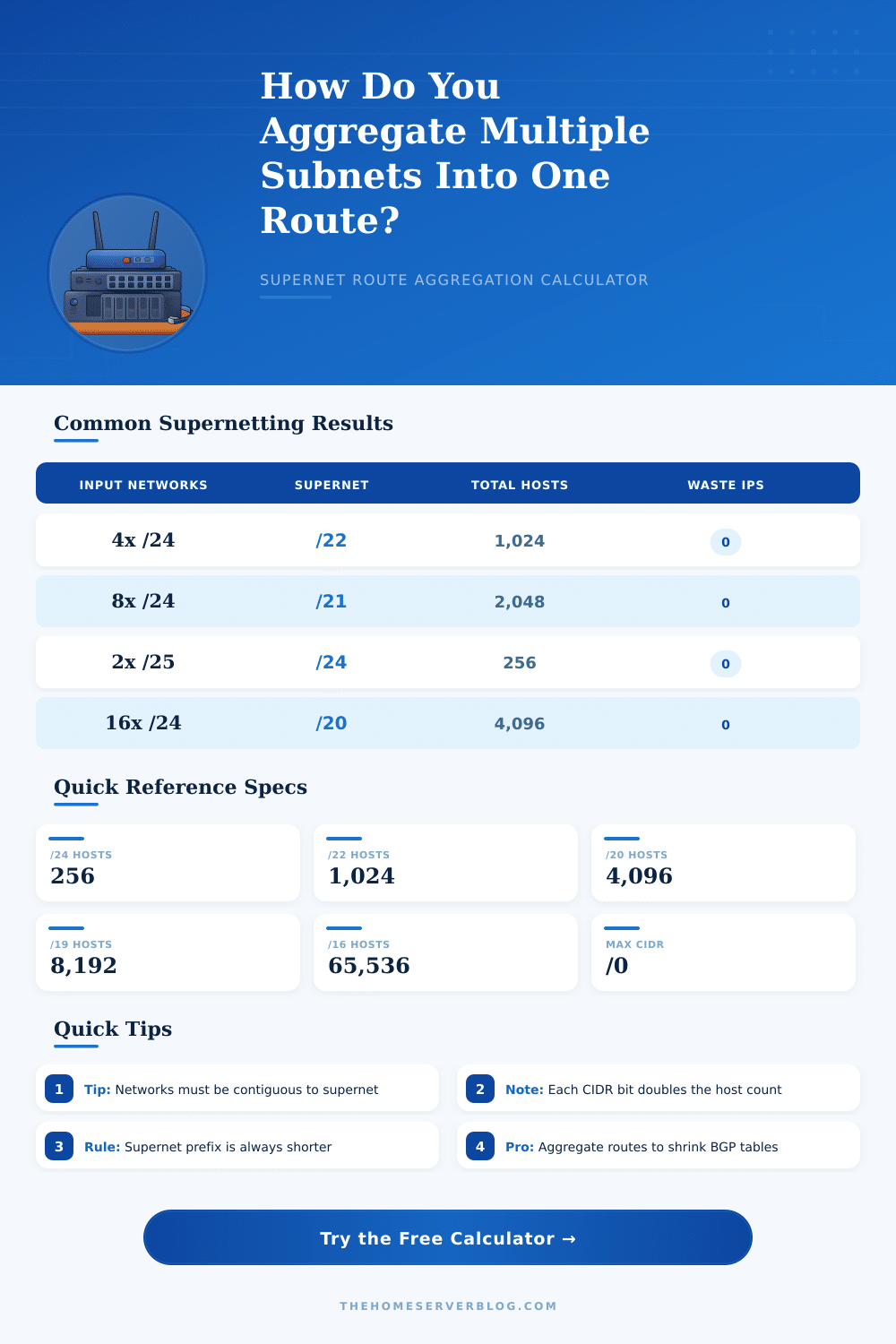
| Branch Office Consolidation | 4 × /24 | /22 | 4 → 1 route |
| Campus Building Summary | 8 × /24 | /21 | 8 → 1 route |
| Enterprise Edge Summary | 16 × /24 | /20 | 16 → 1 route |
| Data Center Pod | 32 × /24 | /19 | 32 → 1 route |
| ISP Customer Allocation | 256 × /24 | /16 | 256 → 1 route |
| Small Office Merge | 2 × /25 | /24 | 2 → 1 route |
| VLAN Aggregation | 4 × /26 | /24 | 4 → 1 route |
A supernet calculator is a kind of IP address calculator. It works almost the same as a subnet calculator, only that instead of handling subnets, it finds supernets. That program helps to combine several nets into supernets to simplify the summary of routes.
Because of that it shows very useful for network engineers, that want to keep their list of routes simple and clean.
How a Supernet Calculator Works
Some supernet calculators work as free network programs. For instance, one version allows users to enter series of IPv4 nets, after what it finds the best combined supernet routes to reduce the size of the list of routes. Other types of network tools give data about IPv4 subnets, using things like network class, IP address and subnet mask.
Those programs are quite simple to use. Simply type the network info, and the calculator cares about the rest.
There are also command line tools, that deal with supernet calculations. One type is a subnet calculator program called subcalc. It includes options like VLSM, FLSM, checking, IP lookup, range finding and supernet calculation.
Users can enter a regular network address in CIDR notation, for instance 192.168.0.0/24, and then run various kinds of calculations form that base.
A subnet calculator can work with IPv4 and IPv6 at the same time. Some programs handle both protocols and give info about IP address, network address, subnet mask, IP range and others. There are also really good professional CIDR calculators, designed for all CIDR and VLSM calculations.
One interesting point is, that supernets can be made using any subnet calculator, that supports classless IPv4. When one supernets a class-C address too /23, that does not turn it into a class-B address. That is a common mistake.
The result of supernet calculation is the smallest supernet, that holds all listed subnets. It can cover ranges, that did not belong to the original listed subnets, so that is worth remembering.
Here is a quick example. If one fills in with zeros, what gives 32 bits, and later converts the result to dotted decimal form with a route prefix, one could get a supernet like 192.168.0.0/21. Those steps help to combine several small nets into one big route.
There are even old class-based supernet calculators, that let you look at the old history of connections. They do not work for use in real networks. They serve more as a fun learning tool.
Some free subnet calculators are made for cloud platforms like AWS, Azure and GCP. In AWS the biggest subnet size is /16, while the smallest is /28. Using CIDR of /29 in AWS mode causes an error.
Building supernets or route summaries along the limits of bits isparticularly useful when managing network changes.