VoIP Codec Bandwidth Calculator
Estimate RTP voice bandwidth from codec bitrate, packetization interval, payload size, IP headers, Ethernet or WAN encapsulation, silence suppression, and concurrent calls.
🎙Named codec presets
⚙Call and packet inputs
Raw voice payload rate before RTP, UDP, IP, and link overhead.
Leave the preset value or edit for codec-specific framing.
Use 0% for no VAD. A practical planning value is often 20% to 40%.
Codec and overhead breakdown
📊Codec comparison grid
📘Codec reference table
| Codec preset | Bitrate | Typical ptime | Payload bytes | Common use |
|---|---|---|---|---|
| G.711 u-law / A-law | 64 kbps | 20 ms | 160 B | LAN phones, PBX trunks, toll-quality audio |
| G.729A | 8 kbps | 20 ms | 20 B | Low-bandwidth WAN calls where transcoding is acceptable |
| G.722 | 64 kbps | 20 ms | 160 B | HD voice on capable handsets and PBX systems |
| Opus voice / wideband | 24 to 32 kbps | 20 ms | 60 to 80 B | WebRTC, softphones, and adaptive audio paths |
| iLBC, GSM-FR, Speex | 13 to 16 kbps | 20 to 30 ms | 33 to 57 B | Legacy systems, remote desks, and lab compatibility tests |
🖧Encapsulation overhead table
| Mode | Extra bytes | Includes | When to use |
|---|---|---|---|
| IP layer only | 0 B | RTP, UDP, and IP header only | Compare codecs before link-layer planning |
| Ethernet LAN | 38 B | MAC header, FCS, preamble, and inter-frame gap | Switch ports, phone VLANs, and lab captures |
| VLAN tagged Ethernet | 42 B | Ethernet wire overhead plus 802.1Q tag | Voice VLANs and trunked switch ports |
| PPP / HDLC WAN | 6 B | Simple serial framing estimate | Router WAN sizing and compressed links |
| IPsec VPN tunnel | 74 B | Outer IP, ESP, padding allowance, and tunnel framing | Home office VPN voice paths |
⏱Packet interval impact table
| ptime | Packets/sec | Overhead behavior | Planning note |
|---|---|---|---|
| 10 ms | 100 per stream | Highest packet rate, lowest packetization delay | Useful for tight latency tests, heavier on routers |
| 20 ms | 50 per stream | Common default for SIP/RTP endpoints | Good baseline for LAN and WAN estimates |
| 30 ms | 33.3 per stream | Lower header overhead with more audio per packet | Seen with iLBC and some constrained links |
| 40 ms | 25 per stream | Lower bandwidth but more packetization delay | Check jitter buffer and endpoint support first |
💻Common VoIP sizing examples
| Scenario | Codec | Calls | Path | What to watch |
|---|---|---|---|---|
| Home PBX lab | G.711 | 4 | Ethernet voice VLAN | Switch QoS and packet captures |
| Remote office phones | G.729A | 8 | WAN or VPN | Licensing, transcoding, and tunnel overhead |
| Softphone team | Opus | 12 | Wi-Fi and internet | Airtime, jitter, and adaptive bitrate changes |
| HD handset rollout | G.722 | 20 | LAN access layer | Same bitrate as G.711, but wider audio quality |
💡Planning tips
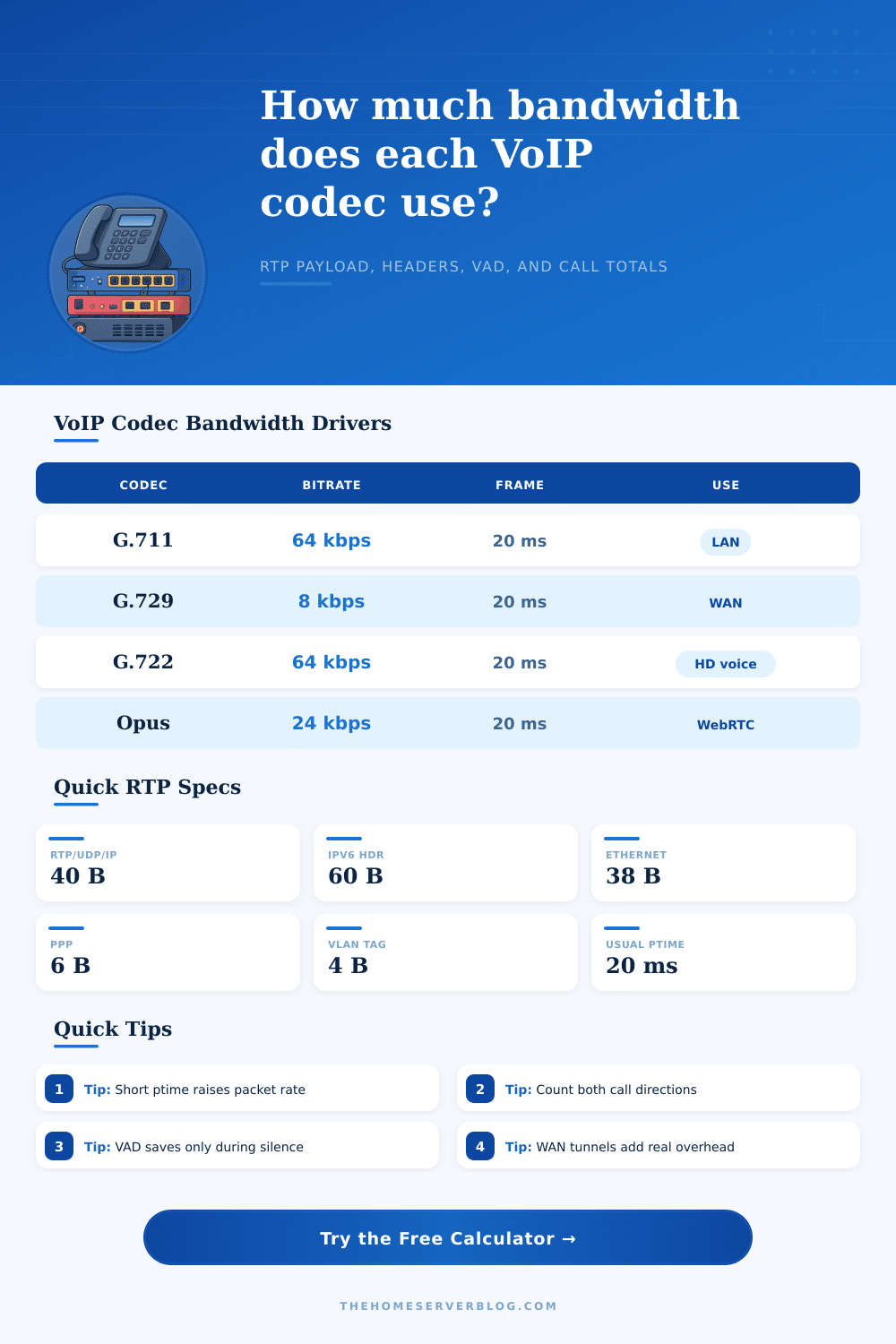
When you design a VoIP systems, bandwidth is critical to both call quality and the feasibility of call capacity. Bandwidth impact call quality, and bandwidth impacts call capacity. Bandwidth isnt the bitrate of the codec that is selected for VoIP calls.
Bandwidth is not the data payload that is used to carry voice information. Many peoples think only about the bitrate of the codec. That bitrate does not include the overhead of data protocols like RTP, UDP, and IP.
How to Calculate Bandwidth for VoIP Calls
That bitrate does not include the overhead of link-layer data protocols like Ethernet. Because data headers adds overhead to every packet of data, you must account for the data headers when calculating bandwidth requirement for a VoIP system. Another variable in the calculation of bandwidth for a VoIP system is the packet interval.
The packet interval impacts the number of packets that are sent over the network during a given time period. For instance, if the packet interval is 10 milliseconds, then twice as many packets will cross the network as if the interval are 20 milliseconds. Because each packet has its own headers, higher rates of packet intervals will result in a higher percentage of data being devote to headers.
This can be problematic for wide area network links with limited bandwidth. However, high packet rates will result in calls taking long to reach the remote call end station. Thus, there is a tradeoff between high packet rates (to minimize the effect of bandwidth limitations) versus low packet rates (to minimize the effect of high call delays).
The direction of a call will also impact the total bandwidth calculation. If calculating bandwidth for a call, the direction of the call will determine if the bandwidth requirement is calculated for one-way or two-way data. One-way data uses half the bandwidth than two-way data, as only one stream of audio data needs to travel the network between two call end points.
Since most calls are two-way calls, bandwidth should be calculated for two-way data to ensure that there is enough bandwidth to support both parties of the call. Silence suppression, also known as Voice Activity Detection (VAD), is another method of reducing the average bandwidth used by calls. Voice Activity Detection algorithms reduce the bandwidth used by VoIP calls by skipping packets during periods of silence.
VAD works best when used in lectures or call center scripts, when individuals has long periods of silence between statements. During a lively meeting, there is no silence so the VAD system will not reduce the bandwidth used by the calls. Thus, VAD should not be counted on to reduce bandwidth for VoIP calls, but should be accounted for in the bandwidth calculations with a specified buffer for bandwidth.
Another factor that impacts the bandwidth calculations for a VoIP system is the encapsulation protocols used on the data path. Data encapsulation protocols add bytes to each packet that travels over the network. For instance, Ethernet protocols adds bytes to packets that travel over a local area network.
Virtual Private Network (VPN) protocols and MPLS paths add even more bytes to the packets. These extra bytes are part of the bandwidth used by the calls, so they must be accounted for in the bandwidth calculations. Another factor that impacts bandwidth requirements is the number of concurrent calls.
The number of concurrent calls will determine the total amount of bandwidth that is used by all of the calls. The bandwidth of a single call can be multiplied by the total number of concurrent calls to determine the total bandwidth that will be used by all calls at once. For instance, if there will be one hundred calls concurrently, the bandwidth that a single call uses will be multiplied by a factor of one hundred to find the total bandwidth that will be used by one hundred calls.
Beyond the variables that must be accounted for in planning a VoIP system, there are also complications to VoIP bandwidth that will impact the bandwidth used by calls. For instance, calls use jitter buffers to equalize the arrival time of packets with variable distances traveled across the network. The use of jitter buffers adds delay to the audio calls.
Furthermore, bandwidth used over Wi-Fi networks can differ from bandwidth used over wired connections. Thus, Wi-Fi links may not perform the same as calculated even with the same bandwidth calculations. Additionally, transcoding calls from one codec to another consume the processing power of computers and introduces latency into the calls.
Background music also prevents silence detection protocols from working proper. These complications to VoIP calls mean that the VoIP network designer must include some extra headroom in the bandwidth calculations. To properly design a VoIP system, calculations must be performed for the bandwidth that will be used by each codec, each call path, and each call volume.
The results of these calculations will reveal how much bandwidth should be reserved for the VoIP system. If the calculated bandwidth is near the limit of the available bandwidth, then additional adjustment to the system should be made. For example, either the packet interval can be adjusted to reduce the amount of bandwidth used, or a lower-bitrate codec can be used for calls.
In either case, using a bandwidth calculator will allow the network designer to test these variables and arrive at a proper configuration without guessing at how many bits will be used for headers or at what rate the packets will cross the network.