1500VA UPS Runtime Calculator
Estimate battery runtime, load headroom, usable watt-hours, and shutdown margin for a 1500VA UPS protecting home servers, NAS boxes, routers, switches, and mini lab clusters.
1500VA UPS Runtime Results
| 1500VA UPS configuration | Typical internal battery | Usable energy range | Best home server use |
|---|---|---|---|
| Desktop standby UPS | 12 V, 9 Ah | 65 to 90 Wh | Router, modem, small switch |
| Line-interactive tower | 24 V, 7 to 9 Ah | 120 to 180 Wh | NAS, mini PC, network core |
| Line-interactive rackmount | 24 V or 48 V pack | 150 to 250 Wh | Rack server plus switch |
| Online double-conversion | 48 V pack | 160 to 300 Wh | Voltage-sensitive lab stack |
| Load scenario | Typical watts | Planning VA | Runtime target |
|---|---|---|---|
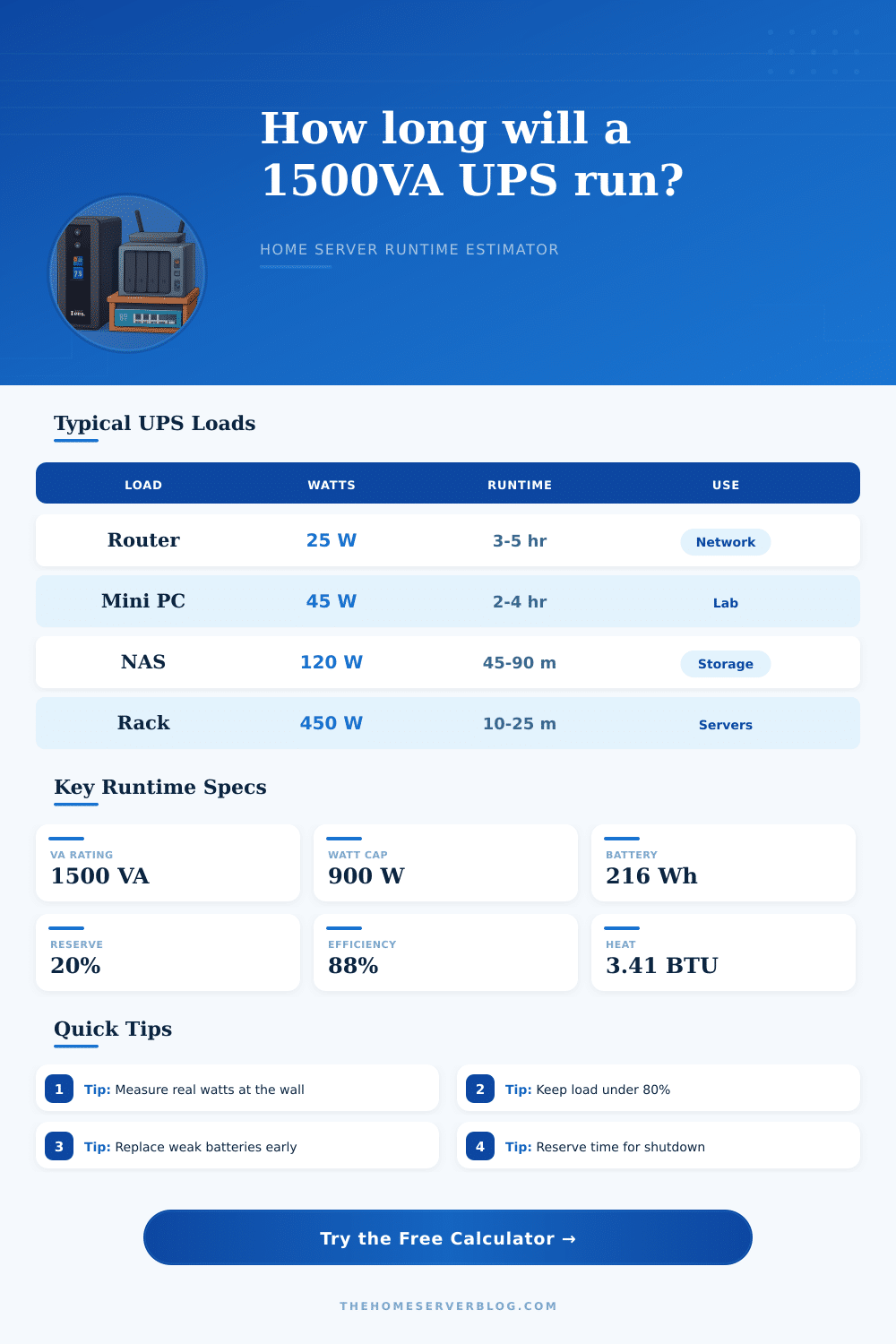
| Internet uptime only | 20 to 45 W | 25 to 60 VA | 2 to 6 hours |
| Mini PC and NAS | 80 to 180 W | 110 to 250 VA | 35 to 120 minutes |
| PoE switch and cameras | 120 to 300 W | 170 to 430 VA | 20 to 75 minutes |
| Rack server workload | 350 to 700 W | 440 to 900 VA | 5 to 25 minutes |
| Runtime formula item | Calculator treatment | Why it matters | Practical limit |
|---|---|---|---|
| VA rating | Load VA divided by UPS VA | Protects inverter apparent power | Stay under 80% |
| Watt rating | Buffered watts divided by watt cap | Prevents overload shutdown | Stay under 80% |
| Battery energy | Volts multiplied by Ah and strings | Sets theoretical stored Wh | Derate for age |
| Reserve margin | Subtracts shutdown reserve | Leaves time for clean poweroff | 10% to 25% |
| Common project size | Equipment count | Primary result | Secondary result |
|---|---|---|---|
| Network closet backup | 3 to 5 devices | Multi-hour runtime | Very low heat load |
| Quiet NAS corner | NAS plus switch | One maintenance window | Plenty of VA headroom |
| Proxmox mini cluster | 3 nodes plus storage | Graceful shutdown time | Moderate battery wear |
| Small rack lab | Server, NAS, PoE | Short ride-through | High watt percentage |
A 1500VA UPS are a device that protects electronic equipment from power outages. When an outage occur, the 1500VA UPS will provide battery power to the equipment for a limited time. When you are using a 1500VA UPS, you will encounter two power ratings for the device: the VA (Volt-Ampere) rating and the wattage rating.
The VA rating measure the apparent power of the device and is the larger of the two ratings. The wattage rating, however, measures the real power of the device and is the one that will limit the amount of equipment that the 1500VA UPS can operate. For example, a 1500VA UPS may only be able to provide 900 watt of power to connected devices.
What a 1500VA UPS Is and How It Works
When the 1500VA UPS is working near its VA rating, the inverter within the UPS will have to work harder to provide that power. As a result of the inverter working harder, the inverter will produce more heat within the 1500VA UPS, which can shorten the runtime of the UPS. The battery capacity of the 1500VA UPS will determine the amount of energy that the UPS can provide to the connected equipment.
1500VA UPS units typically use a small number of internal battery to store the energy that the UPS will provide to the equipment. For instance, many 1500VA UPS units use a pair of 9Ah batteries. The energy that the internal batteries can provide is slightly less then the theoretical amount of energy due to the efficiency of the inverter and the batteries themselves.
Additionally, 1500VA UPS units often come with battery compartments where you can install external battery packs. Installing external battery packs will increase the amount of time that the 1500VA UPS will provide power to the equipment but will also increase the amount of time that the 1500VA UPS will take to charge and will produce more heat. A calculator is available to model the addition of external battery packs to determine if they will provide the amount of additional time that you require.
The equipment you will connect to a 1500VA UPS will determine how long that UPS can operate. Equipment with a small wattage draw will allow the 1500VA UPS to run for longer periods than equipment with a higher wattage draw. For instance, a 1500VA UPS with a 900-watt capacity will last longer if the equipment it is powering is simply a router than if it is trying to power a NAS drive with spinning disks.
Furthermore, the length of time that the 1500VA UPS will run the connected equipment is not a linear relationship to the amount of wattage of the connected devices. Instead, when the load placed upon the 1500VA UPS is above half of its wattage rating, the voltage provided by its batteries will sag more quick and its usable minutes will drop more quickly. Thus, instead of simply reading the wattage specifications of the devices you plan to use, it is better to measure the wattage of the devices that will be connected to your 1500VA UPS.
An aspect of a 1500VA UPS that allows for an automatic shutdown of connected computers is known as shutdown automation. In order to calculate the length of time that your 1500VA UPS will have to provide power to your equipment before the shutdown automation process occur, you must provide a percentage value for the percentage of the batteries that will be reserved for the automation process. If the 1500VA UPS contains an aging battery that may not be able to store as much power as when it was new, providing a higher percentage for the reserve of the UPS will ensure the automation process is still able to complete when the batteries are low in charge.
Additionally, the inverter within a 1500VA UPS converts DC to AC power. Every watt of power that the inverter produces creates heat. The heat that is created may increase the temperature of the data closet in which the 1500VA UPS is located or the temperature of the batteries themselves.
If the UPS is located in a small closet that has no means of venting heat out of the closet, the UPS may overheat. Thus, providing ventilation for the space in which the 1500VA UPS is located may be required. Finally, another calculation that you can perform with the calculator is to determine the length of time that is considered to be sufficient for your needs.
For some individuals, a longer runtime of the 1500VA UPS is desired so that their network equipment will not have to be shut down during a storm. For others, however, the runtime of the UPS is not necessary beyond providing enough time for the equipment to be safely shut down. The calculator can be used to enter the wattage of the devices and the required reserve percentage to determine if the 1500VA UPS is of the appropriate size for the individuals equipment.
Through the calculator, the user can determine the trade-off that exist between the load on the UPS, the battery capacity of that UPS, and the runtime of that UPS. Through these determinations, the individual can make a decision as to whether or not the 1500VA UPS will meet there requirement.