Eaton UPS Runtime Calculator
Estimate backup minutes for Eaton 3S, 5S, 5P, 5PX, and 9PX home lab UPS choices using load, battery age, temperature, reserve time, and EBM count.
⚡Eaton-specific presets
🔌Runtime inputs
Runtime is an engineering estimate from Eaton-family runtime anchors and load-curve interpolation. Eaton runtime graphs and live UPS telemetry should be used for final shutdown policies.
🔧Selected UPS spec grid
📊Eaton model runtime anchors
| Model preset | Rating | Topology | Estimated half-load runtime | Estimated full-load runtime |
|---|---|---|---|---|
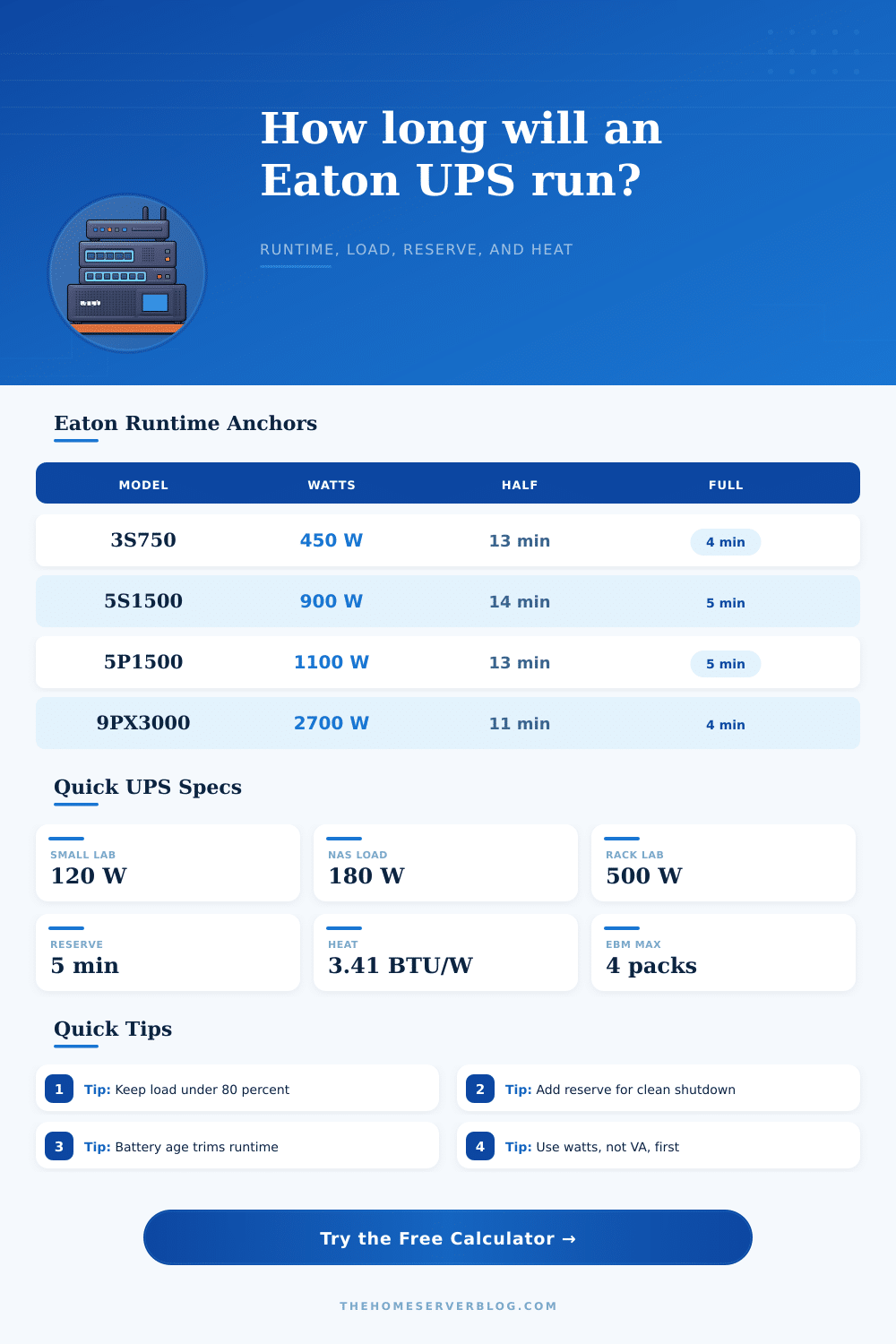
| 3S750 | 750 VA / 450 W | Offline standby | 13 min at 225 W | 4 min at 450 W |
| 5S1500LCD | 1500 VA / 900 W | Line-interactive | 14 min at 450 W | 5 min at 900 W |
| 5P1500RC | 1440 VA / 1100 W | Line-interactive sine | 13 min at 550 W | 5 min at 1100 W |
| 5PX1500RT | 1440 VA / 1440 W | Line-interactive | 15 min at 720 W | 5 min at 1440 W |
| 9PX3000RT | 3000 VA / 2700 W | Online double-conversion | 11 min at 1350 W | 4 min at 2700 W |
🔋Battery and EBM reference
| Eaton family | Battery style | EBM support in this calculator | Best home lab fit |
|---|---|---|---|
| 3S | Sealed lead-acid | Internal only | Modem, router, ONT, small switch |
| 5S | Sealed lead-acid with ABM charging | Internal only | Desktop NAS, mini PC, small lab shelf |
| 5P rack | Sealed lead-acid | Internal only for listed RC presets | Short-depth rack, PoE switch, NAS pair |
| 5PX rack | Sealed lead-acid | Up to 4 EBMs in supported series | Virtualization host and storage rack |
| 9PX rack | Hot-swappable lead-acid | Up to 4 EBMs in supported series | Edge rack with sequenced shutdown |
🌡Runtime adjustment factors
| Adjustment | Calculator value | Runtime impact | When to use it |
|---|---|---|---|
| Future load buffer | 0% to 20% | Raises calculated load before runtime | Planned disks, PoE cameras, or added nodes |
| Battery age | 50% to 100% | Scales runtime capacity | Older sealed lead-acid packs or unknown history |
| Closet heat | 75% to 100% | Reduces runtime in warmer rooms | Unvented racks, top shelves, garage spaces |
| Reserve time | 0 to 15 min | Subtracted from usable shutdown window | Keep margin before low-battery cutoff |
🖥Common home lab load examples
| Equipment group | Typical watts | VA note | Runtime priority |
|---|---|---|---|
| ONT, router, one 8-port switch | 25 W to 60 W | Usually low VA | Longest runtime target |
| Mini PC firewall plus AP controller | 45 W to 100 W | Power brick dependent | Network continuity |
| 4-bay NAS with disks active | 70 W to 160 W | Spin-up can be higher | Clean file-system shutdown |
| PoE switch with APs | 90 W to 300 W | Include PoE budget used | Drop noncritical ports first |
| Single server host | 180 W to 500 W | High PF server PSUs | VM sequence before host off |
| Dense edge rack | 700 W to 1800 W | Check circuit and plug | Use online UPS and EBMs |
💡Runtime planning notes
A power outage will interrupt the operations of the servers, storage, and network gears in your server rack. Additionally, a power outage can cause many hour of recovery work if the power outage isnt managed proper. To determine how long the batteries will provide power during a power outage, you must consider factors like the load on the battery, the health of the battery, and the temperatures of the battery.
The calculator can estimate the runtime of the battery, and this will provide more accuracy than if you guessed at the amount of time the battery would last during a power outage. Eaton manufacture several lines of UPS equipment for home-lab environments of different sizes. Each line of Eaton UPS equipment can provide more or less power than the numbers indicates for the model of the UPS equipment.
How Long Will Your UPS Batteries Last
The calculator will determine the amount of time that the UPS will last during a power outage if you enter the model of the UPS, the load on the system, the health of the battery, and the environmental condition for the UPS. The health of the battery can have a significant influence on the amount of time that the UPS will run on battery power. For example, a battery that is one year old and has 90% of it’s capacity can last longer than a three-year-old battery with 65% of its capacity.
Each battery may not provide the same amount of power due to the aging of the batteries. Another critical factor to consider is the load that is place on the UPS during the power outage. If a UPS can run a computer for fourteen minutes at half of its wattage, it may only run for five minutes if the load is at full power.
The calculator includes the effects of temperature and external battery module. If the temperature in the server room is too high for the UPS, it will reduce the amount of time that the UPS will last on battery power. Additionally, adding external batteries will increase the amount of time that the UPS can last, but each additional external battery will provide less time than the previous added battery.
Power factor is another input that you can use to calculate the runtime of a UPS. Desktop computers usually have a power factor of 0.8, but the power factor of moddern server systems is 0.9 or higher. Enter the power factor of the computers in your system when using the calculator.
The calculator provides several different outputs that help the server administrator to make decisions during the power outage. Runtime will provide the amount of time that the batteries can last before they reach the reserve threshold. The usable shutdown window will subtract the reserve threshold from the runtime and provide the amount of time to shutdown the servers.
Headroom will provide the additional amount of wattage that can be added to the servers before the UPS reaches its overload state. The heat output will show the amount of heat that the rack of servers produce based off the load that is placed on the UPS. This output helps to determine if the rack of servers requires additional amounts of airflow.
The amount of time that the UPS batteries will last can help determine the shutdown sequence of the servers. For example, if a four-bay NAS takes three minutes to complete its file system shutdown, the virtualization host may take eight or ten minutes to shutdown all of its virtual machine. In this example, the target will need to be higher than the calculated amount of time from the UPS battery calculator.
This will allow for errors in the shutdown sequence and for the UPS batteries to be in better condition when they are fully depleted. The chemistry of the UPS batteries will last for a specific amount of time. Sealed lead-acid batteries will lose their capacity after the second year.
Deep discharging of the batteries will shorten the life of the batteries. Some server administrators will replace the batteries in their UPS systems on a regular schedule. Others will purchase additional battery modules for the UPS to provide more runtime for the servers during a power outage.
Another factor to consider when purchasing a UPS is the wattage that the computers in the data center will draw from the UPS. Routers and switches that draw 45 watts each will run for a longer time on a small UPS than a server that draws 500 watts. These wattage measurements are more accurate than the values that is set for the different UPS models in the calculator.
The temperature of the room can have a significant effect on the amount of time that the UPS will last on battery power. If the temperature in the data center is too high for the UPS, the batteries will break down and last for less time. Moving the UPS to a cooler location or adding a fan could allow the UPS to provide more runtime on battery power.
Additionally, placing the UPS off the floor will allow more airflow to the battery compartment. This will extend the amount of time that the UPS will provide power to the servers during a power outage.