Antenna Gain Beamwidth Calculator
Estimate realized gain, azimuth beamwidth, elevation beamwidth, and far-field distance for dishes, panels, yagis, horns, and more.
Full Breakdown
| Family | Gain model | Beamwidth model | Best use |
|---|---|---|---|
| Parabolic dish | 4πA/λ2 | 70λ/D | Long point links |
| Panel / horn / sector | 4πA/λ2 | 58λ/W,H | Campus or AP use |
| Yagi | Empirical | 155/√G | Directional receive |
| Collinear / helix | Empirical | Az 360 / El model | Omni or circular |
| Band | Wavelength | Common antenna | Typical fit |
|---|---|---|---|
| 433 MHz | 69 cm | Collinear | Garage links |
| 900 MHz | 33 cm | Yagi | Rural telemetry |
| 2.4 GHz | 12.5 cm | Panel | Mesh backhaul |
| 5.8 GHz | 5.2 cm | Dish | Bridge links |
| Loss input | Typical range | Effect | Note |
|---|---|---|---|
| Taper loss | 0.5-2 dB | Lowers gain | Tames sidelobes |
| Feedline loss | 0.2-3 dB | Direct subtraction | Coax and pigtails |
| Pol mismatch | 0-3 dB | Cross-pol penalty | Check rotation |
| Pointing error | 0-5 dB | Depends on beam | Narrow beams hurt |
| Preset | Type | Gain goal | Beam goal |
|---|---|---|---|
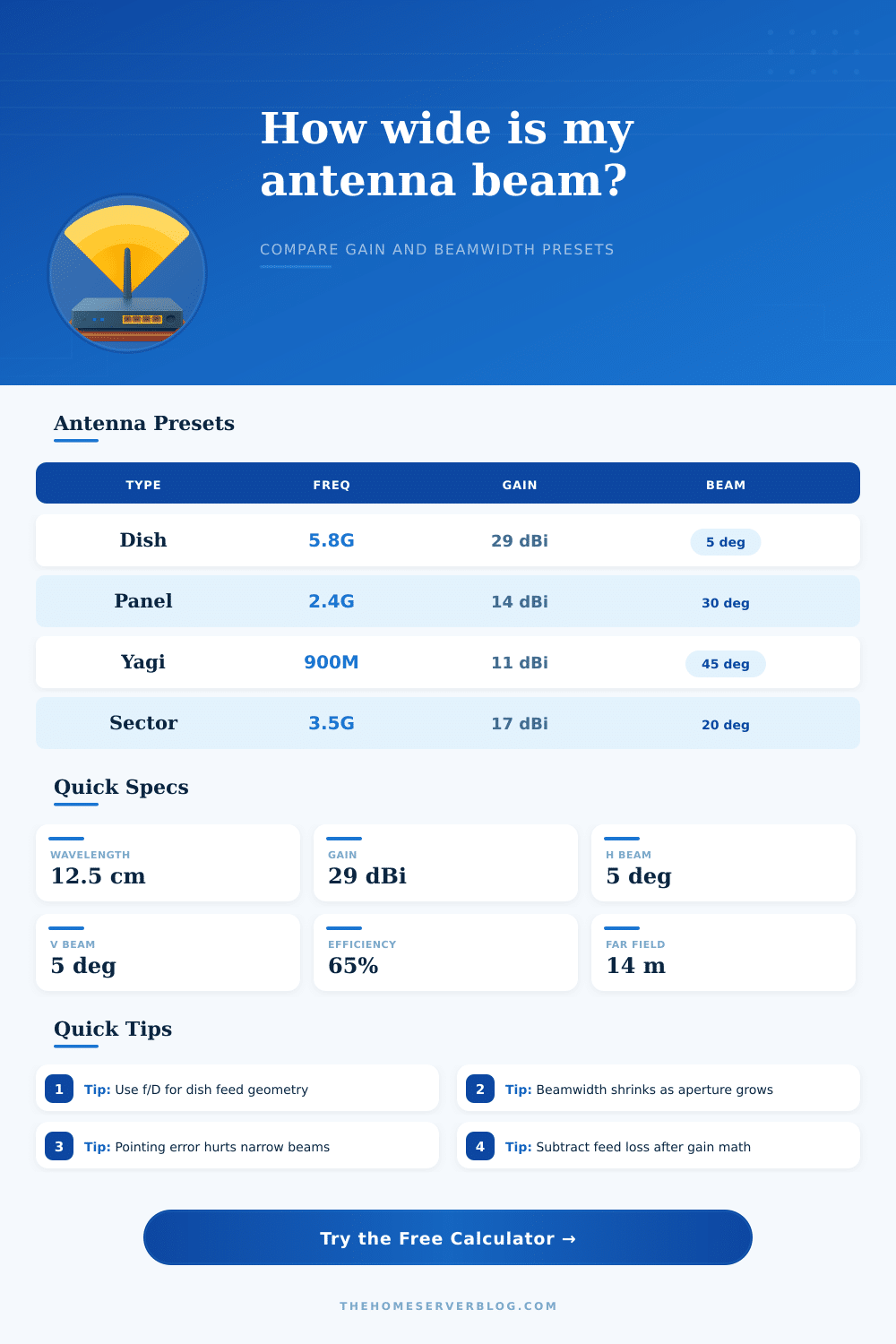
| 2.4 GHz rooftop | Panel | 14 dBi | 30 deg |
| 5.8 GHz bridge | Dish | 29 dBi | 5 deg |
| 900 MHz yagi | Yagi | 11 dBi | 45 deg |
| 3.5 GHz sector | Sector | 17 dBi | 20 deg |
Realized gain is the modeled antenna gain after efficiency, taper, feedline, polarization, and pointing losses are applied to the same geometry.
Antenna gain and antenna beamwidth are two related properties of an antenna. Antenna gain and antenna beamwidth dictate how the antenna distribute the signals in the surrounding space. Antenna gain describe how focused the energy radiated from the antenna is; the more higher the antenna gain, the more focused the energy.
Antenna beamwidth, which is the width of a cone containing the strongest signal radiated from the antenna, describes the range of angles within which the antenna can radiate its signal. Antennas with higher gain has narrower beamwidths. Antennas with narrow beamwidths have their signal focused into a smaller portion of the surrounding space.
How Antenna Gain and Beamwidth Work
If the narrow beam of an antenna is aimed incorrect, the signal strength will drop. Antennas with wide beamwidths allow the antenna to be less precise with the direction of the antenna, but have lower gain. The relationship between antenna gain and antenna beamwidth is related to the physical size of the antenna.
As the physical size of the antenna increase, so does the antenna gain. For instance, if a parabolic dish antenna is twice as wide than another parabolic dish antenna, the wider antenna will have more gain and a narrower beamwidth. The wider antenna will have more gain because it has more surface area to reflect the signal, but it will have a narrower beamwidth because the signal is reflected from a larger surface area and is therefore more focused.
Thus, antenna gain and antenna beamwidth are inversely related to one another; as one increases, the other decrease. Many factor can lead to signal loss from an antenna installation. Antenna pointing error can cause signal loss; however, the effect of antenna pointing errors is more detrimental on antennas with narrow beamwidths.
Polarization skew can also cause signal loss, which occur when the transmitting and receiving antennas dont have the same plane of polarization. Signal loss can also occur along the coaxial cable that connect the antenna to the radio transmitter and receiver, as well as due to the way in which the signal illuminates the antenna’s surface area. Each of these factors will reduce the actual gain that the antenna can achieve, as compared to the theoretical antenna gain.
The beamwidth of the antenna that should be selected depends upon the needs of the wireless network that is to be created. For point-to-point links between two locations, one should of use an antenna with high gain and narrow beamwidth. For links between a wireless access point to many wireless devices, one should use an antenna with lower gain and high beamwidth.
Many antenna installation professional make the mistake of selecting an antenna with the highest possible gain. High gain antennas has narrow beamwidths, which may be more difficult to aim correctly. Finally, the frequency at which the antenna will operate will also affect the gain and beamwidth of the antenna.