Dish Antenna Gain Calculator
Estimate dish antenna gain, beamwidth, and target margin for microwave reflector links.
Full Breakdown
| Band | Range | Wavelength | Typical use |
|---|---|---|---|
| C downlink | 3.7-4.2 GHz | 7.5-8.1 cm | Rain tolerant receive links |
| C uplink | 5.925-6.425 GHz | 4.7-5.1 cm | Earth station uplinks |
| Ku band | 10.7-12.75 GHz | 2.4-2.8 cm | TV and VSAT terminals |
| Ka band | 17.7-31.0 GHz | 1.0-1.7 cm | High throughput gateways |
| Dish size | Gain @12 GHz | Beamwidth | Common use |
|---|---|---|---|
| 45 cm | 33.2 dBi | 4.4 deg | Portable Ku receive |
| 60 cm | 35.7 dBi | 3.3 deg | Home TV and light VSAT |
| 90 cm | 38.3 dBi | 2.2 deg | Stronger Ku or C receive |
| 1.2 m | 41.6 dBi | 1.6 deg | Earth station and hub links |
| Loss source | Typical dB | Good practice | Why it matters |
|---|---|---|---|
| Feed network | 0.3-0.8 | Keep run short | Reduces usable drive power |
| Radome | 0.1-0.5 | Use low-loss cover | Ka bands are sensitive |
| Pointing | 0.2-1.5 | Align carefully | Small beams miss fast |
| Polarization | 0.1-0.4 | Check skew | Cross-pol rejection matters |
| Scenario | Band | Dish size | What to watch |
|---|---|---|---|
| TV receive dish | Ku downlink | 45-60 cm | Rain fade and roof view |
| VSAT uplink | Ku uplink | 75 cm-1.2 m | BUC power and alignment |
| Gateway earth station | Ka uplink | 1.2-2.4 m | Pointing and radome loss |
| C-band hub | C uplink | 3.7-4.5 m | Feed support and wind load |
This calculator keeps reflector gain, aperture size, and loss budget separate so you can see where the final link number really comes from.
Dish antenna gain measure how much a dish antenna increase the strength of a signal. The gain of a dish antenna determine how effectivly the antenna can collect microwaves. Antenna gain is a product of several physical factor of the antenna, such as the diameter of the antenna, the frequency of the signal, and the efficiency of the antenna.
The diameter of the dish antenna can impact the gain of the antenna; the larger the antenna, the more microwave the antenna will catch, thereby increasing the gain of the antenna. Antenna gain and frequency has a correlation with the beamwidth of the antenna; the higher the frequency of the signal, the more focused the signal will be from the antenna. A narrower beamwidth require more precision in the alignment of the antenna.
Dish Antenna Gain and What Affects It
The efficiency of a dish antenna is also a physical factor that impact the gain of the antenna. Antenna efficiency determine the signal strength of the antenna. Many antenna are not as efficient as they could be due to several physical factor that impact the efficiency of the antenna.
Factors such as the feed arm blocking the signal, the ripples on the surface of the dish antenna, and the spillover of the signal from the feed horn to the empty sky all has the potential to impact the efficiency of the antenna. The efficiency of an antenna is related to the shape of the antenna as well. A dish antenna with a better shape than other of the same size will have a higher degree of efficiency.
While not a factor in determining the gain of a dish antenna, losses must be considered in relation to the performance of a dish antenna. Pointing error in the antenna can cause losses in the signal strength; these errors are especially problematic for Ka-band links. Ka-band links use high frequencies that has narrow beamwidths.
Polarization skew can also lead to signal loss; skew occur when the dish antenna isnt perfectly aligned with the polarization of the incoming signal. Since these losses can occur, a person must include a margin in the calculations for the performance of the antenna to account for these losses. Although a person might look at the gain of a dish antenna, the raw gain of the antenna will be higher than the actual signal strength; the losses in the antenna will lower the signal strength that the antenna emit.
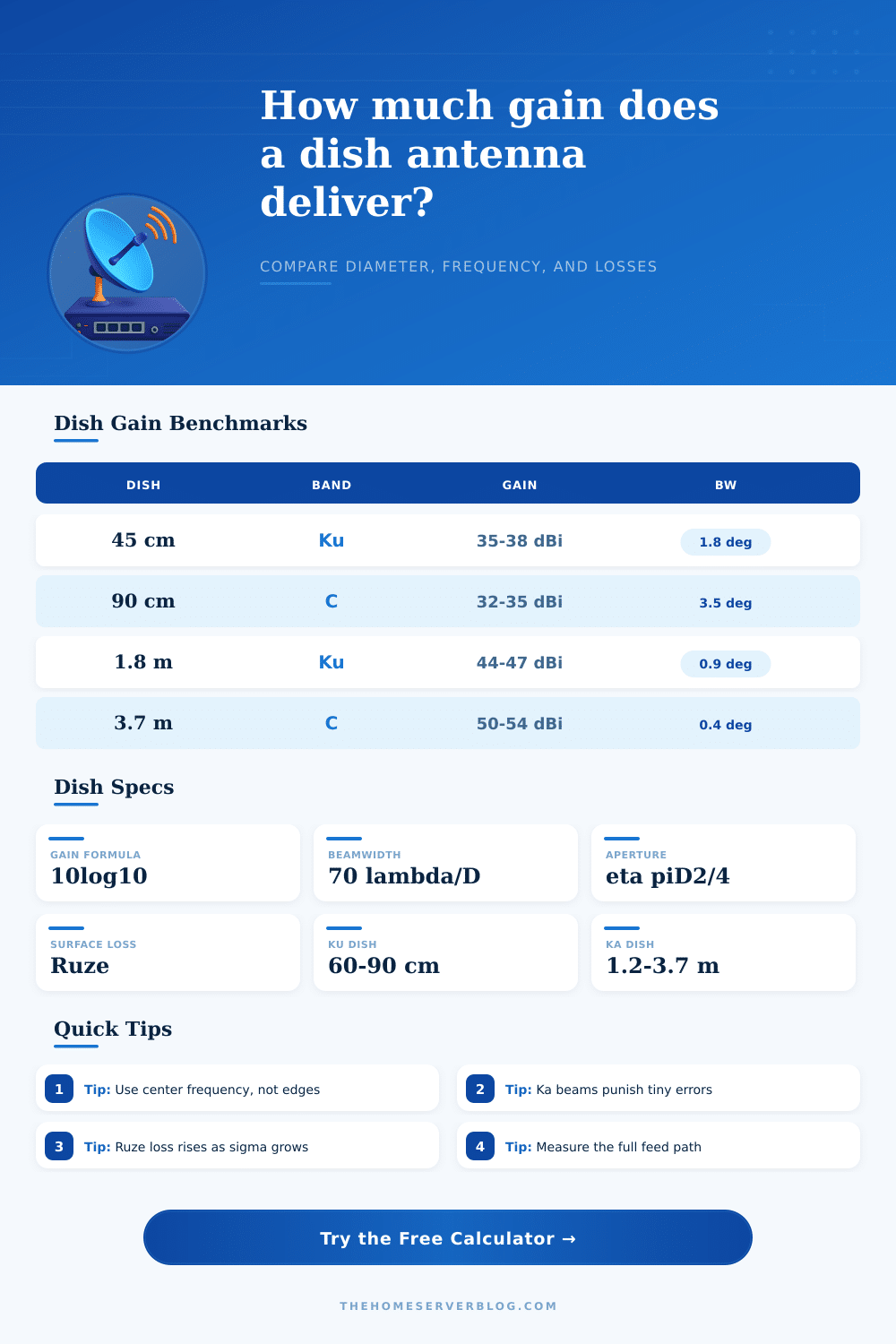
For instance, a 1.8-meter Ku-band dish antenna have a raw gain of 44 dBi. However, the actual gain will be lower due to losses in the feed chain of the antenna. If a person calculate the gain of the antenna without considering these losses, the calculation wont provide the person with an accurate measurement of the signal strength of the antenna.
Therefore, before making any conclusion about the signal strength of an antenna, a person should of consider these factor. Finally, if the signal strength drops at the antenna, a person should check the parabola of the antenna; the shape and alignment of the parabola are also essential to the gain of the antenna.