BTU to Tons Calculator
Convert cooling capacity in BTU/hr into refrigeration tons, kW, estimated airflow, and buffered server-room capacity for home labs and network closets.
⚙️Cooling Presets
🌡Cooling Inputs
🖥Equipment / Spec Comparison Grid
Heat estimates assume most IT electrical input eventually becomes sensible heat in the room. Nameplate wattage can be much higher than actual running draw.
📊BTU, Tons, and Cooling Reference Tables
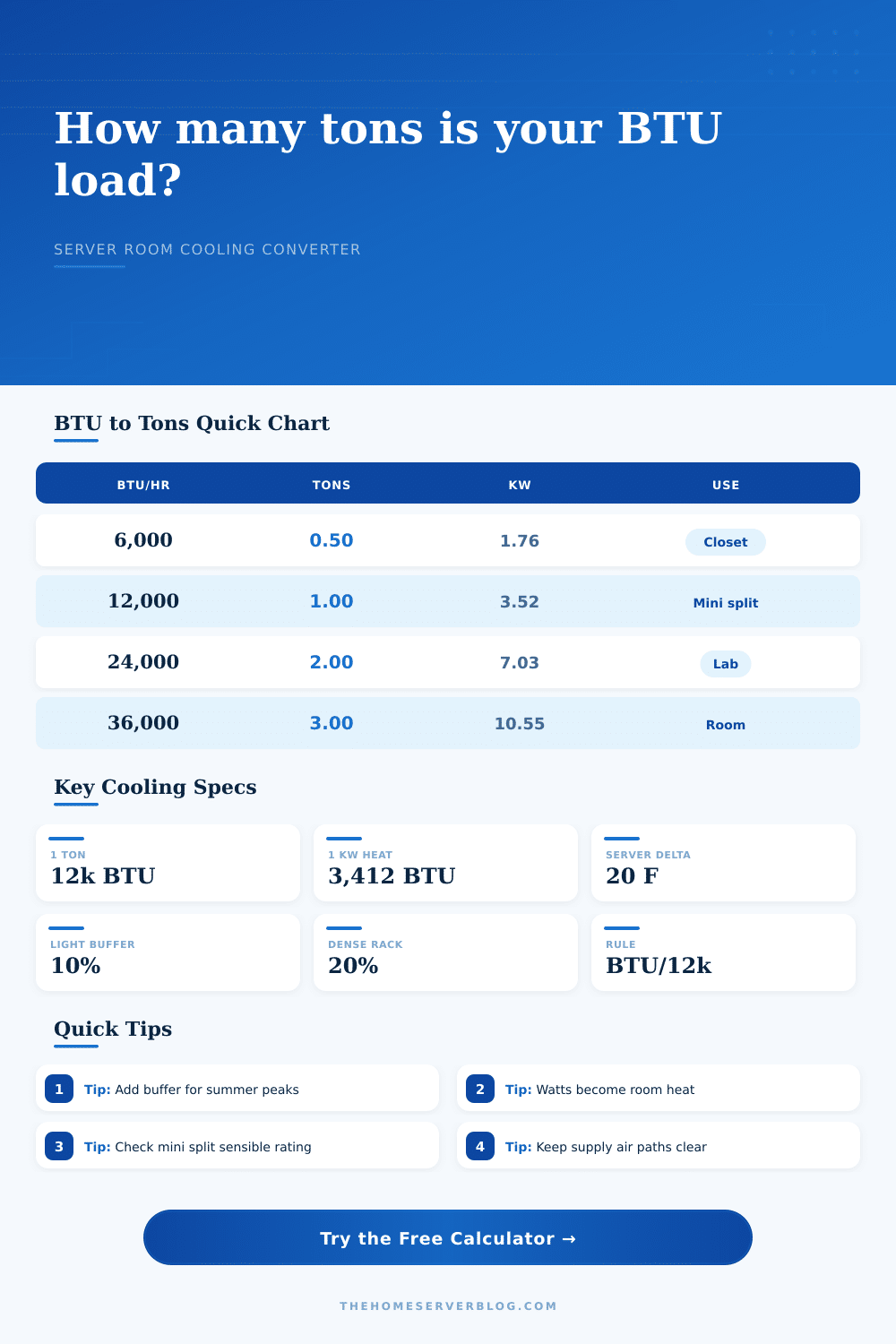
| Cooling Capacity | Refrigeration Tons | Cooling kW | Typical Home Lab Use |
|---|---|---|---|
| 3,000 BTU/hr | 0.25 tons | 0.88 kW | Small network closet or modem shelf |
| 6,000 BTU/hr | 0.50 tons | 1.76 kW | Compact rack with NAS and PoE switch |
| 9,000 BTU/hr | 0.75 tons | 2.64 kW | Mini split zone for a warm office lab |
| 12,000 BTU/hr | 1.00 ton | 3.52 kW | Common 1-ton mini split rating |
| 18,000 BTU/hr | 1.50 tons | 5.28 kW | Small server room or dense home rack |
| 24,000 BTU/hr | 2.00 tons | 7.03 kW | Two-rack hobby lab or hot garage room |
| 36,000 BTU/hr | 3.00 tons | 10.55 kW | High-density rack area with overhead |
| Formula / Standard | Value | Use In Calculator | Practical Limit |
|---|---|---|---|
| Refrigeration ton | 12,000 BTU/hr | BTU to tons conversion | Nominal HVAC sizing unit |
| Electrical heat | 3.412 BTU/hr per watt | Converts IT watts to heat | Use measured draw when possible |
| Cooling kW | 3,412 BTU/hr per kW | Compares heat removal capacity | Matches server power planning |
| Sensible airflow | BTU/hr ÷ (1.08 × ΔT) | Estimates CFM at selected delta | Ductless units vary by fan speed |
| Room volume | Length × width × height | Shows cooling density | Air path matters more than volume alone |
| Cooling Configuration | Common Capacity | Metric Equivalent | Best Fit |
|---|---|---|---|
| Through-wall fan assist | 1,500-4,000 BTU/hr heat removal | 0.44-1.17 kW | Low-load closets with conditioned adjacent air |
| Portable single-hose AC | 6,000-10,000 BTU/hr usable | 1.76-2.93 kW | Temporary cooling where exhaust losses are acceptable |
| 9k ductless mini split | 9,000 BTU/hr | 2.64 kW | Quiet office lab or small rack room |
| 12k ductless mini split | 12,000 BTU/hr | 3.52 kW | 1-ton dedicated home lab zone |
| 18k ductless mini split | 18,000 BTU/hr | 5.28 kW | Dense rack or mixed office/server room |
| 24k ductless mini split | 24,000 BTU/hr | 7.03 kW | Garage lab, multiple racks, or warm climates |
| Project Size | Equipment Count | Likely BTU/hr | Cooling Tons |
|---|---|---|---|
| Home office network shelf | Router, modem, 1 switch | 500-1,200 | 0.04-0.10 |
| NAS media corner | NAS, UPS, switch | 900-2,200 | 0.08-0.18 |
| Mini PC Proxmox cluster | 3-5 mini nodes | 1,800-4,200 | 0.15-0.35 |
| Single rack server closet | 1U/2U server plus storage | 3,500-7,000 | 0.29-0.58 |
| Mixed 12U rack | Server, NAS, PoE, UPS | 6,000-12,000 | 0.50-1.00 |
| Dense 24U home lab | Multiple servers and storage | 12,000-30,000 | 1.00-2.50 |
💡Cooling Calculation Tips
Your fans is noisy and don’t cool down the room. The electricity used by your gear are all converted into heat. Move that heat out of the room or it’ll raise the temperature! It will make things perform worse and components will die if they stays in there. You’re paying for your ability to remove waste heat from your hardware.
The 12,000 BTU/hour = one ton conversion is a hundred years old and dates back to how much ice was required to cool something in the days before air conditioning. This formula is still what HVAC engineers use today when sizing an air conditioner. If you look at the specs for your window unit or mini-split, they’ll typically list them by BTUs.
Why Cooling Matters for Your Home Lab
That’s what this calculator does: it takes that number and splits it out for you into cooling capacity expressed in tons. And then, more importantly, it adds a cushion. That is why I say the calculation is most important for home labs.
How much do things use? How many buffers is there? Take a GPU server for example. At idle, it draws about 500 watts. When doing a render job, it’ll go up to 1,400 watts. If you only size your AC for average load, what happens when it’s under peak load? Your system chugs.
With this tool, you can put in that 10 or 20 percent margin. The extra capacity buys you thermal headroom so the compressor do not run constantly at maximum effort. Instead, there is some extra room for heat which gives you the ability to avoid short cycling. Short cycling lead to premature wear and humidity problems.
But also think about capacity… And airflow. Sometimes a 12,000 BTU unit might not keep a small space like a closet cool if the air isn’t flowing propery. If the air isn’t flowing propery, it won’t cool the room. For that reason, there’s an option in the calculator to estimate how many cubic feet per minute of airflow is needed depending on your desired temperature drop. That’s what the delta T setting is referring to.
In general, ductless mini-splits do better with sensible heat loads different than portable units. Portable units waste energy because they blow out hot air through a hose.
The reference tables spell out typical use cases. A basic home network… Your router, a PoE switch and maybe some other hardware in a network closet, doesn’t create much heat. Unless it’s poorly ventilated, you probably don’t even have to worry about cooling.
Now consider a high-density rack filled with servers and storage devices. That can produce as much heat as a small oven. And because a few mini PCs doesn’t scale the same way as a whole 24U rack, the jump from one configuration to another isn’t linear. In terms of installation complexity and cost, it’s exponential.
If you’re building, many builders overestimate heat load based off the nameplate wattage. Rarely does a 600-watt power supply pulls 600 watts all the time. Plug it into a smart PDU or use a clamp meter. Measure what it actualy draws. Feed that into the conversion tool.
The tool takes watts as input. No guessing required. Because one watt = 3.412 BTUs, it uses this fixed ratio to convert electrical load to thermal output. It creates an exact connection between the electricity you pay for and the heat that needs to be removed from your AC.
Last but not least, think about what else is in the space. If the room has a windowless dedicated interior closet vs. An exterior exposed garage where sunlight hits directly, it’s going to be much easier to keep cool. You can include those variables in the heat gain allowance and use the calculator. Direct sunlight contributes greatly to thermal load, and it doesn’t have anything to do with your servers. Underestimating this will result in under-sized equipment. Taking into account what the room looks like ensures that the cooling system will address all of the heat sources as a whole.
You should of considered this. There’s no such thing as an afterthought when it comes to cooling for a home lab. It’s the bedrock. If you don’t do this right, you risk everything you’ve invested. The math isn’t hard; the consequences are significant. Get it right then err on the side of more. Make sure there’s enough airflow, too. You’ll have happy, cool-running servers and their heat will be carried away efficienty.