Cable Bundle Diameter Calculator
Estimate the outside diameter, occupied area, bend radius, and pathway fit for Ethernet, fiber, coax, and mixed low-voltage cable bundles in racks, trays, sleeves, and conduit.
Cable bundle diameter result
| Ethernet cable | Typical OD | Metric OD | Bundle note |
|---|---|---|---|
| Slim Cat6 patch | 0.150 to 0.190 in | 3.8 to 4.8 mm | Useful in racks, but not the same as horizontal cable. |
| Cat5e UTP | 0.200 to 0.220 in | 5.1 to 5.6 mm | Common for cameras, phones, and 1G home runs. |
| Cat6 UTP | 0.230 to 0.260 in | 5.8 to 6.6 mm | Typical riser cable with separator or spline depending on brand. |
| Cat6A UTP | 0.280 to 0.330 in | 7.1 to 8.4 mm | Larger diameter makes tray and J-hook fill climb quickly. |
| Fiber and coax cable | Typical OD | Metric OD | Bundle note |
|---|---|---|---|
| Duplex fiber patch | 0.079 to 0.118 in | 2.0 to 3.0 mm | Small diameter, but bend radius can dominate routing. |
| Fiber micro cable | 0.120 to 0.180 in | 3.0 to 4.6 mm | High count bundles need careful radius and crush control. |
| RG-6 coax | 0.270 to 0.300 in | 6.9 to 7.6 mm | Round and stiff enough to reduce tight packing efficiency. |
| RG-59 coax | 0.235 to 0.250 in | 6.0 to 6.4 mm | Often similar to Cat6 OD but with a different bend feel. |
| Control or specialty cable | Typical OD | Metric OD | Bundle note |
|---|---|---|---|
| 18/2 control | 0.170 to 0.210 in | 4.3 to 5.3 mm | Small control cable fills gaps but changes the mixed bundle shape. |
| 22/4 security | 0.140 to 0.170 in | 3.6 to 4.3 mm | Low-voltage alarm cable packs loosely with Cat cable. |
| Speaker 16/2 | 0.220 to 0.270 in | 5.6 to 6.9 mm | Jacket shape may be oval, so use the larger measured dimension. |
| Outdoor gel cable | 0.300 to 0.380 in | 7.6 to 9.7 mm | Stiff jackets need extra pathway and bend allowance. |
| Pathway or bend item | Typical limit | Use in calculator | Planning note |
|---|---|---|---|
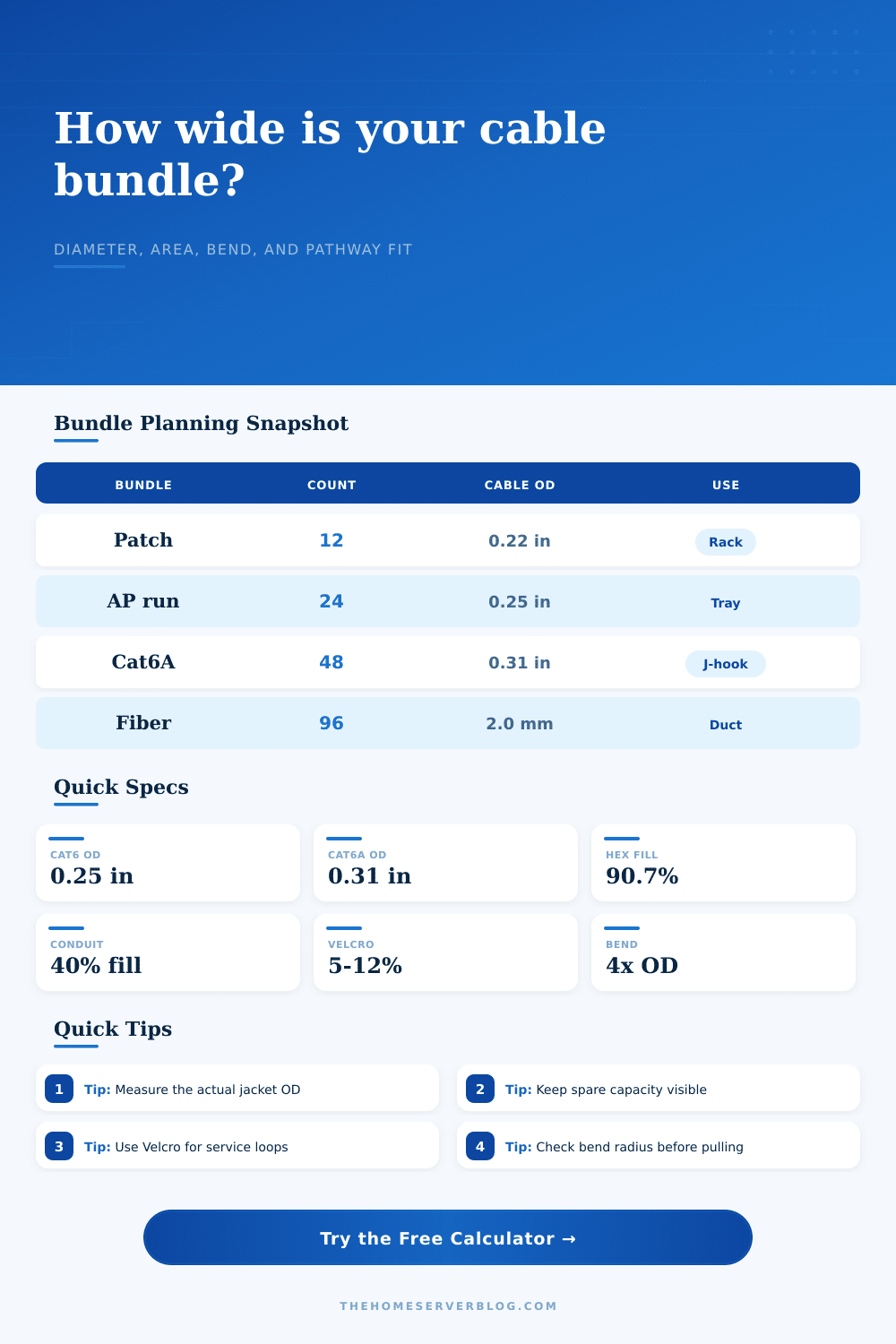
| Conduit with many cables | 40% area fill | Conduit at 40% fill | Use actual raceway inside diameter and avoid long packed pulls. |
| Short sleeve or nipple | 60% area fill | Sleeve at 60% fill | Helpful through walls, but firestop space still counts. |
| Tray or basket | 50% width/area | Cable tray or basket tray | Leave room for separation, access, and future cables. |
| Copper bend radius | 4x cable OD | Bend radius factor | Use higher values for Cat6A, fiber, armored, or manufacturer rules. |
Then there’s the back of the rack. This is the place where you put your patch panel and some new switches that you slid in after pulling old one out. Instead of a utility area, it look more like a nest of angry garden hoses.
This happens to everybody. Maybe you had a color scheme going and started off with good intentions but then reality set in and turned your neat rows into chaos. It’s not the cables so much as the math you skipped when you guessed at how wide a bundle of 40 Ethernet cable would end up being. And your guess? Usually way off. It is usualy way to small. Guesswork turns what was a manageable project into a nightmare behind a closed door.
How to Stop Cable Mess
After inputting your unique combination of jackets and cables, the calculator do all the work for you. No more translating round diameters from square inches. No more wondering if cable will physically fit where you want it.
But how do you know if you can trust the result? How do you know which magic number the calculator spits out actualy means anything? That’s why it’s important to have an idea of what makes the numbers tick. Multiplying the catalog diameter times your count are the most frequent error. But cables don’t stack like coins. Instead, they form spaces between them as they twist and turn in place. Inefficient hexagonal packing may be ideal on paper. In practice real-world bundles is messy.
And that is where the buffer comes in. The extra amount added to the bundle to accommodate the natural lack of efficiency. That buffer is the difference between your bundle sliding into the conduit and getting hung up half way. A hung up bundle tear apart the jacket insulation in the process.
And then there’s stiffness of the jacket. There’s a difference between a slim Cat6 patch cable and a chunky thick Cat6A riser cable that use a metal separator. One’s flexible, forgiving; the other’s rigid and resists compression. Attempting to zip-tie a bundle of rigid cables too snugly isn’t saving space (it’s ruining their internal shape).
With a tie-compression feature, you can adjust for this effect in the calculator which models the physical force you’re applying. Gently compressing by 5% is kind. Strangling by 20% is no good. Most folks over-tie. Tighter means neater they think. Actually, it mean higher insertion loss and more crosstalk. The tool will warn you when the bundle becomes too dense for the pathway you’ve chosen.
Fill is a numbers game. Forty percent is the maximum fill for multiple cables in a raceway according to National Electrical Code. Multiple cables? Sure. But that’s not an arbitrary figure. That’s a friction figure. Exceed 40% conduit fill and the pulling tension go up exponentially. The risk of shearing the conductors skyrockets. The calculator figures all this out for you automaticly.
Does the bundle pass or does it fail? Is it getting tight? Is it going to fail? Failure means running it again or using a bigger conduit. Physics doesn’t have a magic fix. When it says no, the pull will say no louder.
The other silent killer is bend radius. Bundle fits inside the sleeve, no problem… until it can’t make the turn into the rack. The minimum bend radius are typically four times the diameter of the cable. Fiber is even more picky. Cat5e is more forgiving than Cat6A. Bend it past its bend radius and you’ll either distort the pairs or create micro-fractures in the fiber.
The tool tells you how much of a sweep it takes to smoothly turn the corner, and it tells you that a cable isn’t a string. It has memory. Treat it right and it will last decades. Force it and it’ll fail silently. These intermittent connectivity problems can take weeks to track down.
Spare capacity is always a good idea. Size the path for 20% more then you think you’ll need; do this in the tool. Spare doesn’t cost anything. Adding another conduit down the road will cost everything.
And never use eyeball measurements when planning your project, get out your calipers and measure your actual cable OD. A tenth of an inch here or there won’t seem so insignificant after you’ve got fifty cables in there. That little bit make for an additional inch of bundle diameter. Small things matter.
The rack needs to breathe. Don’t let it suffocate. Make it round. Make it loose. Let the numbers tell your fingers what to do. Walk away and the bundle should look like it’s been there all along. It looks neat and waits for whatever might come next.