Cable Weight Calculator
Estimate cable bundle weight, tray load per foot, spool gross weight, and metric equivalents from cable type, outside diameter, density, count, length, slack, and reel tare.
⚡Named cabling presets
📏Cable and run inputs
Cable weight result
🗂Cable spec grid
📊Reference tables
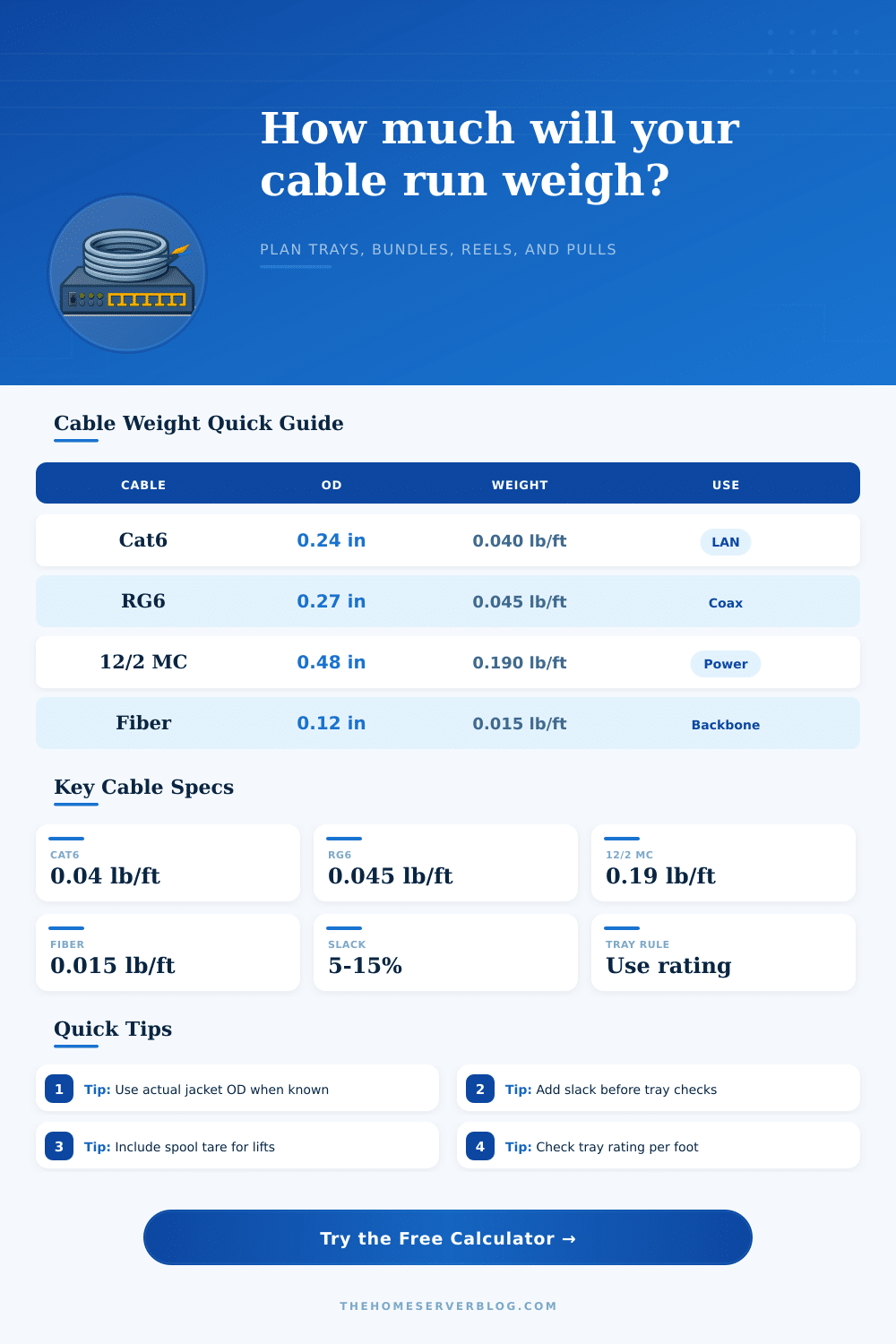
| Cable type | Typical OD | Typical weight | Common home lab use |
|---|---|---|---|
| Cat6 UTP | 0.23 to 0.25 in | 0.035 to 0.045 lb/ft | Desktop, AP, camera drops |
| Cat6A shielded | 0.29 to 0.34 in | 0.050 to 0.070 lb/ft | 10 GbE copper runs |
| 2-fiber indoor | 0.10 to 0.13 in | 0.010 to 0.018 lb/ft | Rack backbone and uplinks |
| RG6 coax | 0.26 to 0.29 in | 0.040 to 0.055 lb/ft | CCTV, modem, antenna feeds |
| 12/2 MC cable | 0.45 to 0.52 in | 0.170 to 0.220 lb/ft | Branch circuits near racks |
| Material / construction | Density to enter | Fill factor guide | Planning note |
|---|---|---|---|
| PVC jacketed data cable | 1.35 to 1.75 g/cm³ | 35% to 50% | Good for Cat5e, Cat6, control cable |
| Shielded copper data cable | 1.75 to 2.60 g/cm³ | 45% to 65% | Foil, braid, and larger conductors add weight |
| Fiber distribution cable | 1.15 to 1.45 g/cm³ | 25% to 45% | Low metal content, often strength-member driven |
| Power or portable cord | 2.50 to 4.50 g/cm³ | 45% to 75% | Copper conductor mass dominates the result |
| Pathway | Weight check | Input to watch | Practical limit |
|---|---|---|---|
| Cable tray | Load per foot | Tray load rating | Stay below allocated working load |
| J-hooks | Point and span load | Bundle count | Use close spacing for heavy bundles |
| Ladder rack | Distributed rack load | Run length and count | Include existing cable weight |
| Spool / reel | Gross handling weight | Reel tare and cable weight | Keep below lift or cart rating |
| Project size | Example cables | Approx run | Weight planning focus |
|---|---|---|---|
| Small closet | 12 Cat6 | 75 ft each | J-hook spacing and slack loops |
| Camera buildout | 24 Cat6 or RG6 | 120 ft each | Tray share and ceiling support |
| Rack row | 48 Cat6A | 60 ft each | Bundle sag and ladder rack load |
| Lab power run | 6 MC or SOOW | 80 ft each | Reel weight and pulling crew |
✅Planning tips
When planning a cable run, the weight of the cable is a critical factor in the planning of that installation. The weight of the cable is more important than many peoples tend to think. A bundle of cables may look good on paper, but a bundle of cables can sag between the supports.
A bundle of cables can also overload a tray section. Additionally, a bundle of cables might make it dificult to move a reel of that cable along the installation site. Knowing the total mass of the data and telecommunications cables is essential to understanding how much weight will be moved, and how much weight will have to be support by the installation pathway.
Why Cable Weight Matters for Installations
The weight of the cables are not a single number. Several factors will affect the weight of the cables. The outside diameter of the cable jacket will impact the weight of the cable.
The density of the materials within the cable will impact the weight of the cable. Additionally, the amount of copper, fiber, or other fill material within the cross-section of the cable will impact the weight of that bundle of cables. A thin data cable will weigh less per foot compared to a power cord that has a thicker amount of conductive material.
A calculator can help to mathematically determine these variable to find the weight of the bundle of cables without having to mathematically calculate the cross-section of each of the cables. The weight of the cables is only the beginning of the calculation process. The installation pathway will distribute the weight of the cables.
A cable tray has a weight limit. A cable tray may be able to hold many light data and telecommunications cables if the tray have a high weight limit. However, if the tray has old cables installed within it, it will quickly reach it’s weight limit if any additional heavy cables are added to the tray.
Using the share percentage for a tray allows for the planning of future installation of any additional cables to that tray, and prevents the assumption that all of the weight limit of the tray can be used for the current installation of the bundle of cables. Another factor in determining the total weight of the installation is the inclusion of slack. Slack is an installation detail that is often overlooked.
Providing ten or fifteen percent slack in the installation pathway will allow for necessary movement of the cables during installation, but that slack will add to the total weight of the installation, as well as the load that will act upon each foot of the installation pathway. The calculator for determining the weight of a cable installation will factor in this slack before calculating the load that will act upon the tray and spool of cable, ensuring that the total weight that is calculated is realistic for the installation. Another consideration for the weight of a cable installation is the handling of the spool of cable.
You must consider the weight of the spool without the cable, as well as the gross weight of that same spool with the cable installed upon it. When crew member move cable reels by hand or upon a small cart, the gross weight will impact the number of crew member that are required to move the spool of cable. Using the handling limit field will allow for the determination of the gross weight of the spool that will be moved from the staging area for installation.
Density and the percent of the area that is filled with conductive material is another important factor to consider for determining the weight of the cables. These two factors will allow an estimation of the weight of the cables if the exact weight of the cables is not available on the cable manufacturer’s datasheet. A cable that contains more copper will have a higher density.
A fiber optic cable will have a lower density if it contains more material in the cable jacket than the amount of fiber itself. The percentage of the area of the cable that is filled with solid material is also important; the remainder of the area is comprised of air. Using the known weight field for the cable, if the value is zero, the calculator will use the density and the fill percentage to determine the weight of the cables.
This estimation of the weight is helpful for early planning of the installation. The type of pathway that is to be used for installation of the cables will impact the requirements for installation of those data and telecommunications cables. The type of installation pathway will change the questions and considerations for the installation.
For instance, fill percentage is one consideration for installation within a conduit, but a different set of considerations will be made for installation along a tray. The spacing of the J-hooks will be critical for installation along a tray, as the weight of the cables will impact the amount of load that is placed upon each of the J-hooks. Additionally, if the cables are to be installed along a ladder rack, the number of existing cables that is installed upon the ladder rungs must be considered prior to installation of new cables.
Such considerations will be presented to the installer if the pathway type is selected within the weight calculator. Many mistakes are made in the installation of data and telecommunications networks. One of the mistakes that is often made is in the consideration of the weight of the cables.
Many individuals use the weights that are provided on the marketing sheets for the cable. However, those weights are nominal weights and do not take into account the length of the cables or the number of cables being installed. If the weight of the cables is not considered in relation to the weight limits of the installation pathway, it is likely that the installation will find that the pathway is over the weight capacity of that installation.
Another mistake for installing cables is the ignorance of the impact that slack will have upon the total weight of the installation. This weight will be placed upon every portion of the installation pathway. The weight calculator includes this parameter before calculating the load that will be placed upon the tray and spool of data or telecommunications cable.
This will ensure that the weight that is presented to the installer is the realistic weight for that installation. Weight planning for data and telecommunications networks will allow an installer or network designer to understand each of the factors that will impact the total load of the installed network. Each of the choices for the characteristics of the cables will impact the total load of the installed network.
By plugging in each of the values for the characteristics of the cables into the calculation software, each designer or installer can make a clear decision regarding the type of pathway, the size of the reels of cable that are to be installed, and the number of crew members that will be required to handle the installation of the cable. Using the actual values of the characteristics of the cables will allow for clarity in the planning of the installation of that network. By providing clarity to the installation process, the network designer can ensure that the installation remains on schedule.