HomeServerBlog storage planning tool
Capacity Forecast Linear Calculator
Project when a home server, NAS, backup repository, or VM datastore reaches its safe capacity limit using linear monthly growth, snapshot churn, retention, data reduction, reserve headroom, and drive bay expansion assumptions.
▣Capacity forecast presets
⚙Linear forecast inputs
Formula breakdown
Capacity status
💾Selected equipment spec grid
Mirror capacity from added disks.
Estimated from drive size and layout.
Space left unused for reliable operation.
Balanced growth and snapshot behavior.
📊Reference tables
Storage profile comparison
| Profile | Expansion math | Typical reserve | Best fit |
|---|---|---|---|
| 2-bay mirror | 1 added TB gives about 0.50 usable TB | 10% to 15% | Simple NAS, photos, documents |
| 4-bay RAID5 or RAIDZ1 | 1 added TB gives about 0.75 usable TB | 15% | Media libraries and general shares |
| 6-bay RAID6 or RAIDZ2 | 1 added TB gives about 0.67 usable TB | 15% to 20% | Larger home lab pools |
| 8-bay RAID6 or RAIDZ2 | 1 added TB gives about 0.75 usable TB | 15% to 20% | Media plus backup targets |
| NVMe mirror | 1 added TB gives about 0.50 usable TB | 20% to 25% | VM datastores and databases |
| Backup dedupe repo | 1 added TB gives about 0.80 usable TB | 15% to 20% | Veeam, Borg, Restic, Proxmox Backup |
Expansion efficiency is a planning estimate; actual values depend on whether you add disks, replace disks, grow vdevs, or create a new pool.
Capacity status bands
| Safe ceiling used | Status | Action window | Home server note |
|---|---|---|---|
| Under 65% | Healthy | Review quarterly | Scrubs, parity checks, and snapshots have room to breathe. |
| 65% to 80% | Watch | Plan next purchase | Good time to validate growth rate from monitoring data. |
| 80% to 95% | Tight | Schedule expansion | VM images, databases, and dedupe repos may slow down. |
| Over 95% | Critical | Expand or prune now | Avoid writes that leave ZFS, Btrfs, or thin pools with no headroom. |
The calculator compares forecast usage to the usable capacity after reserve, so the warning arrives before the pool is physically full.
Common growth sources
| Workload | Typical slope | Churn pattern | Forecast advice |
|---|---|---|---|
| Family photos and phones | 0.05 to 0.30 TB/month | Low edits, high append | Use measured import history from cloud exports and phone backups. |
| 4K media library | 0.30 to 3.00 TB/month | Mostly append-only | Model media ingest separately from backup snapshots. |
| VM datastore | 0.10 to 1.50 TB/month | High block churn | Use a larger reserve because snapshots can expand quickly. |
| NVR camera archive | 0.50 to 10.00 TB/month | Predictable rolling writes | Base growth on bitrate, camera count, and retention policy. |
| Backup repository | 0.20 to 5.00 TB/month | Depends on incrementals | Use dedupe ratio and monthly changed-data estimates together. |
Linear forecasting works best when the workload grows at a steady rate; step changes such as new cameras or a new VM cluster should be entered as updated monthly growth.
Example project sizes
| Project | Starting data | Monthly growth | Planning reserve |
|---|---|---|---|
| Small home NAS | 2 to 6 TB | 0.10 to 0.40 TB | 10% to 15% |
| Creator workstation backup | 6 to 16 TB | 0.40 to 1.20 TB | 15% |
| Proxmox home lab | 4 to 24 TB | 0.20 to 2.00 TB | 20% |
| Media plus backups | 12 to 80 TB | 0.80 to 5.00 TB | 15% to 20% |
| Camera archive | 8 to 60 TB | 1.00 to 10.00 TB | 10% to 15% |
When a workload has both append-only data and high-churn data, run the calculator twice and add the resulting monthly physical growth.
💡Capacity planning tips
A home server for storage works fine, quietly storing stuff until it won’t anymore. It was just fine and then the progress bar stoped. You were starting a virtual machine? Copying photos? Maybe you were starting a virtual machine or copying photos. The pool isn’t full. There’s empty space on dashboard. But it won’t take new data.
That’s the paradox of capacity planning. It’s almost never an absolute limit of your hardware. It’s the invisible ceiling you constructed around your hardware so everything stays stable, and most people don’t notice that ceiling until they crash into it. That’s where thinking about growth comes into play.
Why Your Server Stops Working Even With Free Space
Because you think about data as this static pile. Add some files, pile grows. Delete some files, pile shrinks. That works for a filing cabinet. It doesn’t work for a NAS drive that needs to manage virtual disk, backup increments, and snapshots. You aren’t just consuming the sum of your files. It’s the sum of your files, plus the overhead necessary to maintain a coherent file system, plus the history of all changes to those files.
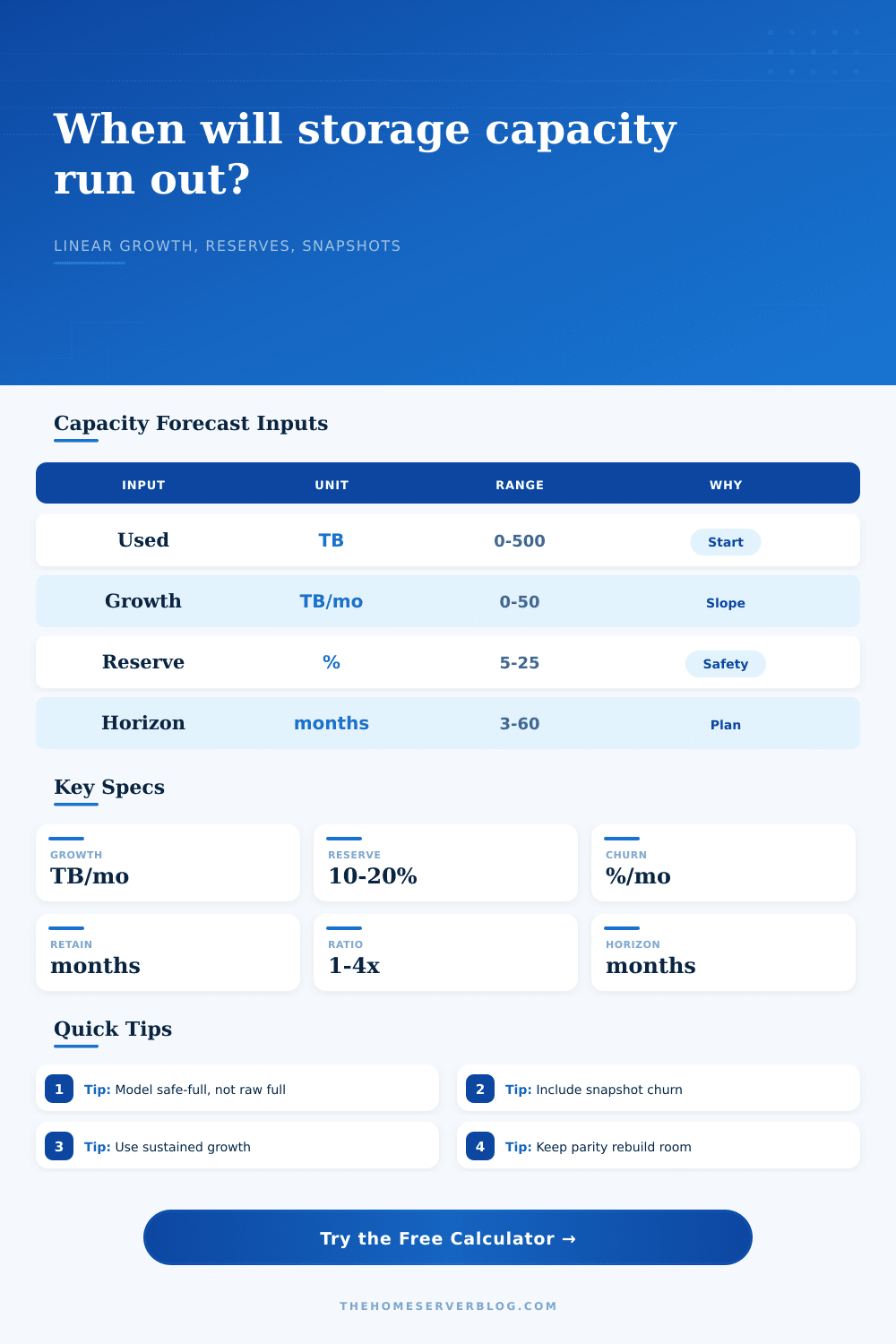
Enter your current usage and monthly growth rate into the calculator and let it do the math for you (no need to try to figure out conversions or coefficients). Plug in your slope and it’ll project when you reach that safe reserve line. Most importantly: that’s your reserve line. Don’t run a storage pool full. File systems and operating systems requires breathing room. They need space to manage their own metadata. You need space to do some background checks. You need space to write temporarily while repairing something else. Running full hurts efficiency, whether you’re just copying things or using complex file systems like Btrfs or ZFS.
So the calculator lets you specify how much safety buffer you want. Maybe ten percent for a static movie archive. You probably need at least twenty percent if you are using snapshots heavily or running active virtual machines. That space isn’t wasted. It’s insurance, for when a background scrub needs to write parity but can’t find any room to do it.
The secret multiplier on most people home lab is snapshot retention. One version per day? And keeping it around for three months? You’re not storing one version of your data. You’re storing three months worth of deltas. If you’re changing lots of blocks every month (high churn), then those snapshots is consuming physical space at a higher rate then you get new stuff. The tool allows you to enter that number. How much do you retain? How quickly does your data change? It takes that general policy and turns it into actual terabyte usage.
You’ll often discover that your retention policy is costing you more capacity than your actual files cost. That’s hard to accept, but it’s true. But “more” isn’t always bigger. More is also knowing how efficient you are. Adding a drive to a mirrored set gets you only half that drive. The same applies to a RAID5 array… Because parity is spread across all the drives, you get even less space. The site has a reference table on the page explaining what various profiles mean. So you see that if you have an eight bay and add another drive to make 9 bays, your effective expansion in usable disk space may be far less than that drive size itself. That’s an important trade-off, and you don’t want to pay for it without knowing it ahead of time.
You want to buy drives which will stretch your timeline; not by months, but years. Predicting with a straight line makes sense, right? It is just a straight line up. Except that the real world doesn’t grow in a straight line. There are bumps: a new baby means more photos. A new 4K TV means larger media files. A new VM cluster mean heavy block allocation.
You won’t know about each bump. What you can do is look back and measure your average. Review usage from the past six months. Compute the change per month. That’s your number. Be slightly conservative because it’s better to be slightly conservative than be caught flat-footed when the curve suddenly steepens.
Capacity planning in short means: purchasing peace of mind. Knowing that your wallet won’t be opened until you’ve got some breathing space; six months from now. Two years from now. Next week. Knowledge that takes away the panic. It transforms a crisis into a shopping list. It stops you from guessing how long until the disk fills. It begins managing where the disk is heading. And when it’s time to expand, you aren’t forced to do it; you could of done it on purpose as part of a plan.
The silence descends again. And this time it lasts much longer while you enjoy it.