Cipher Suite Strength Calculator
Score a TLS cipher suite by protocol version, key exchange, authentication, bulk cipher, mode, key length, MAC or hash, PFS, certificate key, and policy target.
Suite classification and formula
| TLS version | Planning cap | Typical suite model | Home lab note |
|---|---|---|---|
| TLS 1.3 | 140-bit cap | AEAD plus HKDF hash | Best default for public HTTPS, APIs, and reverse proxies. |
| TLS 1.2 | 128-bit cap | KX, auth, cipher, MAC named together | Keep ECDHE plus AEAD for broad client compatibility. |
| TLS 1.1 | 80-bit cap | Mostly CBC era suites | Legacy only; plan removal from exposed services. |
| TLS 1.0 / SSL 3.0 | 70-bit or less | Legacy CBC or stream suites | Do not expose unless isolated for a known old device. |
| Component | Examples | Estimated strength | Planning meaning |
|---|---|---|---|
| ECDHE X25519 / P-256 | X25519, secp256r1 | 128-bit | Modern default and efficient on most TLS stacks. |
| ECDHE P-384 | secp384r1 | 192-bit | Useful when the policy target is high assurance. |
| DHE 2048 / 3072 | FFDHE 2048, FFDHE 3072 | 112 to 128-bit | Forward secret, but usually slower than ECDHE. |
| RSA certificates | 2048, 3072, 4096-bit | 112 to 152-bit | Often compatible, but large keys do not fix weak suite choices. |
| ECDSA / EdDSA certs | P-256, P-384, Ed25519 | 128 to 192-bit | Compact signatures with strong modern browser support. |
| Primitive | Common suites | Score effect | Risk note |
|---|---|---|---|
| AES-GCM | AES_128_GCM, AES_256_GCM | AEAD credit | Preferred for most TLS 1.2 and TLS 1.3 deployments. |
| ChaCha20-Poly1305 | CHACHA20_POLY1305 | AEAD credit | Strong software performance and modern security properties. |
| AES-CCM | AES_128_CCM | AEAD credit | Often seen in constrained systems and TLS 1.3 profiles. |
| CBC plus SHA-1 | AES_256_CBC_SHA | Heavy deduction | Legacy construction; avoid for internet-facing services. |
| 3DES or RC4 | DES_CBC3_SHA, RC4_SHA | Reject | Old compatibility suites with known practical risk. |
| Preset suite | TLS | Strength floor | Why it lands there |
|---|---|---|---|
| TLS_AES_128_GCM_SHA256 | 1.3 | 128-bit | AEAD suite with mandatory ephemeral key exchange in TLS 1.3. |
| TLS_AES_256_GCM_SHA384 | 1.3 | 128 to 192-bit | Usually limited by selected group or certificate, not AES-256. |
| TLS_CHACHA20_POLY1305_SHA256 | 1.3 | 128-bit | Strong AEAD construction with SHA-256 transcript hash. |
| TLS_ECDHE_RSA_WITH_AES_128_GCM_SHA256 | 1.2 | 112 to 128-bit | Good if RSA certificate and ECDHE group meet policy. |
| TLS_RSA_WITH_AES_128_GCM_SHA256 | 1.2 | 112-bit | AES-GCM is strong, but static RSA removes PFS. |
| TLS_RSA_WITH_AES_256_CBC_SHA | 1.2 | 80-bit class | CBC, SHA-1, and no PFS make it legacy only. |
| Reference | Used for | Calculator interpretation | Practical limit |
|---|---|---|---|
| RFC 8446 | TLS 1.3 suite model | Suite names cover AEAD cipher and hash only. | Key exchange is negotiated separately. |
| RFC 9325 | Secure TLS use | Prefer modern protocol versions and AEAD suites. | Legacy TLS needs explicit justification. |
| NIST SP 800-57 | Security strength | Maps RSA, finite-field DH, and ECC sizes to bit strength. | The weakest component controls the floor. |
| NIST SP 800-52 | TLS configuration | Supports policy-style checks for TLS deployments. | Operational policy may be stricter than bit math. |
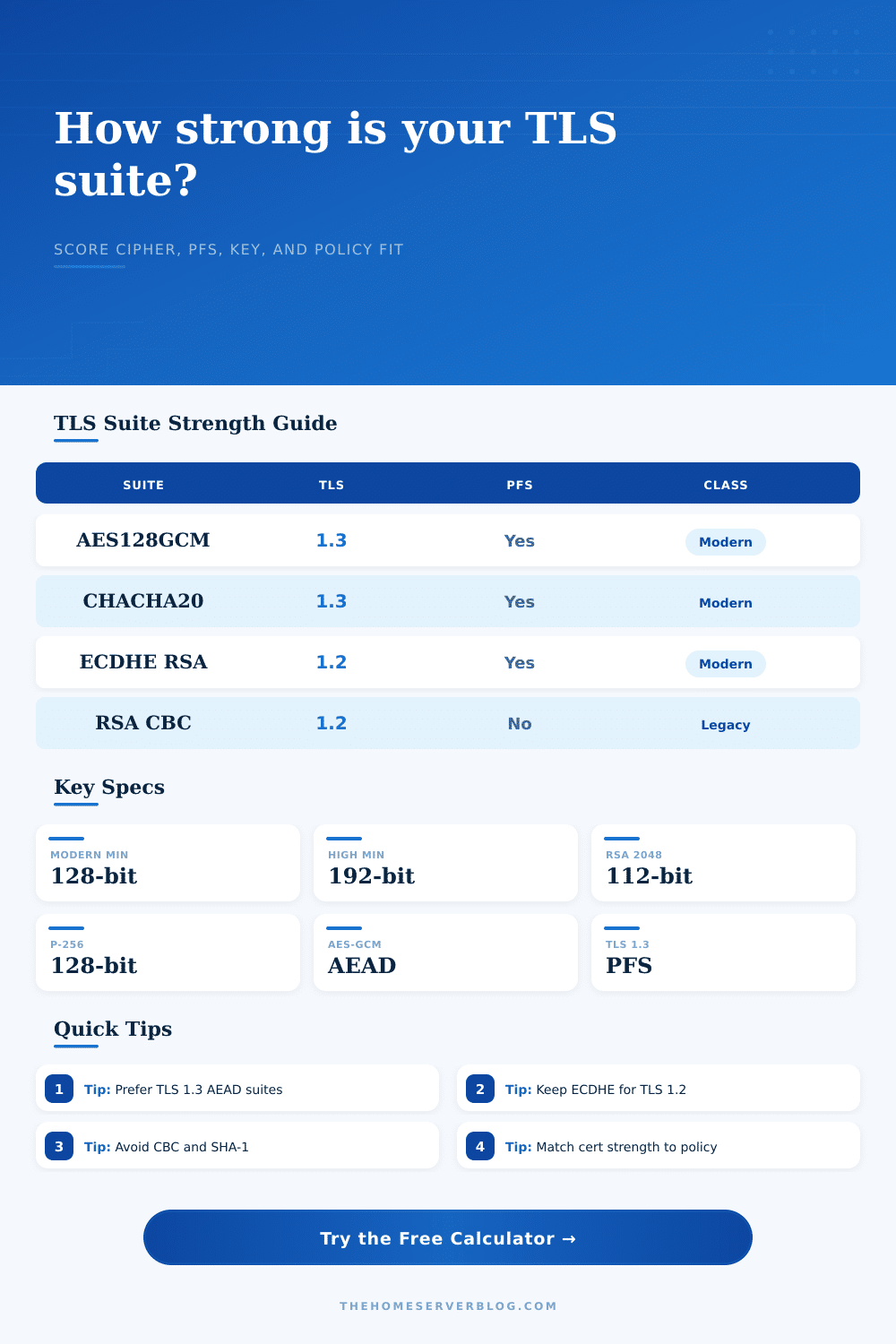
When picking a TLS cipher suite, you have to consider performance versus security. You’d like to use strong cipher suite to protect you from attackers as much as possible without using too many server resources.
That means that it’s not just a single strong component in the cipher suite that makes configuration good or bad. It’s the weakest component in the chain, the weakness could be the certificate signature, the key exchange method, the protocol version, etc. Most admins picks a suite that looks strong and then move on. They miss individual vulnerabilities.
Why You Need to Check Every Part of Your Cipher Suite
That’s what the calculator forces you to do, looking at each piece.
Your security is limited by the protocol version. Moddern cryptographic methods are supported in TLS 1.3. Legacy features that may leads to vulnerabilities remain in TLS 1.2 and older. Even with a strong symmetric key those vulnerabilities still exist. By picking a version in the tool, you set architectural constraints of the connection. Version is like the foundation: if there’s no good foundation, additional layers of encryption won’t help. Those limitations are taken into account in the calculator. A high bit length doesn’t makes up for an old protocol.
You might forget about forward secrecy until you are breached. Your attacker steals your server’s private key later but can’t decrypt any of your previous traffic. For this to work, you need to have a temporary key exchange. DHE and ECDHE does so. Static RSA key transport doesn’t. Without forward secrecy, your connection will be much weaker than before. That long-term private key acts as a single master key for all your past session. And the tool shows it clearly. Strong ciphers such as AES-256 won’t help you if your session key can being retrieved in the future.
The second consideration is cipher mode of operation. Today, we use AEAD (authenticated encryption) ciphers such as ChaCha20-Poly1305 or GCM. These authenticate and encrypt in a single operation. That protects against issues with old CBC mode, including padding oracle attacks. Moving from CBC to GCM is a big win for security. It completely eliminates whole categories of ways to attack. And the calculator gives you credit for making this change because it’s true: integrated authentication is less easy to abuse than separate MAC computations.
The overall security score depend on the weakest link in the entire handshake chain. Perhaps you’re using AES-256 for encryption. But if the certificate itself has an old hash algorithm or a weak RSA key, it breaks the trust chain. The actual strength of the handshake depends only on its weakest link. To put that into perspective, the tool’s reference tables converts key sizes to estimated security strength. If a big key size doesn’t help with a poorly designed protocol, this will help you understand what you missed.
Lastly, consider policy fit and client compatibility. If there’s nobody who can connect then a technically-perfect suite won’t do anything. Maybe you want to support older device. That means trading off ideal security for something that’s practicaly accessible. To help with this, the calculator lets you define a policy target. Should it be an ambitious standard like modern public services? Or should it be a bare minimum for internal use? Either way, it helps inform tradeoffs so you aren’t shooting for a perfect score (at the expense of breaking your infrastructure). It’ll help you find the appropriate balance for your environment.
Getting something right means reducing your risks in many ways, and having any single strong piece does not compensates for other weaknesses. By breaking it down into components you see what’s vulnerable. Then you fix them before they becomes problems. Make sure it scales with what you need. It has to stand up to review because you want to be secure. All of the pieces has to fit so that the protection works.