Conduit Fill Percentage Calculator
Estimate conduit fill percentage, remaining pathway area, maximum cable count, and pull risk for Ethernet, fiber, coax, low-voltage bundles, or mixed cable pathways.
Conduit fill result
| Fill rule | Planning limit | Best use | Home lab note |
|---|---|---|---|
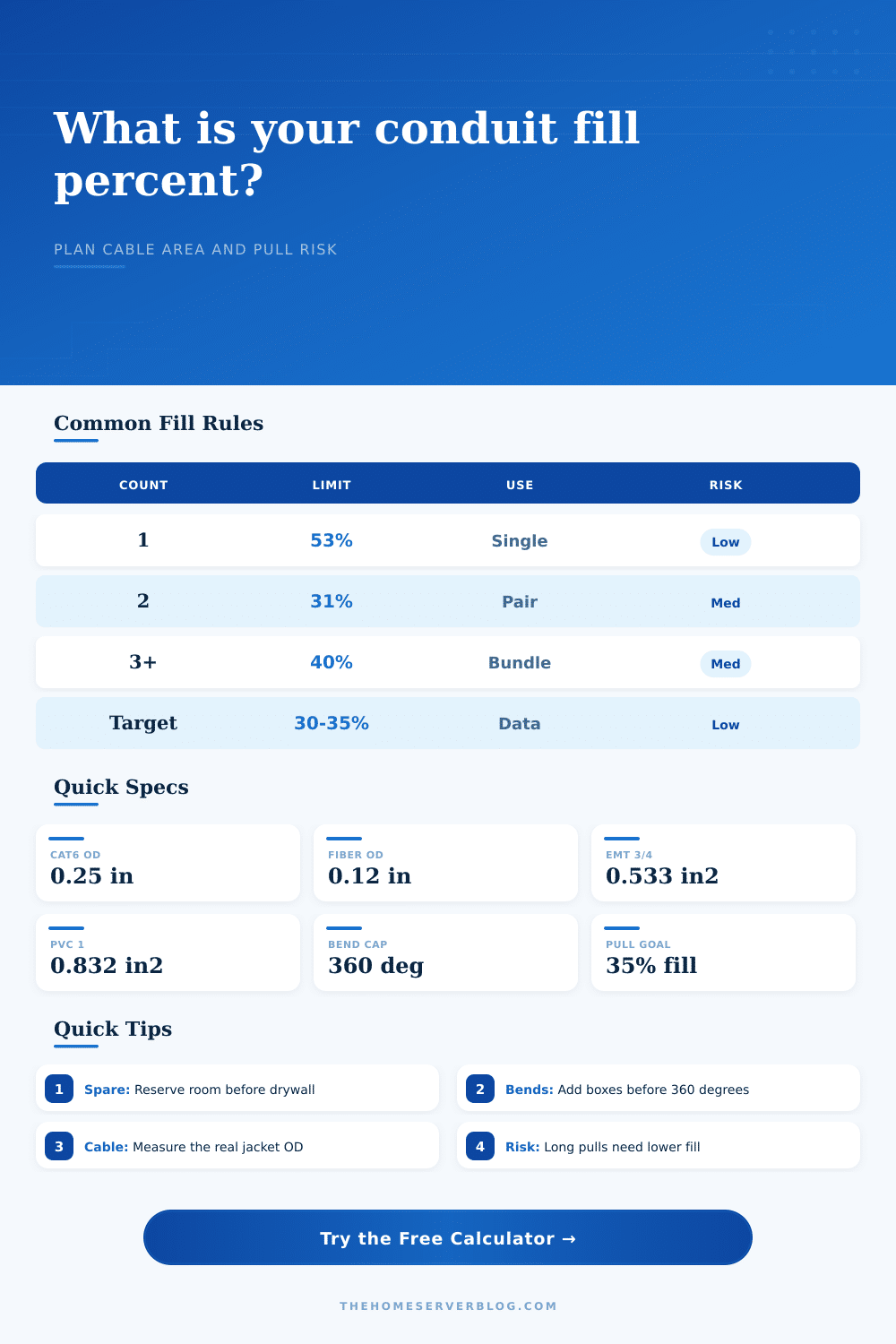
| 1 cable | 53% of conduit area | Single conductor or cable | Rare for network bundles, but useful for one large sleeve cable. |
| 2 cables | 31% of conduit area | Two cables | Lower than the 3+ rule because two round items can jam side by side. |
| 3 or more | 40% of conduit area | Typical bundled run | The usual starting point for multi-cable conduit planning. |
| Data target | 25% to 35% of conduit area | Future-friendly low voltage | Often easier to pull, label, and upgrade than a conduit at its maximum. |
| Trade size | EMT area in2 | EMT 40% area | Approx Cat6 at 40% |
|---|---|---|---|
| 1/2 inch | 0.304 | 0.122 | 2 cables at 0.25 in OD |
| 3/4 inch | 0.533 | 0.213 | 4 cables at 0.25 in OD |
| 1 inch | 0.864 | 0.346 | 7 cables at 0.25 in OD |
| 1-1/4 inch | 1.496 | 0.598 | 12 cables at 0.25 in OD |
| 1-1/2 inch | 2.036 | 0.814 | 16 cables at 0.25 in OD |
| 2 inch | 3.356 | 1.342 | 27 cables at 0.25 in OD |
| Trade size | PVC Sch 40 area in2 | PVC Sch 80 area in2 | 40% planning area |
|---|---|---|---|
| 1/2 inch | 0.285 | 0.217 | 0.114 / 0.087 in2 |
| 3/4 inch | 0.508 | 0.409 | 0.203 / 0.164 in2 |
| 1 inch | 0.832 | 0.688 | 0.333 / 0.275 in2 |
| 1-1/4 inch | 1.453 | 1.237 | 0.581 / 0.495 in2 |
| 1-1/2 inch | 1.986 | 1.711 | 0.794 / 0.684 in2 |
| 2 inch | 3.291 | 2.874 | 1.316 / 1.150 in2 |
| Cable type | Typical OD | Area each | Use in calculator |
|---|---|---|---|
| Cat5e UTP | 0.205 in / 5.2 mm | 0.033 in2 | Patch drops and cameras |
| Cat6 UTP | 0.250 in / 6.4 mm | 0.049 in2 | General home network runs |
| Cat6A UTP | 0.300 in / 7.6 mm | 0.071 in2 | 10G backbone planning |
| RG6 coax | 0.275 in / 7.0 mm | 0.059 in2 | Coax plus data chases |
| Duplex fiber | 0.120 in / 3.0 mm | 0.011 in2 | Low-fill backbone upgrades |
| HDMI active cable | 0.320 in / 8.1 mm | 0.080 in2 | Media conduit checks |
| Pull condition | Low risk | Medium risk | High risk |
|---|---|---|---|
| Design fill versus adjusted limit | Under 70% | 70% to 95% | Over 95% |
| Pull length | Under 50 ft | 50 to 120 ft | Over 120 ft |
| Bends | 0 to 2 bends | 3 to 4 bends | More than 4 bends |
| Cable stiffness | Fiber or UTP | Coax or shielded | Flat, stiff, or mixed bundle |
We’ve all been there. You’re looking at that giant wad of cable and it’s way too large for that conduit you purchased. Drywall sits in the corner, walls are open, the nerves is tingling. This is a particular sort of panic that all home lab builders experience at some point during their build process.
Most of the time, it’s not even related to the cables. It’s related to the space in which they exist, specifically the distance from the inside of the pipe to the outside of wire itself. That’s where your home lab lives and dies.
Why You Should Leave Empty Space in Your Pipes
Conduit fill is one of those things most folks view as a hard mathematical question. You look at the table in the code. It says you can have X% conduit fill with 3 cables. Great! Stop right there, that is where you go wrong. What the code provides you is the maximum allowed by law, not what will actualy work.
If you jam conduit up to the letter of the law, it is going to be a bitch to pull, particularly if there are any kind of bend in there. The calculator does all that math for you regarding the areas. But it still requires you to know what these numbers translate into for your wrists/hands.
The biggest variable is the outside diameter of your cable. Don’t believe what’s printed on the box. Even though a given Cat6 cable may have been marked to be a certain standard, the jacket thickness differ from maker to maker. You’ll need to measure with calipers and use that actual jacket measurement.
Why? Because a millimeter of difference in outside diameter adds up fast when you’re pulling eight or ten of them. Underestimate the diameter and now you’re forcing those square pegs into round holes. Sure it’s a small thing, but when the pull jams half way through a wall chase, it really matters.
The silent killer in conduit runs are bends. Two 90 degree bends don’t sound like much, but it compounds your friction big time. The tool factors in bend number but the radius make a difference too. A tight bend kinks the cable and creates a bottleneck. Tight bends cause the cable to kink up and act as a bottle neck. Every bend multiplies the resistance the pull string must go through if there’s a long run, say in a garage or basement. That’s why it has a risk assessment on the calculator.
The cables not only have to fit. But can they make it. The material makes all the difference. A thin walled EMT will have lots of interior room. A thick wall PVC sch 80 will make lots of room dissapears. Maybe you’re replacing some old run with new. Chances are you’ll be switching conduit materials. Check out the area difference in the table on the page. What seems like swapping one half inch for another half inch could actualy be a huge difference in internal diameter. The lost volume is where your plans to expand will eventually die.
What’s the big deal? Why leave some spare capacity? Think about the future before you close the wall. Pulling in additional wires later isn’t just a matter of fitting them in. It’s also about how easy it is. I love working with a conduit that’s only 35% full. I can live with one that’s up to 40%. Anything more is a fight.
You can configure the calculator to reserve some space for future requirements by setting a spare percentage. This is inexpensive insurance. It costs a few bucks in materials right now to upsize the conduit. You could of faced frustration, wasted time, and maybe ripped up cable jackets later when pulling another cable into a jam-packed conduit.
For small runs, Flex conduit works well enough, though its interior corrugations add resistance, so don’t overpack it. Even when your math says it should work, the rough surface grabs at the jacket and makes pulling hard. It’s one of those things the tool flags as something to be aware of; your back muscles will back up that message in real time.
Flexible Ethernet and rigid coax present different densities; round cables slide into each other, while any flat or square object throws that nesting arrangement off kilter. Don’t try for the most you can get. Build a system that can breathe. Look at the total length, how many bends, what kind of conduit? Plan out the run when you plan it. Your judgment is the key. The calculator says you are good to go, but if you think the risk score indicates a slower pace, then slow down. Put in a pull box. Lubricate. Or better yet, go up one trade size. Always easier to have a little more room than no room at all.
The conduit is nothing but a sleeve. Stuff any number of cables in there and it won’t complain so long as they fit. Pulling them out is up to you. Take note of the geometry. Check the jacket. Account for the number of bends. Add some wiggle room for the errors you haven’t committed. It is the breathing space between success and constant aggravation.