Data Lake Storage Calculator
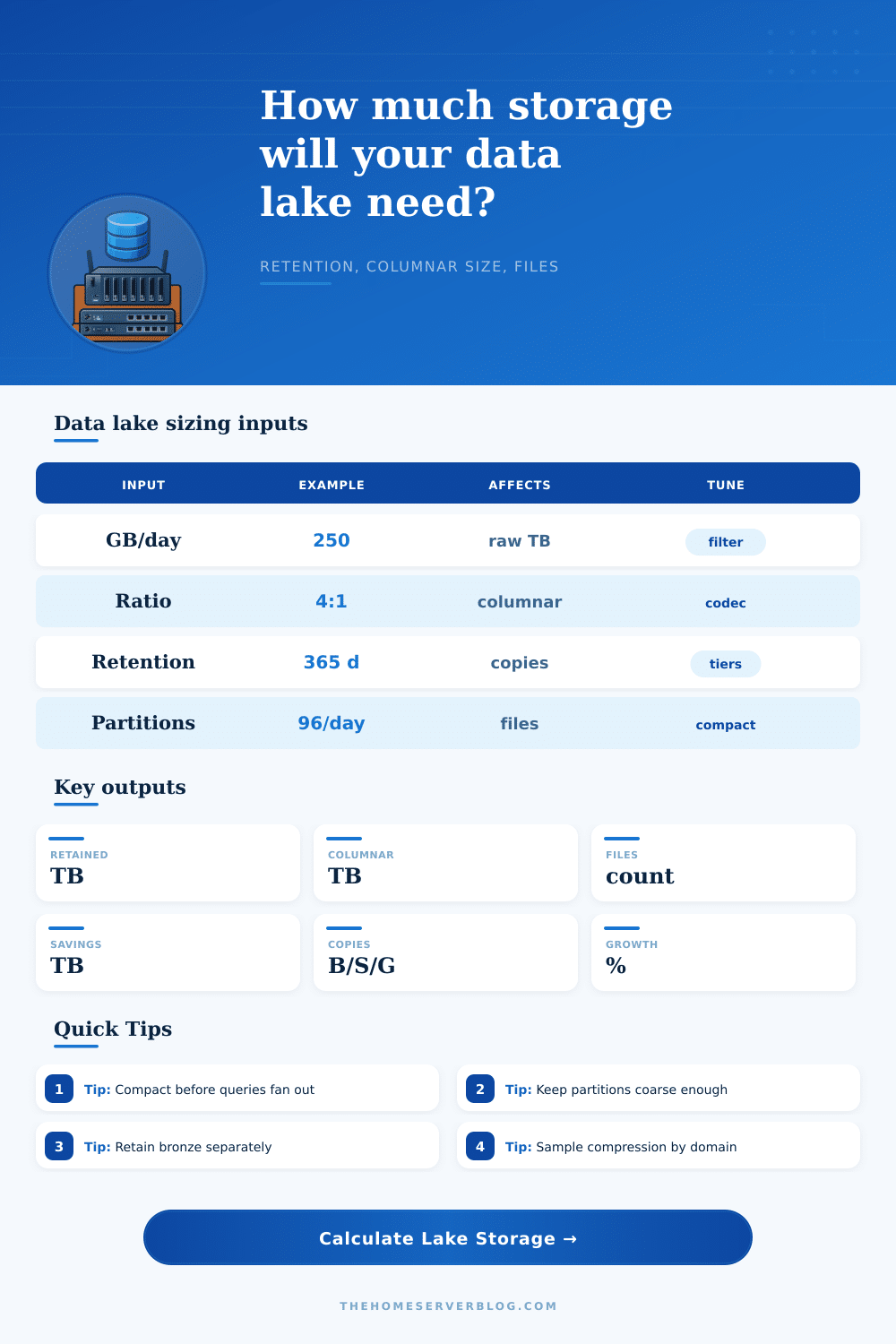
Estimate retained raw data, optimized Parquet or ORC footprint, bronze/silver/gold layer copies, partition-driven small files, and compaction savings for home lab and production lakehouse planning.
⚙Lake workload presets
📊Storage and layout inputs
Calculation breakdown
📈Derived lake metrics
🛠Lake format/spec comparison grid
Parquet
128-512 MBColumn chunks, row groups, statistics, and broad query engine support for data lake analytics.
ORC
64-256 MBStripes, indexes, bloom filters, and strong compression for Hive-style warehouse workloads.
Delta Lake
Log + filesTransaction log helps updates and time travel, but needs checkpoint and small-file maintenance.
Apache Iceberg
ManifestsSnapshot metadata and manifests scale table changes when partition evolution is important.
📄Layer storage planning table
| Lake layer | Typical format | Storage behavior | Calculator input | Planning note |
|---|---|---|---|---|
| Bronze | Raw JSON, CSV, Avro, or CDC logs | Usually near raw size before lifecycle cleanup. | Bronze copies | Keep immutable landing data only as long as replay needs require. |
| Silver | Parquet or ORC | Compressed, typed, cleaned, deduplicated, and partitioned. | Silver copies | Most analytics tables live here, so compression ratio matters. |
| Gold | Curated Parquet, Delta, or Iceberg | Aggregated or domain-specific marts may be smaller than silver. | Gold copies | Use fractional copies when only a subset reaches marts. |
| Archive | Cold object tier | Lower query rate, longer retention, fewer compact jobs. | Retention days | Separate audit requirements from hot BI retention. |
🗃Partition and compaction table
| Pattern | Partition count/day | Compaction interval | Small-file risk | Use when |
|---|---|---|---|---|
| Daily batch | 1 to 8 | 7 to 30 days | Low | Warehouse loads arrive in larger daily files. |
| Hourly logs | 24 to 96 | 1 to 7 days | Medium | Log search and dashboards need recent partitions quickly. |
| IoT or clickstream | 96 to 1440 | 1 to 3 days | High | Many topics, devices, or tenants write small objects frequently. |
| Cold audit | 1 to 31 | 30 to 90 days | Low-medium | Reads are rare and lifecycle tiers dominate query speed. |
📖Formula reference table
| Output | Formula used | What raises it | What lowers it |
|---|---|---|---|
| Retained TB | GB/day x growth x retention / 1024 | More ingest or longer retention. | Lifecycle rules and filtering noisy sources. |
| Optimized TB | Bronze raw + curated converted/unconverted layers + overhead | More copies, lower compression, and high overhead. | Better compression, fewer copies, and compaction. |
| Small-file count | Partitions x days x copies x files per partition | Many partitions and tiny streaming batches. | Coarser partitions and larger writer targets. |
| Compaction savings | Small-file overhead x compaction reduction rate | Higher overhead and more frequent compaction benefits. | Already-large files and low metadata overhead. |
📝Preset reference table
| Preset | Ingest shape | Copy model | Partition style | Expected pressure |
|---|---|---|---|---|
| Home Lab Logs Lake | Small syslog and app events | Bronze plus silver | Hourly | Small files more than raw TB. |
| IoT Sensor Lake | High-volume narrow metrics | Bronze, silver, partial gold | Device and hour buckets | Partition count and compaction load. |
| Clickstream Bronze Silver Gold | Wide events and sessions | Full three-layer model | Hour plus event domain | Large curated footprint. |
| Security SIEM Archive | Compressed logs retained long-term | Bronze-heavy archive | Day and source | Retention dominates storage. |
| Media Metadata Lake | Metadata, thumbnails, manifests | Curated search copies | Collection and date | Overhead from many tiny files. |
| Batch ETL Warehouse | Nightly fact and dimension loads | Silver and gold marts | Daily batch | Compression is the main lever. |
| ML Feature Store | Features and point-in-time snapshots | Silver plus gold features | Date and entity | Gold copies grow quickly. |
| PostgreSQL CDC Lake | WAL-derived row changes | Bronze CDC and cleaned silver | Table and hour | Many small batches before merge. |
| Cold Audit Lake | Low-touch compliance records | Bronze archive only | Month or day | Long retention, low compaction need. |
This calculator is a planning model. Validate with representative data because compression, manifest size, partition pruning, writer behavior, and table format metadata vary by engine.
Typically, a data lake project begins full of excitement and ends with an overage on your storage bill that appear to be a typing error. So you spin up a cluster, throw some logs into it, pull in a couple of streams of application data, and now you’re maintaining terabytes of unstructured JSON files no one looks at. Why does this happen? It’s not typically because the tools don’t work; it’s because math doesn’t add up.
Engineers has guessed at how long to retain things. They’ve assumed that compression will bail them out eventually. But they haven’t considered the silent killer of data lakes. These are small file overhead and the redundant copies created across various layers of data processing. Enter this data lake storage calculator, which will prevent you from guessing.
Why Your Data Lake Costs So Much
It models the efficient (columnar) format of ORC or Parquet, then estimates your raw retention requirements. It also makes you face the fact there is three layers: bronze, silver, and gold. Moving data from its raw landing zone into curated tables isn’t simply about changing the schema; it’s also about storage duplication until those raw files age out. Feed in your retention window and daily ingest volume, and the calculator do the math for you. It lets you know exactly how much all that duplication is costing you…until compaction happens.
Most commonly, the number of partitions are the killer variable. Partitioning by user session, by device ID or something else create thousands of little files per hour. Little files incur metadata overhead. And for every little file, there’s a listing operation on object store. Letting you specify both the percent overhead from small files and frequency at which you create partitions lets the calculator model that stress. Then it displays how many files are predicted prior to compaction. Ten thousand little files expected for one day can make coarsely grained designs suddenly look appealing.
Ratio is important, although people misunderstand what’s being compressed. Four-to-one sounds impressive… until you look at the fact that only your gold and silver layers gets the benefit. Your bronze just stays raw. It is by definition. If you hold bronze for a year and only compress the layers below it, the unchangeable rawness of your history dilutes any savings you achieve. And the tool allows you to assign a different copy multiplier to each of the medallion layer. Maybe you keep a complete copy of both bronze and silver, but only 1/2 a copy of gold, in case most of your data never gets to summary tables, and fractional inputs mirror how actualy warehouses really work.
The price of tidiness is compaction. Reducing metadata bloat and improving query performance mean grouping smaller files into bigger ones. The calculator has a compaction interval setting to show how much you save by merging frequently versus not. This is where storage costs meet engineering effort, so it shows the difference when you let files accumulate over time compared to aggressively maintaining the layout of your lake. Going daily keeps it tidy but burns compute cycles. Going weekly/monthly saves compute while leaving you with more fragmented data for longer.
Many of us fail to realize that retaining data is as much a policy decision as a technical one. Storing data for three years “just in case somebody asks” is costly. And storing it for those three years means your lake is clogged with cold things, which slows down your catalog queries. You should of planned better. The calculator assumes a straight percentage increase and projects growth to match. Storage isn’t static… You’ll see your ingests grow and your retention window expand. If you don’t account for this drift then your capacity planning is outdated by the end of the quarter.
To give some context to those decisions, the site includes a set of reference tables that compare layer behavior and file formats side by side. So now you know that Parquet would be better for one workload different than Delta Lake would be for another. That’s helpful to understand before it becomes a line item in your budget.
Before adding more compute clusters, right-size your partitions; before spending on curated layers, spend time modeling how that differs from your bronze. This is an attempt to show the tradeoffs early enough to avoid them becoming budget items. This is not a storage optimization game of minimizing your bytes at all costs. This is a storage optimization game of knowing where your bytes are and for how long. You can’t have a lake without structure, it’s just a swamp. Run the numbers early and keep it clean.