Diffie Hellman Group Strength Calculator
Compare finite-field MODP/FFDHE and elliptic-curve ECDH groups for VPN, IKEv2, TLS, WireGuard, and home lab security planning.
Group Strength Result
| Classical strength | Finite-field DH / DSA / RSA modulus | ECDH curve order | Typical symmetric peer |
|---|---|---|---|
| 80-bit | 1024-bit finite-field group; legacy only | 160 to 223-bit ECC range | Below modern AES planning |
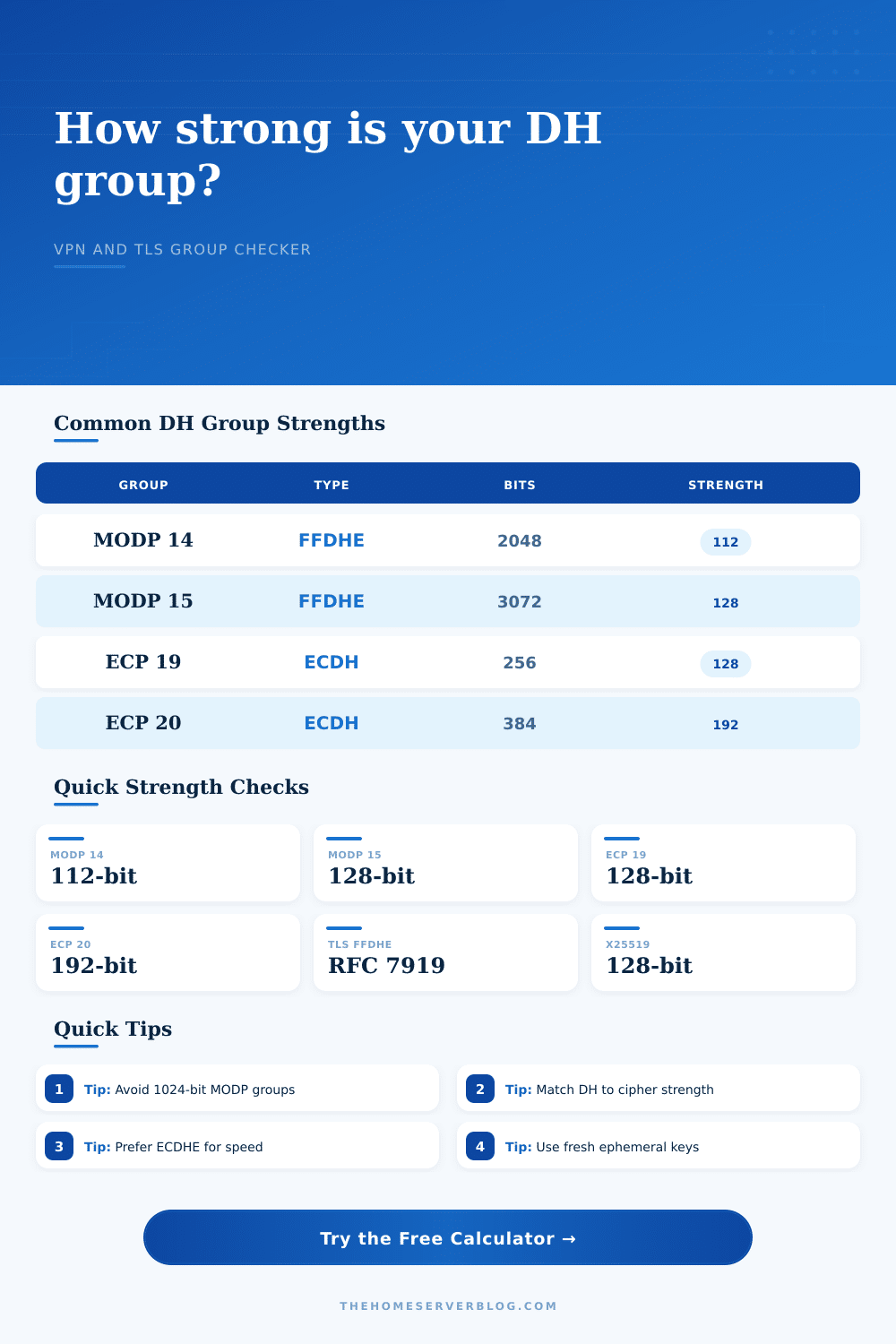
| 112-bit | 2048-bit finite-field group such as MODP 14 or ffdhe2048 | 224 to 255-bit ECC range | Minimum modern compatibility floor |
| 128-bit | 3072-bit finite-field group such as MODP 15 or ffdhe3072 | 256 to 383-bit ECC, including P-256 and X25519 | AES-128 and ChaCha20 planning target |
| 192-bit | 7680-bit finite-field group, approximated between MODP 17 and 18 | 384 to 511-bit ECC, including P-384 | AES-192 or high-assurance services |
| 256-bit | 15360-bit finite-field group; uncommon for home services | 512-bit and larger ECC, including P-521 | AES-256 classical-security ceiling |
The calculator interpolates finite-field strength between common NIST planning points and uses half-size curve strength for ECDH curves.
| Group | Protocol names | Bits | Use in a home server stack |
|---|---|---|---|
| MODP 2 | IKE group 2, 1024-bit MODP | 1024 p | Disable unless a legacy peer cannot be replaced. |
| MODP 14 | IKE group 14, 2048-bit MODP, ffdhe2048-like floor | 2048 p | Acceptable compatibility floor for IPsec tunnels. |
| MODP 15 | IKE group 15, 3072-bit MODP, ffdhe3072-like floor | 3072 p | Good default when finite-field DH is required. |
| MODP 16 | IKE group 16, 4096-bit MODP, ffdhe4096-like floor | 4096 p | Stronger finite-field choice with higher CPU cost. |
| MODP 17 | IKE group 17, 6144-bit MODP, ffdhe6144-like floor | 6144 p | High-strength but heavy for small routers. |
| MODP 18 | IKE group 18, 8192-bit MODP, ffdhe8192-like floor | 8192 p | Very strong classical finite-field option; test latency. |
| ECP 19 | IKE group 19, NIST P-256, secp256r1 | 256 curve | Efficient 128-bit VPN default for modern peers. |
| ECP 20 | IKE group 20, NIST P-384, secp384r1 | 384 curve | Good high-assurance ECDH option. |
| ECP 21 | IKE group 21, NIST P-521, secp521r1 | 521 curve | Near 256-bit classical strength, slower than P-256. |
| X25519 | TLS supported group x25519, WireGuard style DH | 255 curve | Excellent TLS and VPN choice when supported. |
| Scenario | Recommended floor | Good group choices | Reasoning |
|---|---|---|---|
| Internal home lab TLS | 112-bit | ffdhe2048, P-256, X25519 | Reasonable for local-only experiments and short-lived certificates. |
| Public reverse proxy | 128-bit | X25519, P-256, ffdhe3072 | Keeps handshakes fast while matching AES-128 style security. |
| Site-to-site IPsec | 128-bit | IKE group 19, 20, 15, or 16 | Balances tunnel stability, router CPU, and modern security floor. |
| Long-lived sensitive archives | 192-bit | P-384, P-521, MODP 18 | Use stronger classical groups and plan hybrid PQ migration. |
| Old appliance compatibility | 112-bit | MODP 14 minimum | MODP 2 and 5 are legacy pressure points; upgrade the peer if possible. |
| Check | Finite-field DH concern | ECDH concern | Calculator treatment |
|---|---|---|---|
| Public-key range | Reject y values outside 1 < y < p - 1 | Reject invalid points or malformed encodings | Partial or missing validation applies a penalty. |
| Subgroup membership | Small subgroup confinement can leak exponent bits | Invalid-curve attacks can leak scalar bits | Unknown checks reduce the action signal. |
| Short exponent | Too-short exponents may be easier than solving p | Scalar should match curve order practice | Effective strength uses min(group, exponent model, cipher). |
| Perfect forward secrecy | Fresh ephemeral DH limits key compromise blast radius | Fresh ECDHE gives the same session isolation | Static or long-lived DH receives a target increase. |
In Diffie-Hellman group selection, there’s a tradeoff between computation speed and math strength. Picture an electronic keypad versus a heavy bar for installing a lock.
The bigger the finite field number, the more CPU-intensive it gets, slower then the keypad, and might not even provide security you expect. Mathematically, the bigger number is stronger, so most users opt for maxing out at the biggest number. This happens when that doesn’t get you what you expect in terms of security, or when you don’t like how much overhead the server must deal with due to handshakes.
How to Balance Speed and Security
With that, all you have to do is input group and protocol preference, and let the calculator do the math. You won’t have to guess about conversions and coefficients anymore. You won’t have to squint at abstract bit lengths no more. Now you’ve got a practical strength rating.
For example, a 2048-bit prime in finite-field Diffie-Hellman equates to roughly 112 bits of classical security. Why does that matter? Because these days, 112 bits are considered the bare minimum for moddern compatibility. 112 bits will be sufficient for most internal traffic or home lab uses. But it sits uncomfortably close to the edge, something a well-funded attacker could eventually brute-force leveraging parallel processing. To get that same 128-bit security margin as defined by AES-128 standards, you’ll want to go up to a 3072-bit group. An additional thousand bits may not look like much on paper, but in practice, this mean a whole lot more CPU effort per tunnel establishment.
Elliptic curve cryptography is another tradeoff. Public keys of a given strength (like P-256 or X25519) are smaller than those of a comparable finite field group. Handshakes can be quicker. In the analogy above, they represent the electronic keypad. Handshakes can be quicker. In the analogy above, they represent the electronic keypad. They’re new, they’re fast, and they’re efficient.
You tend to see curves like X25519 or P-256 used on high-traffic VPN endpoints and other public-facing services, such as TLS proxies. The tradeoff is represented by the handshake cost index in the tool. Running a huge finite-field group on your router will slow down that router. If you only have so much power on your tiny home server, forcing it to do that work isn’t going to add anything to your security profile based off what you get from smaller curve. Sure, it’s a small thing, but it adds up if you want to keep your latency low.
But what about the other end? Many legacy devices can only handle older MODP groups. That’s a drag on your overall security posture. To model those sorts of situations, just select particular protocol profiles from the calculator. Pick TLS 1.3 if you’re connecting to a web server or IKEv2 if you’ve got site-to-site tunnels. It will factor in validation strictness and even length of time before keys expire.
Generating new ephemeral keys each time is better than re-using the same ones for days. Regardless of how solid the underlying math is, it adds risk. Static configs are penalized. Isolation matters too, not just complexity. A session key used in one should not compromise others.
In the background, there’s also quantum computing. While current quantum computers cannot break these systems, there’s a real threat from store-now-decrypt-later attacks on long-lived data. But there’s also the worry of store-now-decrypt-later attacks on long-lived but secret information. This toggle is included in the calculator. If you’re archiving something that has to be kept secret for decades, it encourages you to think about bigger groups and hybrid approaches.
That may be noise for most casual users. But for regulated industries, it’s a planning necessity. You shouldn’t of have to overengineer your home lab today. But you should understand what levers to pull as the threat model changes.
The mathematics of Diffie-Hellman isn’t a contest to pick the most mathematically strong number. Instead, it’s picking the appropriate number for your environment. You don’t need the strongest number to defeat any attacker in the real world. But you do want to spend enough CPU time on each connection.
Compare numbers, side-by-side, using the reference tables. Look at their effective strength rating, and let that be your final guide. The sweet spot is protecting your data with a configuration that doesn’t burn up your CPU on every connection, yet still leaves your network responsive. That’s the sweet spot where security is a feature instead of a burden.
The door flies open fast, and the lock stays firmly shut.