Doppler Shift Calculator
Estimate RF carrier offset from mobile, aircraft, drone, train, and LEO satellite motion using projected radial speed, channel spacing, and oscillator tolerance.
▣RF, mobile, and satellite presets
⚙Doppler link inputs
Full calculation breakdown
📻Equipment and spec comparison grid
VHF/UHF FM Radio
Wide enough that car and handheld Doppler is usually negligible, but ppm error can still move the carrier.
TCXO SDR Receiver
Good for ADS-B, L-band checks, and satellite passes when paired with software frequency correction.
LEO Satellite Downlink
UHF and higher downlinks often need live Doppler tracking or step tuning during a pass.
ADS-B Front End
Aircraft motion can create hundreds of hertz of shift, normally inside receiver bandwidth.
GNSS L1 Receiver
Satellite motion and receiver dynamics are large enough that acquisition search bins matter.
LoRa Gateway
Low data rates and narrow spreading factors can make oscillator tolerance more important than speed.
2.4 GHz Drone Link
High carrier frequency raises Doppler shift, though spread spectrum links usually tolerate it.
X-Band Ground Station
Microwave satellite links can see large offsets, so prediction tables and AFC loops become important.
📊Reference tables
| Preset case | Carrier | Radial speed | Approx shift |
|---|---|---|---|
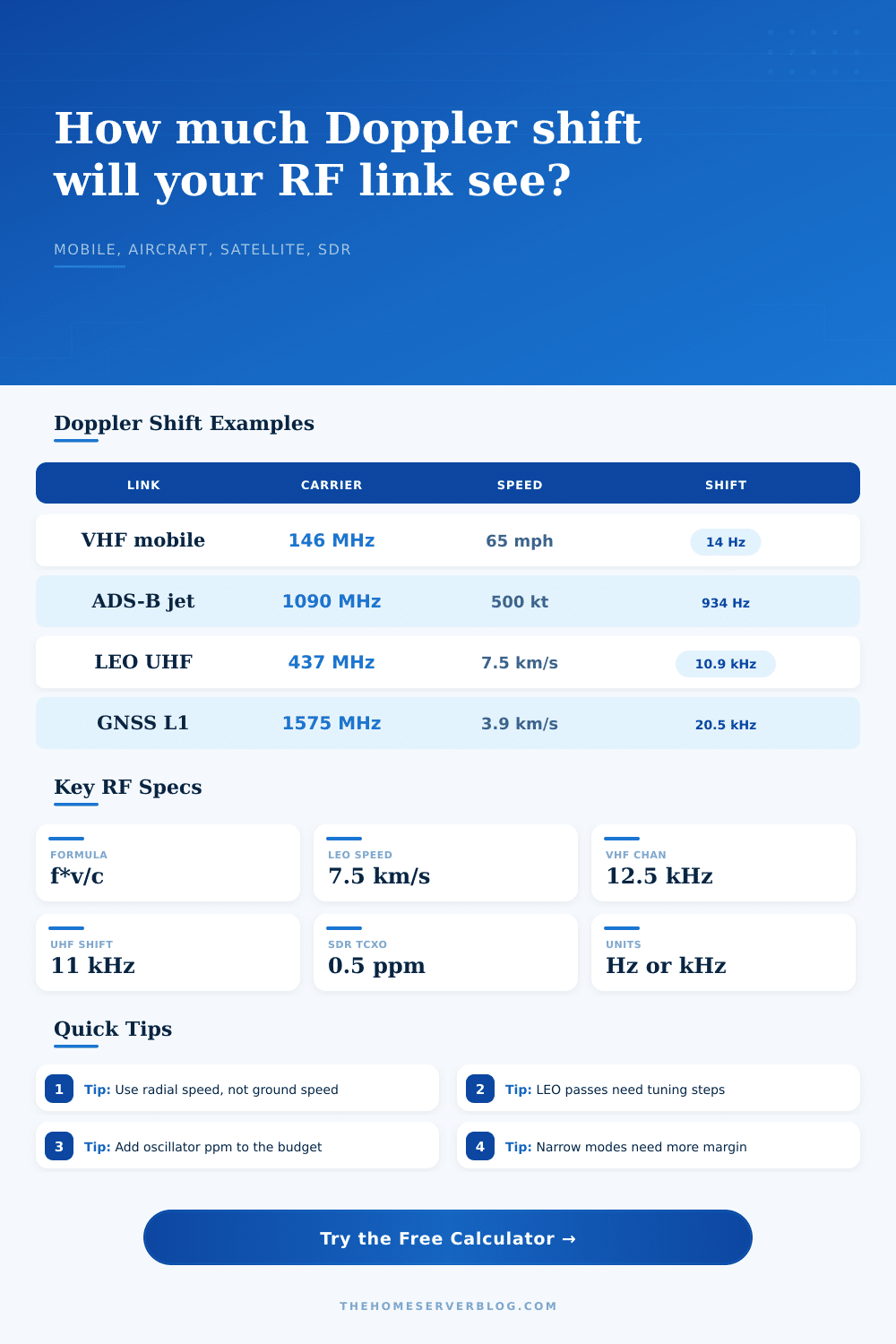
| 2 m FM car pass | 146.520 MHz | 29 m/s | 14 Hz |
| 70 cm hilltop mobile | 446.000 MHz | 38 m/s | 57 Hz |
| ADS-B jet closing | 1090.000 MHz | 257 m/s | 934 Hz |
| LEO UHF downlink | 437.100 MHz | 7500 m/s | 10.9 kHz |
| GNSS L1 acquisition | 1575.420 MHz | 3900 m/s | 20.5 kHz |
| RF band or system | Typical frequency | Common bandwidth | Doppler sensitivity |
|---|---|---|---|
| VHF FM amateur | 144-148 MHz | 12.5-25 kHz | Low for ground mobile |
| UHF FM / satellite | 430-450 MHz | 5-25 kHz | Moderate on LEO passes |
| ADS-B receive | 1090 MHz | About 2 MHz | Usually tolerated |
| GNSS L1 | 1575.420 MHz | Acquisition bins | High, must be searched |
| X-band satellite | 8-12 GHz | Mission dependent | Very high without tracking |
| Projection angle | Cosine factor | Effective speed | Practical reading |
|---|---|---|---|
| 0 deg direct closing | 1.000 | 100% | Maximum positive shift |
| 30 deg off-axis | 0.866 | 86.6% | Strong shift remains |
| 60 deg off-axis | 0.500 | 50.0% | Half the headline speed |
| 90 deg cross-track | 0.000 | 0% | Near-zero radial Doppler |
| 180 deg opening | -1.000 | -100% | Maximum negative shift |
| Correction method | Best fit | Typical interval | Watch item |
|---|---|---|---|
| Manual tuning steps | UHF voice satellite | 5-30 sec | Step size vs signal width |
| SDR software tracking | LEO data downlink | 1-5 sec | Clock ppm and TLE age |
| AFC loop | Digital receiver | Continuous | Pull range and lock time |
| Wide demod bandwidth | ADS-B or spread spectrum | None | Noise and adjacent signals |
| Acquisition bin search | GNSS and narrow beacons | Per acquisition | Search span and dwell time |
💡Planning tips
“Seven and a half kilometers per second. That’s how fast that thing is moving across the sky.” You’re standing on top of a hill, pointing a Yagi antenna at a satellite. In minutes, the carrier frequency shift more than ten kilohertz higher, or lower, to your radio.
For most folks casually checking VHF, a couple dozen hertz of drift goes unnoticed. But for tight connections like narrowband packet links or digital modes, getting precise alignment matter. Those few hundredths matter enough to make-or-break it.
Why Frequency Shifts Happen
With the calculator, you can estimate the offset so you don’t have to manually aim the dish. It’s simple, basic physics. How far the source approach or recedes from you affects the pitch you hear.
It’s not just about the ground speed itself. Maximum shift is a jet coming straight towards you. Minimum shift occur when it passes over your head at a right angle. And that’s where many folks screw up. They input only the airspeed and wonder why it doesn’t seem right.
Enter the radial component. Once you enter the angle into the tool it figures the trigonometry for you and spits out what you’re hearing, you won’t have to dig out a protractor to try to picture the velocity vector as the sound slips away.
Oscillator tolerance describe how much your gear drifts. Do we ever think about it? How much will your cheap radio wander when it gets warm? Several hundred parts per million is not uncommon. Is that more than the Doppler effect of some guy cruising down the highway in his car? Yeah!
You’re using a narrow channel at 12.5-kilohertz? Can’t ignore clock drift in your own gear. The calculator tacks this onto your budget so you know the whole story. Takes both hardware error plus motion error and rolls it into one figure. Tells you whether you just need a better temperature-compensated crystal or if your receiver should of been wider.
Because of their speed and brief duration, Low Earth Orbit satellites present a special case. Let’s say that your pass begin with a plus-eleven-kilohertz shift. Your pass concludes with an equal but opposite minus-eleven-kilohertz shift. That’s a twenty-two-kilohertz swing during your conversation.
And if you’re operating your radio at the center frequency, you’ll drop the satellite at either end. You can either tune in steps which is not practical or track the shift. The table on the page makes it clear: common bands, how much shift you can expect, and why LEO tracking software becomes nearly mandatory for reliable reception.
A repeater link on a hilltop barely even feel it moving. And then there’s the new: ADS-B. At two-hundred fifty meters per second, aircraft aren’t going slow. And yet the signal travels on 1.09 gigahertz carrier frequency.
There’s a wide capture bandwidth for the receiver. Yeah, you can see that shift almost a kilohertz. It’s designed to swallow it. Retuning every second isn’t necessary.
Sensitivity and bandwidth is always a tradeoff. The wider filter swallows more noise but hides the shift. The narrow filter rejects the noise but requires exact frequency alignment. What you can tolerate is what you’re choosing.
Of course planning for the unknown also helps. Include a margin in your numbers so when the orbit isn’t quite right or your estimated angles are off a bit, you still have some headroom. A 10% buffer is generally good for field use. So if you’re off by a fraction of a degree (and we all will be) you won’t chase the signal as it dissapears.
This isn’t about just catching the signal. It’s about keeping it coherent. Whether you’re trying to set up a solid drone control link or chase down a NOAA weather satellite, knowing how much things shift avoids frustration. And you no longer blame the antenna and instead trust the math.
The frequency shifts, it’s now simply your job to move with it.