UPS Battery Sizing Calculator
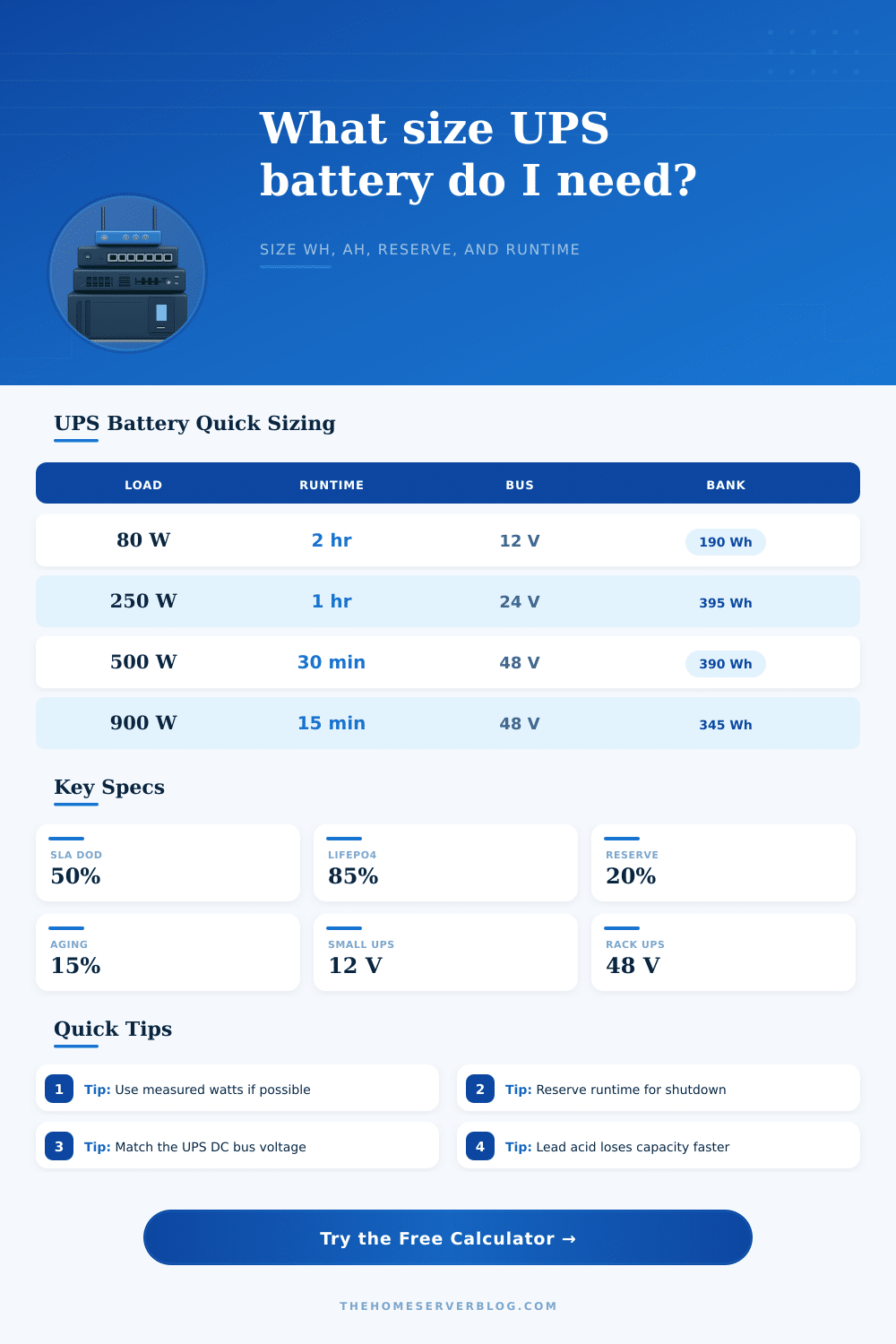
Estimate nominal Wh, usable Ah, DC bus current, inverter losses, reserve runtime, and battery module count for a home lab UPS bank.
Use measured real watts from a UPS display, PDU, or plug-in meter when possible.
For shutdown-only UPS sizing, 0.25 to 0.5 hours is common.
Online and double-conversion units often consume more energy than line-interactive units.
Lower DoD generally improves cycle life, especially with lead-acid UPS packs.
| Chemistry | Design DoD | Runtime Behavior | Home Lab Note |
|---|---|---|---|
| Sealed lead acid AGM | 50% | Voltage sag increases under high load and near empty. | Common in desktop and rack UPS cartridges. |
| Gel lead acid | 45% | Prefers gentler charge and discharge profiles. | Use only with compatible UPS charging voltage. |
| Deep-cycle AGM | 60% | Handles deeper cycles better than small UPS bricks. | Useful for external packs with proper fusing. |
| LiFePO4 | 85% | Flat voltage curve and high usable energy. | Needs BMS and charger compatibility check. |
| Lithium-ion NMC | 80% | High energy density with strict BMS requirements. | Best used in UPS units designed for lithium packs. |
| NiCd industrial | 70% | Tolerates abuse and temperature better than lead acid. | Rare in homes, but useful as a comparison point. |
| UPS Class | Typical DC Bus | 12 V Modules In Series | Planning Detail |
|---|---|---|---|
| Small router UPS | 12 V | 1 module | Simple wiring, but higher current at moderate loads. |
| Tower UPS | 24 V | 2 modules | Common for home office and light server loads. |
| Mid-size tower | 36 V | 3 modules | Less current than 24 V, often used in 1500 VA units. |
| Rack UPS | 48 V | 4 modules | Good fit for switches, NAS, and compact server racks. |
| Larger rack UPS | 72 V to 96 V | 6 to 8 modules | Lower current, but battery string matching matters more. |
| Scenario | Typical Load | Useful Runtime | Sizing Note |
|---|---|---|---|
| Router, ONT, firewall | 25 W to 80 W | 1 to 4 hours | Runtime matters more than inverter surge. |
| NAS graceful shutdown | 60 W to 180 W | 15 to 45 minutes | Reserve enough time for clean disk flushes. |
| PoE switch and APs | 90 W to 350 W | 30 to 120 minutes | Include actual PoE draw, not only switch base draw. |
| Mini server cluster | 180 W to 600 W | 15 to 60 minutes | Use measured average plus boot and fan margin. |
| Rack core stack | 500 W to 1200 W | 10 to 30 minutes | High DC current can force a higher bus voltage. |
| Step | Formula | Purpose | Why It Matters |
|---|---|---|---|
| AC energy | Watts × hours | Find the load energy needed at the outlet. | This is the runtime target before UPS losses. |
| DC energy | AC Wh / efficiency | Account for inverter conversion losses. | A low efficiency setting increases battery size quickly. |
| Nominal bank | DC Wh × reserve / DoD / aging | Convert usable energy into installed battery capacity. | Prevents sizing a bank that only works when new. |
| Bus Ah | Nominal Wh / DC V | Translate energy into amp-hours at the UPS bus. | Battery strings must match the UPS bus voltage. |
| DC current | Watts / efficiency / DC V | Estimate battery-side current during backup. | Higher current raises cable, fuse, and voltage sag concerns. |
When you choose a battery bank for your Uninterruptible Power Supply (UPS) units, you must ensure that the battery bank you choose is appropriate for your hardware requirement. While it might seem like the best idea to purchase the largest battery bank that you can afford, a battery bank must be size correctly for your hardware and the aging of those batteries over time. Many people believe that a battery bank should provide power for a set amount of time to their server hardware, but the reality is that people often find out too late that the battery bank either cannot provide the necessary current to the UPS from the battery bank, or that it does not have enough runtime to meet the target runtime that the server administrator intend the battery bank to have.
An incorrectly sized battery bank can result in a corrupted array that stores the server data rather than being able to cleanly shutdown that server. UPS units take the DC energy from the battery bank and convert it to AC energy through an inverter circuit. An inverter is never 100% efficient with the energy that it sends to the connected hardware; some of that energy is lost to heat within the UPS unit.
How to Choose the Right Battery Bank for Your UPS
The efficiency setting within the UPS unit will impact the size of the battery bank that is required for the hardware; the lower the efficiency setting, the more energy that the battery bank must provide to supply the hardware with the power it needs. Battery capacity must be provided for both the hardware and the heat that are lost by the UPS unit. A calculator is available for UPS manufacturers to calculate the size of the battery bank that is required based off the watts that are drawn by the hardware and the efficiency of the UPS unit.
Battery banks has a depth of discharge that limits the extent to which the UPS discharges them. Lead acid batteries lose their capacity and the length of their cycle if they are ever discharged to levels below half of the total energy that the battery bank can store. Lithium iron phosphate battery bank can be discharged to higher levels relative to lead acid batteries and can, therefore, provide more runtime in the same amount of physical space.
The software tool that calculates the size of the battery bank will automatically adjust to provide for deeper discharge cycles if the chemistry is changed from lead acid to lithium batteries. However, it is still important to ensure that the charging circuit on the UPS unit is compatible with the chemistry of the battery bank. For example, many UPS unit are set to provide the charging voltage of sealed lead acid batteries; they can either undercharge or overcharge the lithium battery bank if the Battery Management System does not provide the UPS unit with the proper charging voltage.
Beyond the factors that impact the performance of the battery bank, there are two settings within the software tools for calculating the size of the battery bank that will protect your hardware in the future. The reserve runtime provides for additional minutes of runtime after the UPS unit has performed a graceful shutdown of the data servers and virtual machine. The aging allowance accounts for the fact that battery banks lose some of their capacity over time if they are continually in use in warm environment.
The age of the battery bank, the reserve runtime, and the aging allowance will all increase the size of the nominal battery bank that is selected and purchased for the UPS units. By accounting for these setting, the battery bank will still meet the target runtime eighteen month from now. If these two settings are not included when setting up the UPS units, the battery bank will have to be replaced prior to the time that the manufacturer estimate for the useful life of the battery bank.
The DC bus voltage that the battery bank provides will have an impact upon the amperage of the battery bank as well as the voltage drop that occur within the cables that connect the battery bank to the UPS unit. A 48-volt battery bank will require half of the amperage as a 24-volt battery bank for the same amount of load, and the higher voltage will reduce the voltage drop within the cables. A voltage drop within the battery bank allows for the use of thinner wires or cables to connect the battery bank to the UPS unit.
A table of different voltages of battery banks and the amount of 12-volt module that are required to provide that bus voltage can be found in the manufacturer specifications. The bus voltage can be used to determine if additional battery bank string should be connected in parallel, or if the UPS units can be replaced with those of a higher voltage. The amount of real power that the hardware draws is typically less than the nameplate power rating for that hardware.
Network Attached Storage (NAS) device, for example, may idle at 60 watts, but may spike to 180 watts during certain operation. Power over Ethernet (PoE) switch will draw the amount of power from the data switch that is used by the cameras or access point that are connected to the switch. To determine the load for the battery bank, it is best to measure the power draw of the hardware with a meter over the course of a day.
The highest reading will be entered into the load field within the software tool. Furthermore, many UPS units also include a surge margin setting; when the UPS unit is initially powered on, there is a surge within the power draw of the UPS unit as the disk within the UPS unit spin up to full speed; the surge margin ensures that the current draw of the UPS unit does not exceed the current that is provided to the battery bank and the fuse that protect the battery bank. Finally, there are a few additional factor that will impact the battery bank and its ability to provide runtime for your data server.
For instance, battery banks of the lead acid chemistry lose their capacity if the temperature within the location drop to levels that are too low for the batteries to effectively perform their task, while the lead acid batteries lose their capacity the faster if the temperature within those location is too high. Similarly, the lithium battery bank have a broader range of tolerance for temperatures, but still require the provision of airflow around the Battery Management System (BMS) box that control the individual battery bank. Furthermore, regardless of the chemistry of the battery bank, neither chemistry perform well if the battery bank is placed behind the rack door of the data center; air must be able to move in a front to back manner by the battery bank.
If the temperature within the data center is higher than 25 degree Celsius, a higher aging allowance will be required for the battery bank to still meet the runtime specification after it ages within the data center over time. After calculating the required size of the battery bank that will be used with the data center’s server, that calculation should be verified with the actual hardware that will be utilized. The battery bank will have to be connected to the data center’s hardware, and the load can be discharged to verify the runtime of the battery bank.
This will allow the administrator to determine if the reserve runtime and aging allowance setting are appropriate, or if an additional battery bank is required to provide the necessary runtime to the data center’s hardware. This step should of been performed each time additional drive are added to the UPS units, if a switch is replaced, or if the rack behind which the battery bank is installed is moved.