Exponential Backoff Calculator
Plan retry timing before it becomes outage traffic. Model capped exponential delays, jitter spread, timeout boundaries, success probability, concurrent clients, and retry budget pressure.
Retry Policy Inputs
Results
Distributed System Presets
Backoff Table
| Attempt | Scheduled delay | Jitter min | Jitter max | Cumulative wait |
|---|
Retry Load Table
| Attempt | Chance reached | Clients trying | Expected successes |
|---|
Jitter Strategy Grid
| Strategy | Formula idea | Best for | Tradeoff |
|---|---|---|---|
| No jitter | delay = capped exponential delay | Single client tests, deterministic demos | Synchronizes clients and can amplify outages |
| Full jitter | random between 0 and scheduled delay | Large client fleets, public APIs, brownouts | Some clients retry very soon unless budgeted |
| Equal jitter | half delay plus random half delay | Latency-sensitive services that still need spreading | Less spreading than full jitter during big waves |
| Decorrelated jitter | random between base and previous delay times multiplier | Long-running reconnect loops and queue consumers | Harder to predict exact schedules |
Common Backoff Ranges
| Use case | Initial delay | Multiplier | Cap | Attempts |
|---|---|---|---|---|
| Browser request retry | 100 to 300 ms | 1.5 to 2.0 | 2 to 10 s | 3 to 5 |
| Server-to-server API | 50 to 250 ms | 2.0 | 1 to 30 s | 3 to 6 |
| Webhook delivery | 1 to 10 s | 2.0 | 1 to 15 min | 5 to 12 |
| IoT reconnect | 2 to 30 s | 1.5 to 2.0 | 1 to 30 min | Many, budgeted |
| Database transient failure | 10 to 100 ms | 1.5 to 2.0 | 500 ms to 5 s | 2 to 5 |
Practical Tips
You’re hitting a service that’s returning 503s, so all of your system clients start pounding away at it in parallel. Instead of assisting the system back to health, well-intentioned retries actualy magnify the outage. That’s the thundering herd problem.
Before you roll out your retry policy in production, the calculator above will do the math for you, letting you know exactly how many requests your retry policy will generate. Most engineers design their retries based off instinct, the calculator will help you turn abstract world of timing logic into concrete traffic estimates.
How to Set Up Your Retry Policy
It’s a pretty basic mechanism: You begin with a delay (say two hundred milliseconds) and multiply your delay by an amount following every failure. Normaly that amount is two, which means delays compounds exponentially. But here’s the problem with straight-up exponential growth: If lots of client fail at exactly the same moment, they’ll all conclude their same delays at the exact same moment. And that results in a new wave of synchronized requests.
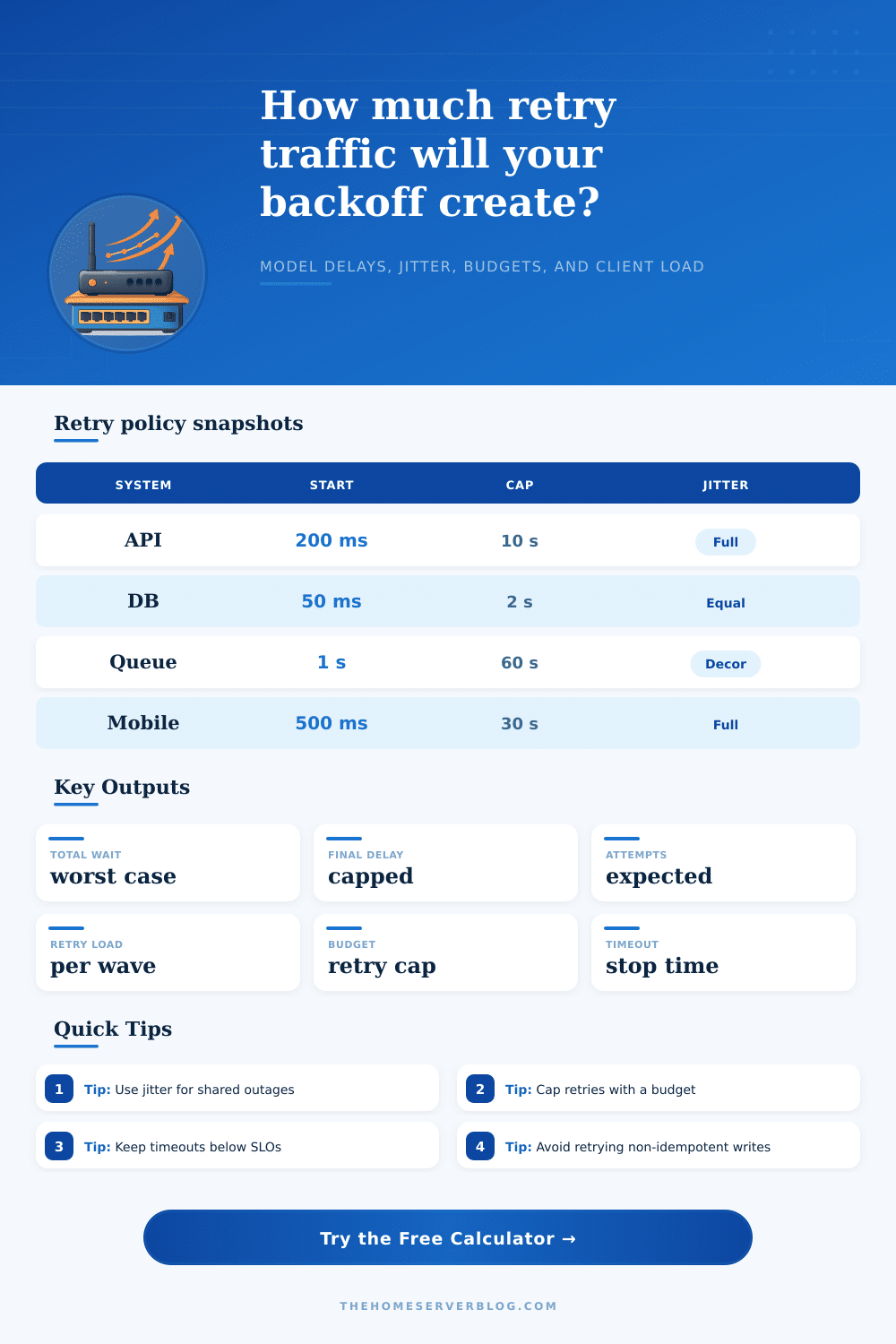
This is why it’s important to include some jitter, which randomizes the wait times and scatters out retries so you don’t get a tsunami of requests on the server, but just a trickle. To do so, the calculator provides options on your jitter strategy… Which will change the nature of your recovery.
For example, full jitter selects a random time from zero to delay as computed; this is aggressive (and effective) at breaking herds. Equal jitter is in-between: it spreads out the load, but also gives you some amount of predictability. Decorrelated jitter are good if you’re trying to reconnect after a long delay, since it helps prevent you from getting caught in a rhythmic pattern that might collide with timing elsewhere in the system. The balance among these strategies is between how much chaos they inject into request stream versus how quickly you can recover.
However, there are some hard limits you must place. Users only have so much patience, and max delay cap keeps waits finite. So, for example, if you’ve got a cap of ten seconds, then no single retry will ever take more than that amount of time, even after multiple previous failures. Finally, the overall timeout serves as the last stopper; if the service never returns within this period, client will just give up. It’s important to make this timeout less than your user-facing service level objective. For instance, if your user-facing SLA is five seconds, then having a retry loop that takes thirty seconds violate your promise to the user.
If you’re within your budget, you’ll see it in the outputs. Compare the retry load against your budget. For example, a budget of 20% allows one retry for each five original requests. If the calculator tells you you’re over-budget, your current settings will send more traffic to your upstream service then it can handle during an outage. This is where it starts getting dangerous. Consider raising the initial delay or lowering max attempts to decrease the pressure.
In particular, don’t repeat failed requests that can’t be fixed (e.g., authorization errors or validation failures aren’t transient, and will always fail). Think about idempotency too: If a retry results in a duplicate booking or duplicate charge, then nothing in smart backoff would of helped you avoid a bug in your business logic.
To get you started tuning your parameters, the tool offers presets for typical scenarios. These include using an API gateway or a database connection pool. These presets is listed on the reference tables.
Here is a word of caution. All in all, backoff is a balance between holding back and bouncing back. How resilient do I need to be while still keeping my head down? You need to be resilient long enough to recover from the occasional hiccup, but not so aggressive as to transform a blip into a blackout.
By translating time-based settings into actual requests, the tool gives you a handle on this balance. Every millisecond of delay add up across thousands of clients. Watch what happens as you tweak the knobs; if the resulting retry load fits your bill, you’ve probably discovered the right balance for your use case.
At the end of the day, you want to fail gracefully and not attempt to recover if it’s clear things aren’t going to work out. Protecting your infrastructure and keeping users’ trust in mind means having a well tuned backoff policy. When the smoke clears you’ll have systems prepared for normal traffic rather than dealing with a mess of your own creation.