Home Standby Generator Sizing Calculator
Estimate a standby generator for essential circuits, HVAC locked-rotor surge, managed load sequencing, voltage, phase, and transfer switch ampacity.
⚙Standby Presets
▣Service And Transfer Switch
⌁HVAC Locked Rotor And Sequencing
▦Essential Circuit Load Grid
Priorities shape the starting-surge assumption: critical loads are always counted, managed loads are staged, and shed loads are excluded unless included above.
Recommended Standby Generator
▤Equipment And Standby Load Grid
▥Essential Circuit Reference
| Essential Circuit | Running Watts | Starting Watts | Sizing Note |
|---|---|---|---|
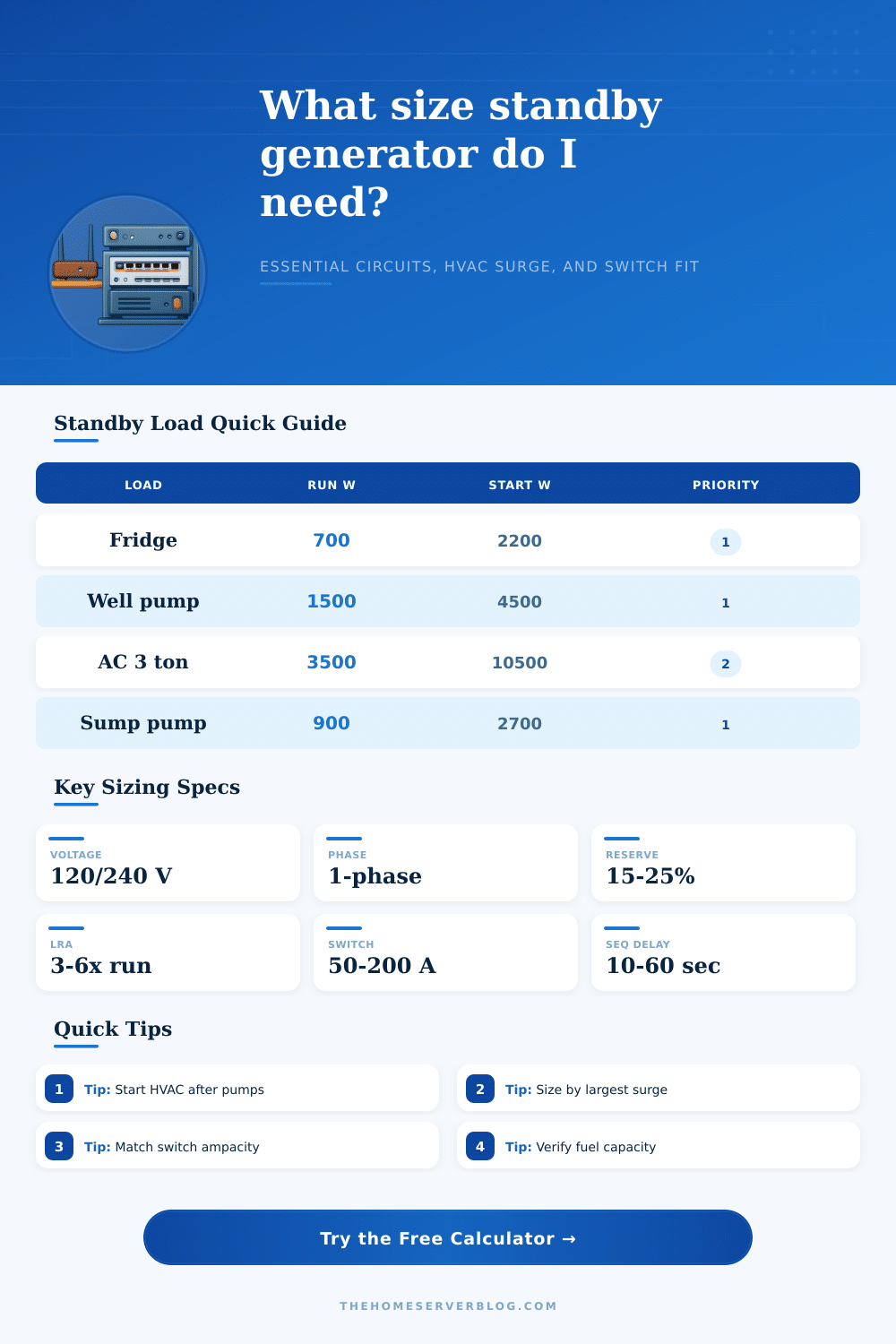
| Refrigerator or freezer | 500-900 W | 1,500-2,500 W | Count one compressor surge |
| Sump pump, 1/2 hp | 800-1,100 W | 2,200-3,200 W | Often critical during storms |
| Well pump, 1 hp | 1,500-2,000 W | 4,000-6,000 W | Start before HVAC when possible |
| Gas furnace blower | 600-1,000 W | 1,200-2,000 W | Usually easier than electric heat |
| Network, modem, small server | 150-700 W | 200-900 W | Low surge, high priority |
▧HVAC LRA And Start Method Table
| Compressor Size | Typical Run | Nameplate LRA | With Soft Start |
|---|---|---|---|
| 2 ton AC | 2,300-2,800 W | 45-60 A | 20-35 A equivalent |
| 3 ton AC | 3,200-4,000 W | 65-85 A | 30-45 A equivalent |
| 4 ton AC | 4,300-5,200 W | 80-110 A | 40-60 A equivalent |
| 5 ton AC | 5,500-6,500 W | 100-140 A | 50-75 A equivalent |
▨Voltage, Phase, And Ampacity Table
| System | Amps Formula | Common Use | Switch Note |
|---|---|---|---|
| 120/240 V single phase | W ÷ 240 | Residential standby | Use 50-200 A ATS |
| 120/208 V three phase | W ÷ (208 × 1.732) | Small commercial | Balance phases |
| 277/480 V three phase | W ÷ (480 × 1.732) | Large buildings | Use listed equipment |
| Managed load module | Stage largest motor | HVAC and pumps | Protects voltage dip |
▩Common Standby Preset Outcomes
| Scenario | Included Loads | Typical Size | Best Sequencing |
|---|---|---|---|
| Critical circuits | Fridge, lights, network | 7-10 kW | Minimal delay |
| Well pump rural | Pump, furnace, fridge | 10-14 kW | Pump before HVAC |
| Managed 3 ton AC | Essentials plus AC | 16-22 kW | Soft start preferred |
| Large essential ATS | Multiple motors, kitchen | 22-30 kW | Smart load manager |
A standby generator will provide electricity to an house if the main power supply fails due to a storm. For a standby generator to properly supply a house with electricity, the generator must be sized correctly to meet the electrical needs of the house. The generator must be sized according to the electrical loads that a house require to operate.
To determine the proper size of a standby generator, a person must understand the difference between running watts and starting surge. Running watts is the amount of electricity that a device uses while it is running. Starting surges is the amount of electricity that a device requires at the beginning when it starts to function.
How to Size a Generator for Your House
Devices like refrigerators, well pumps, and air conditioning units require a starting surge that is more higher than the running watts of those devices. The starting surge for these appliances can be three to four times higher than the running wattage. If the standby generator that is used is too small to provide the amount of electricity to perform the starting surge of an appliance, the voltage will drop and the appliance will fail to start.
A person can use a calculator to determine the proper size of a standby generator. The calculator can account for the electrical loads of running watts and starting surges. Additionally, a calculator allow a person to determine which electrical circuits is most important so that the starting surges of motors can be sequenced so that not all appliance start at the same time.
For instance, the start of a well pump can be sequenced to occur after the start of an air conditioner to minimize the starting surge of both appliances. If a person does not use the calculator to sequence the starting surges, the person will require a larger standby generator to handle those starting surges. A larger standby generator will cost more money than if the start of appliances could be sequenced.
Therefore, sequencing the electrical circuits of a house can save a person money on the purchase of a standby generator. The type of fuel that the user uses for a standby generator will affect the amount of electricity that the standby generator can produce. For instance, natural gas has less energy per unit then propane.
If the standby generator uses natural gas, the natural gas that is delivered to the generator may have energy lost during the transport of the gas through the gas lines. Additionally, if the house that is to be equipped with the standby generator is located at a high altitude, the natural gas may lose some of it energy during the process of extraction from the ground. These energy losses will reduce the total energy of the natural gas that reaches the standby generator.
The calculator for determining the size of a standby generator includes a derating field for these types of energy losses. If a person does not account for these energy losses in the standby generator, the generator may not produce enough power to run appliances like the furnace blower and the well pump. The transfer switch will connect the standby generator to the electrical panel in the house.
The transfer switch must be able to handle the amount of electricity produced by the standby generator. The transfer switch must also be able to handle the electrical load of the house. For instance, a person can purchase a standby generator with the proper kilowatts for the house, but the transfer switch will not be able to provide enough electricity for all of the electrical loads in the house if the transfer switch is too small.
A transfer switch can be sized correctly if a calculator determine that the current produced by the standby generator is equal to the rating of the transfer switch. Additionally, if the transfer switch is too small for the house electrical load, the standby generator will cause the circuit breakers to trip or the electrical conductors to overheat. Therefore, it is necessary to size the transfer switch correctly.
A person may need to add additional electrical loads to the house in the future. For instance, a person may want to add an electric vehicle charger to the house. If a person plans on adding more electrical loads in the future, a reserve percentage should of been included in the size of the standby generator.
The settings in the calculator allow for a person to include a fifteen to twenty-five percent reserve for future electrical loads. This percentage allow for more power to be provided for additional electrical devices without having to upgrade the standby generator in the future. Additionally, it can help prevent voltage drops in appliances and circuits that have long wire runs between the standby generator and the transfer switch.
Finally, a person must install the standby generator according to the manufacturers instructions. The manufacturer may require that a qualified electrician or a dealer installs the generator. Additionally, local codes will dictate how the generator’s concrete pad and gas lines will be installed.
The calculator will provide a recommendation for the size of the generator but the professional installer will ensure that such a size can be implemented according to local laws. Additionally, the calculators requirements can be met with realistic data about the home so that the standby generator will be able to power the essential items in that house during power outages.