IP Address Class Calculator
Identify IPv4 class ranges, default masks, usable hosts, and fit prefixes for home labs, VLANs, legacy plans, and special-use blocks.
Full Breakdown
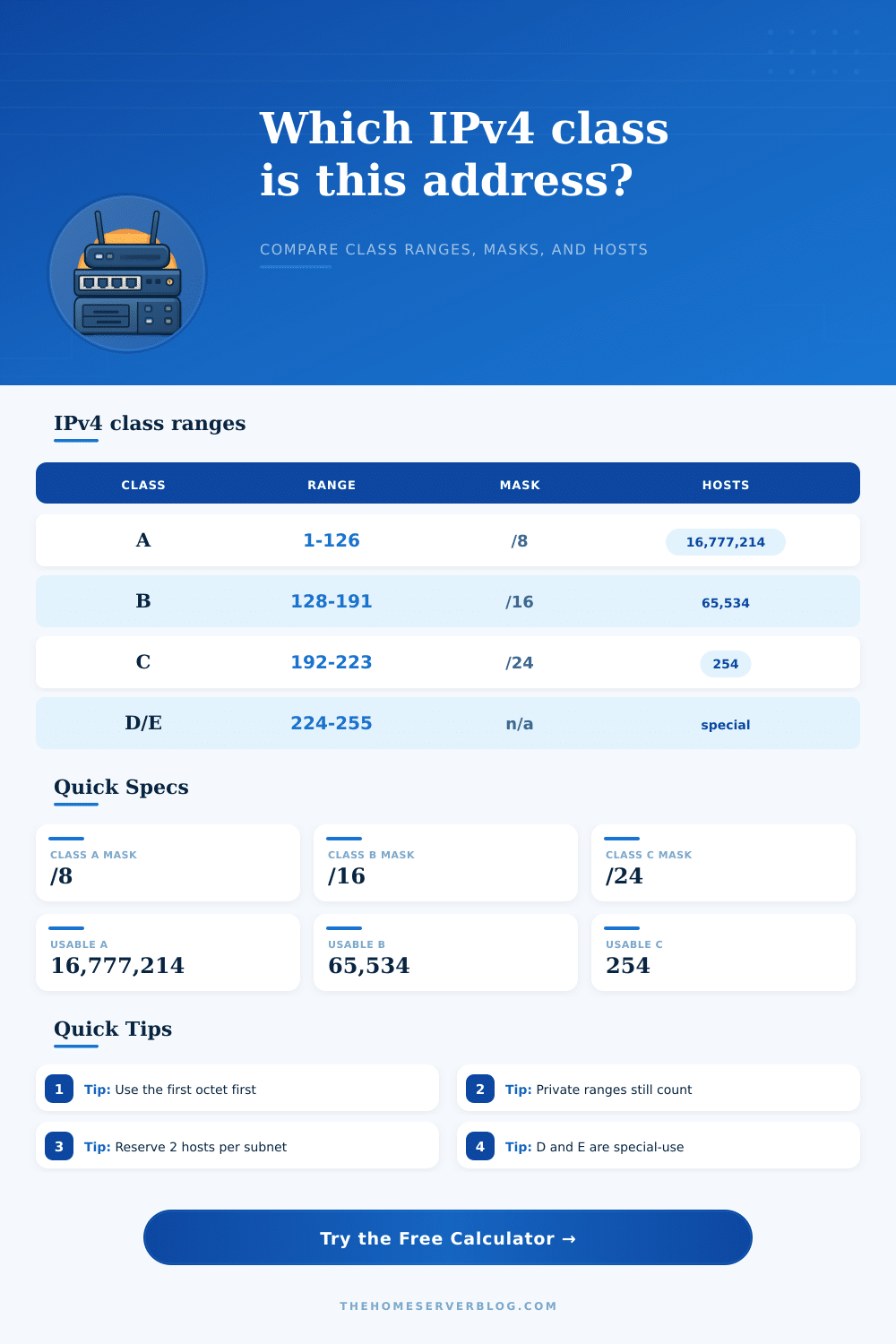
| Class | First Octet | Default Mask | Usable Hosts |
|---|---|---|---|
| Class A | 1-126 | 255.0.0.0 | 16,777,214 |
| Class B | 128-191 | 255.255.0.0 | 65,534 |
| Class C | 192-223 | 255.255.255.0 | 254 |
| Class D/E | 224-255 | n/a | special-use |
| Private Block | Class View | Range | Notes |
|---|---|---|---|
| 10.0.0.0/8 | Class A | 10.0.0.0-10.255.255.255 | Large home and lab nets |
| 172.16.0.0/12 | Class B | 172.16.0.0-172.31.255.255 | Mid-size private space |
| 192.168.0.0/16 | Class C | 192.168.0.0-192.168.255.255 | Common home LAN block |
| 100.64.0.0/10 | Class A | 100.64.0.0-100.127.255.255 | CGNAT shared address space |
| Special Range | Type | Class View | Notes |
|---|---|---|---|
| 127.0.0.0/8 | Loopback | Class A | Local host only |
| 169.254.0.0/16 | Link-local | Class B | No DHCP lease |
| 224.0.0.0/4 | Multicast | Class D | Group delivery space |
| 240.0.0.0/4 | Reserved | Class E | Experimental and reserved |
| Prefix | Total | Usable | Typical Fit |
|---|---|---|---|
| /24 | 256 | 254 | Small LAN |
| /25 | 128 | 126 | Split floor |
| /26 | 64 | 62 | IoT or guest |
| /30 | 4 | 2 | P2P link |
This calculator keeps class detection, special-use checks, subnet fit, and sample-host math separate so you can see exactly how an IPv4 block behaves.
An IP address is a number that identifies a device on a network. There are different class of IP addresses, each of which are categorized according to the value of the first octet of the IP address. Network engineers classified IP addresses into different classes to allocate different numbers of host to different networks.
The first octet of an IP address determine the class of the IP address, and the value of the first octet also determines the number of hosts that a network can support. IP addresses that begin with a first octet between 1 and 126 are of Class A. Each Class A IP address allow for approximately 16 million usable hosts on the network. Class A IP addresses are best suited to very large organizations, but are inefficient for small networks due to the huge number of possible host addresses that they provides.
IP Address Classes and Subnets
IP addresses that begin with a first octet between 128 and 191 is of Class B. Each Class B IP address allows for approximately 65,000 usable hosts on the network. IP addresses that begin with a first octet between 192 and 223 are of Class C. Each Class C IP address allows for 254 usable hosts on the network. Class C IP addresses are appropriate for small local area network, but the limited number of hosts that they support.
IP addresses that begin with a first octet of 224 or higher are of Class D or Class E. These classes of IP addresses is used for multicast communication or are reserved for experimental use, respectively. While most moddern networks use Classless Inter-Domain Routing (CIDR) as a standard, the logic of IP classes is still used. Even in private networks, IP addresses still use the logic of IP classes; thus, a private IP address in the 10.0.0.0 range will behave like a Class A IP address until a subnet mask is applied to that private IP address.
Subnetting allow for an IP address block to be divided into smaller IP address blocks. Additionally, using borrowed bits from the subnet mask allows those smaller blocks to be created within the initial IP address block. One recommendation for IP subnetting is to allow for a growth reserve within the IP address block.
Providing for a growth reserve in the subnetting of an IP address block provides extra IP addresses for future network device. In creating a network, the number of hosts that the network will support will determine the size of the subnets that will be used on the network. If a network will require 42 device to be connected to the network, for instance, the subnet mask that is applied to that network will need to provide for at least 42 usable IP addresses.
By comparing the lengths of subnets that can be created within an IP address block, it is possible to determine whether a network will be able to support the needs of the devices that will be connected to the network. In any network, it is important to be aware of IP addresses that cannot be used to provide host addresses for devices on the network; these are referred to as special IP addresses, such as multicast addresses. IP addresses that begin with a first octet of 224, for instance, are used for multicast communication and thus will not provide any usable host addresses for network devices.
Subnets always contain two address that cannot be allocated to network devices. These are the network address itself and the broadcast address. For example, if a network contains 256 devices, only 254 of those devices will have usable host addresses.
Uses of preset scenarios for subnets will help individuals to formulate an effective plan for a network. If an individual understands the IP address classes and the subnet mask, then it is possible for an individual to effectively plan an IP address block. Effectively planning an IP address block will ensure that there are enough IP addresses for the devices that are currently on the network, but also that there are enough addresses for any future device on that network.