HomeServerBlog IPv6 DNS tool
IPv6 Reverse DNS Zone Name Generator
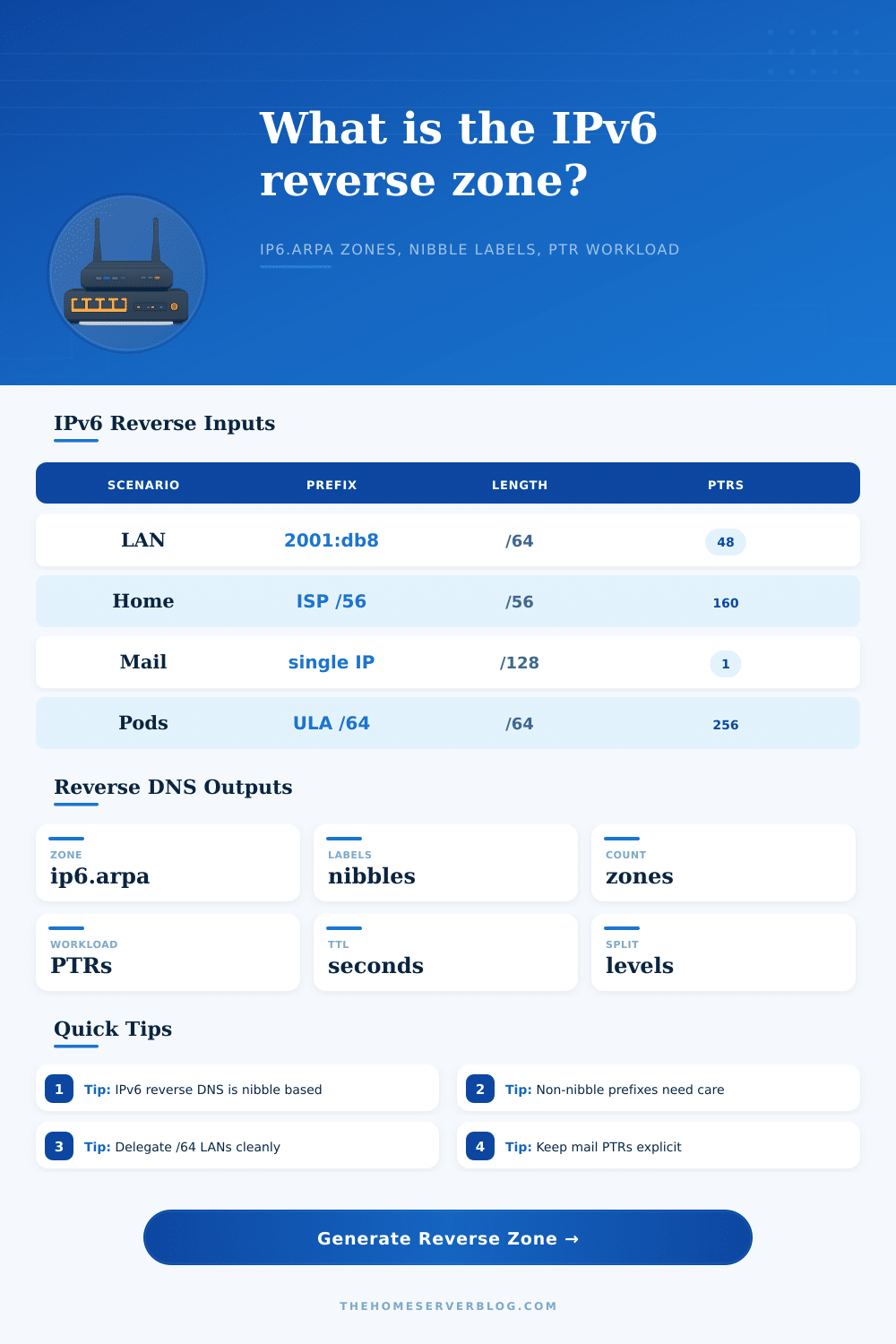
Convert an IPv6 prefix into the correct ip6.arpa reverse zone, reversed nibble labels, delegation count, TTL seconds, and PTR record workload for home labs, mail hosts, ISP delegated space, and internal ULA networks.
1Presets
2Calculator
Reverse DNS Breakdown
3Output Labels
4IPv6 Reverse DNS Grid
5Reference Tables
| IPv6 size | Nibbles | ip6.arpa labels | Typical home server use |
|---|---|---|---|
| /48 | 12 | 12 reversed hex labels | Site allocation, ULA lab parent, routed internal services. |
| /56 | 14 | 14 reversed hex labels | Residential ISP delegation containing up to 256 common /64 LANs. |
| /64 | 16 | 16 reversed hex labels | Single SLAAC LAN, server VLAN, Kubernetes pod segment, or VPN subnet. |
| /128 | 32 | 32 reversed hex labels | One host PTR, commonly used for mail, monitoring, and static services. |
| Boundary mode | Non-nibble prefix behavior | Zone count effect | Use when |
|---|---|---|---|
| Strict nibble boundary | Warns and falls back to the lower parent zone. | One broader zone before split levels. | You want to see alignment risk before delegating. |
| Round down | Uses the nearest shorter multiple of 4 bits. | Can cover space outside the exact CIDR. | Your parent DNS zone is managed by the same operator. |
| Round up | Expands the partial nibble into exact child zones. | 2^(4 - remainder bits) before extra split. | You need accurate delegation for a /57, /61, /125, or similar prefix. |
| Host PTR name | Uses all 32 nibbles regardless of CIDR length. | One host owner name per address. | You are creating a single PTR record owner. |
| PTR plan | Suggested TTL | Workload note | Operational reminder |
|---|---|---|---|
| Mail server IPv6 | 24 to 48 hours | Low PTR count, high correctness requirement. | Forward and reverse names should agree with mail reputation policy. |
| Home LAN /64 | 4 to 24 hours | PTR count depends on static leases and service hosts. | Avoid trying to publish every privacy address. |
| Kubernetes pods | 1 to 6 hours | High churn can make manual PTR management noisy. | Automate from service inventory when possible. |
| ISP delegated block | 24 hours | Zone count grows fast when splitting below /56 or /64. | Delegate only levels you really administer. |
| Example prefix | Boundary | Reverse origin pattern | Why it matters |
|---|---|---|---|
| 2001:db8:42:100::/64 | 16 nibbles | 0.0.1.0.2.4.0.0.8.b.d.0.1.0.0.2.ip6.arpa | Clean LAN reverse zone with no partial nibble. |
| fd42:beef:cafe::/48 | 12 nibbles | e.f.a.c.f.e.e.b.2.4.d.f.ip6.arpa | ULA site parent can hold many internal /64 zones. |
| 2001:db8:1234:5600::/57 | 15 nibbles at ceil | Multiple child zones | A /57 fixes one bit of the next nibble, so exact reverse needs 8 child zones. |
| 2001:db8:25:25::25/128 | 32 nibbles | Full owner name | Single PTR owner is useful for mail and static service addresses. |
6Tips
Most people think of IPv6 addresses as just another set of long hexadecimal numbers destined to be placed somewhere inside a firewall rule. That changes when it come time to configure your Domain Name System (DNS) or operate a mail server requiring reverse DNS lookups. At this point, those thirty-two characters become something of a design issue, but not because off the arithmetic. This is because DNS was designed decades ago for use within constraints of IPv4 space, and architecture does not map well onto current network scales.
The ip6.arpa domain contains IPv6 reverse zones. To understand how they work, each four-bit nibble are reversed into its own label. So even just the network portion has sixteen labels before adding any host bits (with a normal slash sixty-four prefix). Anything that doesn’t align with a multiple of four get really ugly real quick. The DNS protocol works with labels as atomic units. There’s no way to delegate part of a half-byte to a child zone.
Why IPv6 Reverse DNS Is Hard to Set Up
This page calculate the math for you when you enter your prefix. Save yourself the trouble of counting out hex digits and dealing with alignment errors.
The typical home lab run its primary network on a standard slash sixty-four subnet, so they neatly break up into nibbles, making delegation simple enough. It is one zone file that are sixteen labels long. But what if your ISP allocates you a slash fifty-seven? The Internet Engineering Task Force anticipated slash sixty-four subnets when designing the address space hierarchy. So, in this situation, why do we run into problems?
A slash fifty-seven cuts right through middle of a nibble, meaning half of it gets wasted and half of it become ambiguous. Do you round down to parent zone or split that single nibble across eight smaller child zone? Either decision will greatly affect amount of administrative overhead you incur. Without going into detail here about how that works, feel free to play around with these boundary modes using this tool which would of not break your production DNS servers!
Compare expanding a non-aligned prefix against rolling it up to its closest clean boundary to see which zone file are created and how many there are. This is shown directly via the reference table on page where you’ll see why strict alignment is important for delegation stability. Also we calculates the full PTR record workload so you know the maintenance costs before committing to a design.
Another common pain point is mail servers. Their reverse DNS needs to be exact, so the forward and reverse records must match. If they don’t match, a mistake in the pointer record will bounce your real email into peoples spam folders. That’s right: you’re now at the mercy of individual slash one-hundred-twenty-eight addresses. There is thirty two complete labels per host. Although it’s not many records overall, that’s pretty light lifting. But their accuracy cannot be compromised. Reputation algorithms scans through your zone files, there’s no wiggle room here.
Containerized services and Kubernetes pods creates a new category of noise. Hundreds of transient address are spun up and torn down each day in these environments. Attempting to keep track of static PTRs for all of them will lead to administrative burnout. Instead, limit your reverse zones to just the long-lived, stable service endpoints and let the DNS updates is automated. If most of the host portion of a subnet change more rapidly than you can update the zone file, don’t attempt to map them all out.
So with reverse DNS, consider this an exercise in putting all the books back onto shelves after organizing by a complicated algorithm. Except instead of just giving each book a number for an aisle, you have to figure out how to delegate zones at clean nibble boundaries. And if the algorithm is bad, then the books goes into the wrong aisle, nobody knows where they are, and you have to fix it. Ideally, keep your zone files manageable, so when you need to make changes, you know what’s going on. Delegate zones when practical, ideally at clean nibble boundaries. Instead of creating a record for everything every time someone connects, think about what really needs to stay across connections. Put a reverse record into those. When you work with the nibbles (and stop fighting against them), the rest will sort itself out.