MAC Address to Decimal Converter
Convert a MAC address into an exact decimal integer, inspect the hex and binary forms, and reverse any decimal back to a MAC preview.
Full Breakdown
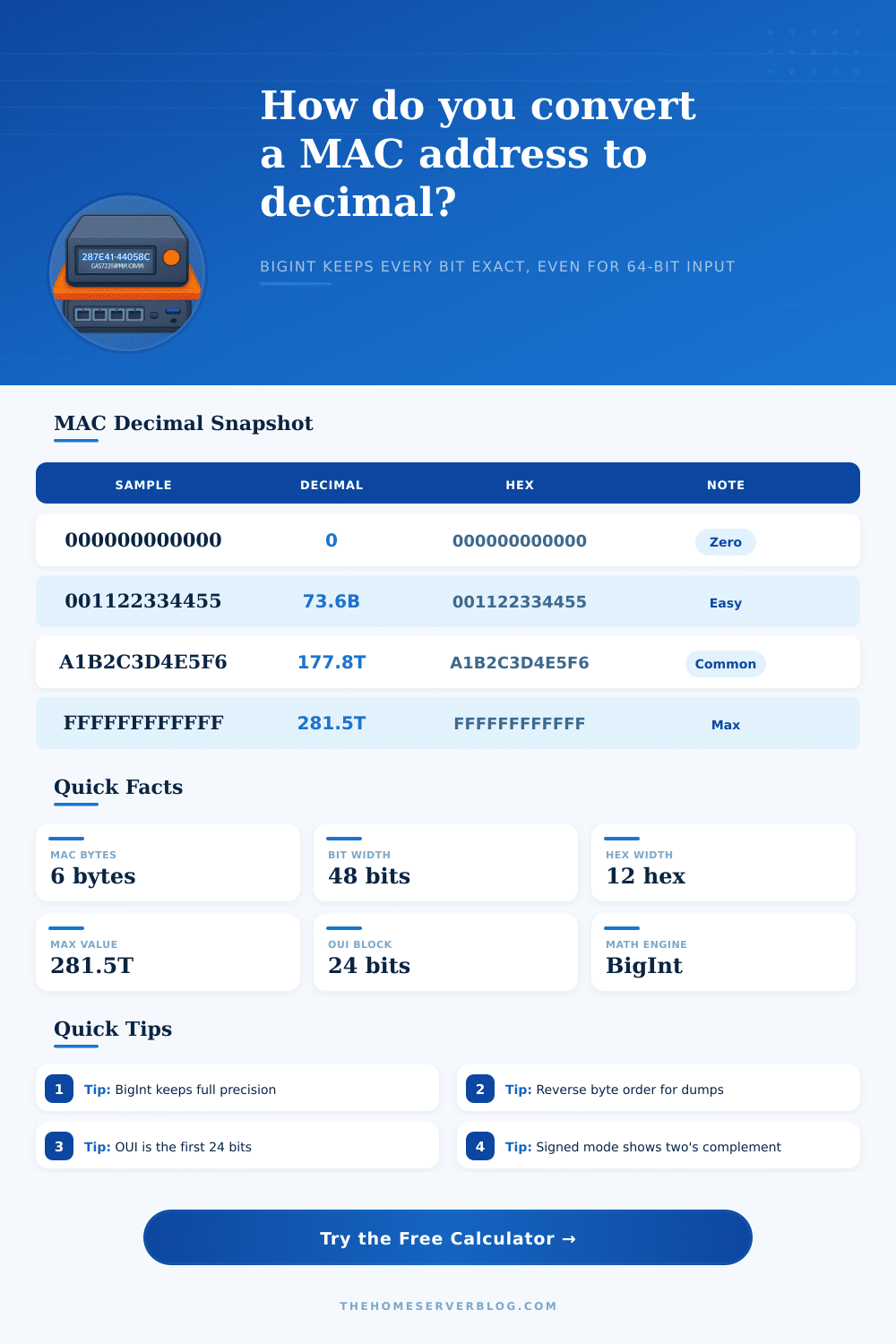
| MAC | Decimal | Hex | Use |
|---|---|---|---|
| 00:00:00:00:00:00 | 0 | 000000000000 | Lowest |
| 00:11:22:33:44:55 | 73,588,229,205 | 001122334455 | Test |
| 02:00:00:11:22:33 | 2,199,024,378,419 | 020000112233 | Virtual |
| 18:FE:34:AA:BB:CC | 27,480,084,364,236 | 18FE34AABBCC | Printer |
| 3C:52:A1:B4:C5:D6 | 66,325,597,963,734 | 3C52A1B4C5D6 | AP |
| 58:69:6C:7A:88:99 | 97,209,814,780,057 | 58696C7A8899 | Switch |
| A1:B2:C3:D4:E5:F6 | 177,789,161,760,246 | A1B2C3D4E5F6 | Demo |
| FF:FF:FF:FF:FF:FF | 281,474,976,710,655 | FFFFFFFFFFFF | Max |
| Family | Bytes | Bits | Range |
|---|---|---|---|
| MAC-48 / EUI-48 | 6 | 48 | 0 to 281,474,976,710,655 |
| EUI-64 | 8 | 64 | 0 to 18,446,744,073,709,551,615 |
| Signed 48-bit | 6 | 48 | -140,737,488,355,328 to 140,737,488,355,327 |
| Signed 64-bit | 8 | 64 | -9,223,372,036,854,775,808 to 9,223,372,036,854,775,807 |
| OUI block | 3 | 24 | 0 to 16,777,215 |
| Bit | Mask | 0 Means | 1 Means |
|---|---|---|---|
| I/G | 0x01 | Unicast | Multicast |
| U/L | 0x02 | Universal | Local |
| First byte | 0xFF | Raw octet | Flags applied |
| Signed top bit | 0x80 | Positive | Negative |
| Byte | 48-bit Weight | 64-bit Weight | Role |
|---|---|---|---|
| 1 | x 2^40 | x 2^56 | Front byte |
| 2 | x 2^32 | x 2^48 | Second byte |
| 3 | x 2^24 | x 2^40 | Third byte |
| 4 | x 2^16 | x 2^32 | Fourth byte |
| 5 | x 2^8 | x 2^24 | Fifth byte |
| 6 | x 2^0 | x 2^16 | Sixth byte |
| 7 | n/a | x 2^8 | EUI-64 only |
| 8 | n/a | x 2^0 | EUI-64 only |
This converter keeps the cleaned bytes, exact decimal, OUI split, and reverse MAC preview together so you can verify a round trip without guessing or losing a nibble.
A MAC address are a series of hexadecimal character that uniquely identifies a network device. A MAC address can be presented in the following format: A1:B2:C3:D4:E5:F6. Converting a MAC address to a decimal integer is helpful for script and database lookups.
Converting the MAC address to a decimal integer make it easier to compare two MAC addresses together. Additionally, the decimal representation of the MAC address can reveal pattern in the address that are otherwise hidden in the default MAC address presentation. For instance, the decimal representation of the MAC address can reveal which device has a more higher Organizationally Unique Identifier (OUI) value than the other device.
How to Convert a MAC Address to a Decimal Number
A MAC address is composed of 48 bit of information that can be divide into two components: the vendor prefix and the device identifier. The first 24 bits of the MAC address represent the Organizationally Unique Identifier (OUI), which are the manufacturer of the device. The central registry assign the Organizationally Unique Identifier (OUI) values to organizations.
Because a central registry controls the Organizationally Unique Identifier (OUI) values, all of the prefixes associated with the OUI values cluster in range. The conversion of the MAC address to a decimal integer reveal the vendor prefixes of the network device. Additionally, a tool can split the MAC address into two integer.
Furthermore, the tool can show the full decimal representation of the MAC address. Using the decimal representations of the MAC addresses allow people to more easy identify devices with duplicate MAC addresses. This would of been helpful for network administrator reviewing logs from network switches or virtual machine.
When people convert MAC addresses to decimal integer, care must be taken when interpreting the results. Different systems may have different interpretations of the MAC address byte. For example, packet captures use little-endian order for the bytes.
This can reverse the order of the byte of the MAC address. Thus, the decimal integer will be different than the MAC address that is entered into the tool. Tools allow people to toggle between different byte order.
Additionally, the tool also allow people to view the MAC address as either signed or unsigned number. For example, if the database stores the MAC address as a signed integer, the range of possible value is extended to include negative integer. In this mode, the highest bit is used as the sign bit of the integer.
Thus, using signed mode allow the MAC address to be represented as -1 instead of 281474976710655. Such use of signed mode would be of interest to those programmer who are performing check on the MAC address to ensure it is within a certain range of values. Precision is required when converting MAC address to decimal integer.
The 48 bit of information that comprise a MAC address can be represented by a number as high as approximately 281 trillion. Numbers in JavaScript are of finite precision, and any number higher than JavaScript’s precision will be rounded to that number of precision. To handle MAC address, the BigInt data type in JavaScript can be use.
BigInt can handle 64-bit EUI-64 value just as well as 48-bit MAC address. Additionally, various form of input can be accept by the tool. For instance, the tool can interpret input in Cisco dotted notation as well as plain hexadecimal input.
The tool can also pad and trim the input by the user. Furthermore, the tool display the binary representation of the MAC address to ensure that no information is lost during the conversion process. Confirming that no bit are lost during the conversion process is important for those auditing MAC address and their Organizationally Unique Identifiers (OUIs) or for those checking the unicast and multicast flag of a device.
Converting a MAC address to a decimal integer can be helpful in various situation. For instance, when performing an inventory audit or digital forensics investigation, it may be helpful to match the MAC address of a network device to the vendor by using the decimal integer of that address. Using the decimal integer avoid the need for people to perform the math themselves.
In addition, the decimal integer of a MAC address can be reverse to convert it back to its original hexadecimal notation. This can help people detect if the address was converted from a different byte order then the original MAC address. For instance, a common error is to forget to include the flag in the first byte of the MAC address.
These flag indicate various characteristic of the MAC address, such as whether it is used for multicast communication or if it is locally administered to the network. Thus, including these flag in the MAC address is part of the address’s identification. Additionally, converting a hexadecimal MAC address to a decimal integer allow people to view the structure of the MAC address itself.