Mac Address to EUI-64 Converter
Convert a MAC address into modified EUI-64, IPv6 interface ID, and link-local preview with byte-order control and first-octet checks.
Full Breakdown
| Input Style | Example | Bytes | Parser Note |
|---|---|---|---|
| Colon pairs | A1:B2:C3:D4:E5:F6 | 6 bytes | Common network text |
| Dash pairs | A1-B2-C3-D4-E5-F6 | 6 bytes | Label friendly |
| Cisco dotted | A1B2.C3D4.E5F6 | 6 bytes | Four hex chars each |
| Packet dump | F6 E5 D4 C3 B2 A1 | 6 bytes | Reverse before use |
| Mode | Result | Best Use | Extra Note |
|---|---|---|---|
| Modified EUI-64 | Insert FFFE | IPv6 derivation | Flip U/L bit |
| IPv6 interface ID | 4 hextets | SLAAC checks | Same 64-bit body |
| Link-local preview | fe80::IID | Quick test | Uses /64 prefix |
| EUI-64 seed | Keep 8 bytes | Compare layouts | No insert step |
| Output Format | Layout | Example | Best For |
|---|---|---|---|
| Colon | AA:BB:CC | A1:B2:C3 | Most tools |
| Dash | AA-BB-CC | A1-B2-C3 | Inventory tags |
| Dotted | AAAA.BBBB | A1B2.C3D4 | Vendor notes |
| IID | XXXX:XXXX | AABB:CCDD | IPv6 display |
| Preset | Source | Mode | Why It Helps |
|---|---|---|---|
| Desktop NIC | Colon | Modified | Normal hardware path |
| Little-Endian | Plain | Modified | Reversed dump fix |
| SLAAC Preview | Dash | Link-local | Shows full IPv6 form |
| Broadcast Edge | Plain | IID | Edge-case sanity test |
This converter keeps the source bytes, inserted bridge, 64-bit result, and IPv6 preview visible so you can verify vendor prefixes and interface IDs in one pass.
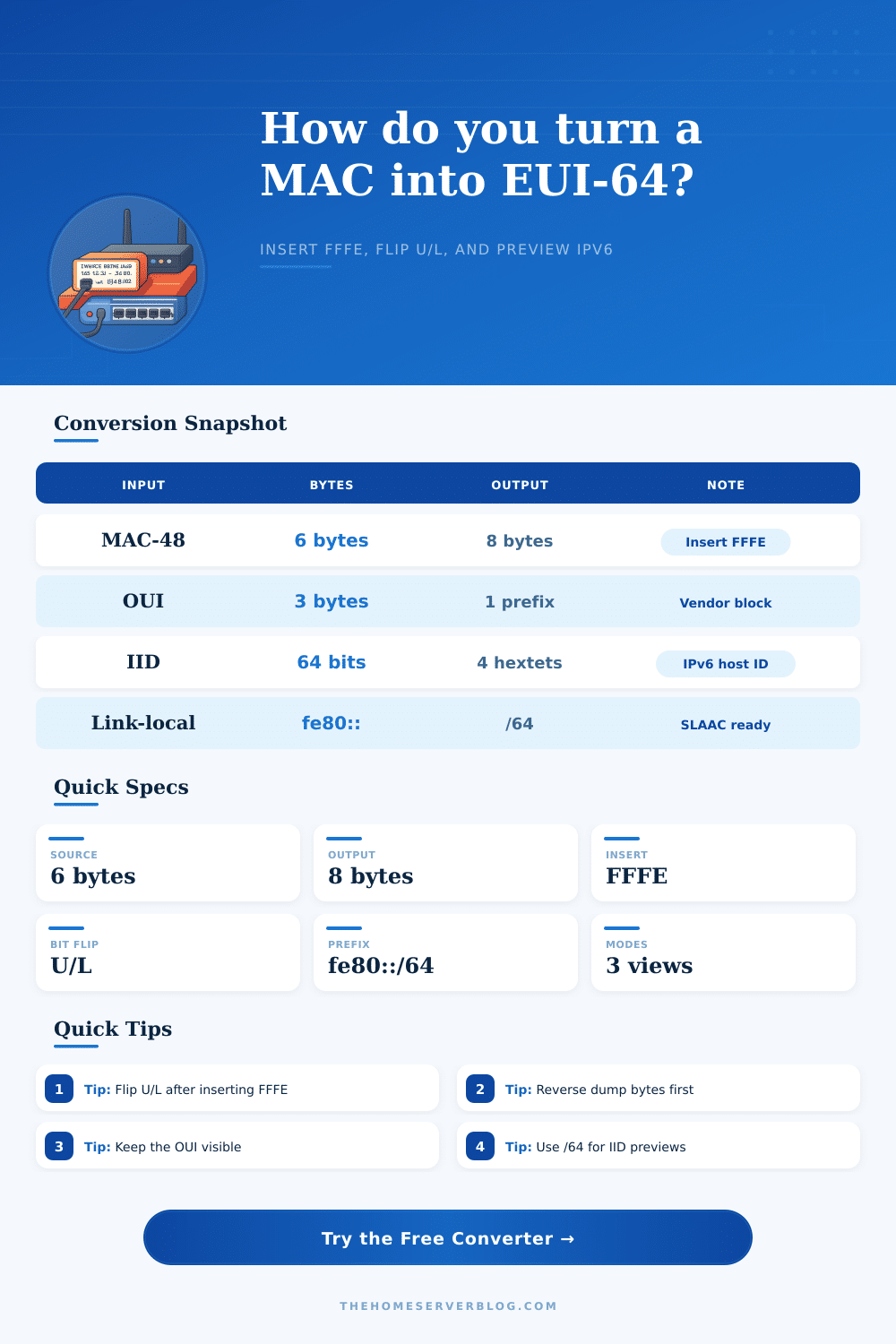
An IPv6 link-local address can be different from the MAC address of a device due to the EUI-64 conversion process that change the MAC address to an interface ID. The MAC address of a device are comprised of six byte of data. An IPv6 interface ID, however, is comprised of eight byte.
Through the EUI-64 conversion process, the process can change a six byte MAC address into an eight byte interface ID. This conversion process is necessary because IPv6 require interface IDs to be 64 bits in size for various processes, such as SLAAC autoconfiguration. The EUI-64 conversion process begin by taking the six-byte MAC address of a device.
How a MAC address becomes an IPv6 link-local address
The process splits the MAC address after the third byte. The byte FF:FE are inserted into the MAC address in the middle of the address to make it eight byte in length. These specific byte must be inserted into a MAC address during the EUI-64 process to mark the end of the devices MAC address and allow for the definition of an expanded identifier.
Following the insertion of the bytes FF:FE, the second-least-significant bit of the first octet of the MAC address are flipped from a 0 to a 1 or from a 1 to a 0. Flipping this bit is a requirement for the process to transform the address from a unicast hardware address to an interface ID. Should this bit not be flipped, the network will incorrectly identify the interface ID, and it will cause errors throughout the global namespaces of the network.
As with most process, errors can occur during the EUI-64 process. One reason for errors during the process is the complexity of the process. For instance, the bit flip may be forgoten.
Another reason for errors is that link-local IPv6 addresses does not respond to ping requests. These addresses may also be presented in a different order in the packet captures of the data being sent by the device. In this case, the order of the bytes in the MAC address must be normalized.
In addition to these issues, the Organizationally Unique Identifier of a device MAC address can be used to determine whether a MAC address has been locally administered. The OUI is visible during the EUI-64 process, and it can be used to determine if a MAC address was locally administered before the EUI-64 conversion process occur. Finally, various tool can assist in the EUI-64 process.
These tools can accept MAC addresses of various formats and convert them into the correct format. These tools can automatically determine the length of the MAC address and provide a clear explanation of each step of the EUI-64 process. Furthermore, these tools can display the raw bytes of the EUI-64 addresses, the interface IDs, or the link-local IPv6 addresses of the device.
Using these tools will help to avoid making mistake in the EUI-64 process and ensure that the link-local IPv6 address is mathematicaly correct.