Multicast IP to MAC Address Converter
Map IPv4 and IPv6 multicast groups into their Ethernet MAC form, then inspect alias windows, bit loss, and segment pressure.
Full Breakdown
| Family | Group Example | MAC Output | Rule |
|---|---|---|---|
| IPv4 | 224.0.0.1 | 01:00:5E:00:00:01 | All hosts |
| IPv4 | 224.0.0.5 | 01:00:5E:00:00:05 | OSPF |
| IPv4 | 239.255.255.250 | 01:00:5E:7F:FF:FA | SSDP |
| IPv4 | 224.0.0.251 | 01:00:5E:00:00:FB | mDNS |
| Family | Group Example | MAC Output | Rule |
|---|---|---|---|
| IPv6 | ff02::1 | 33:33:00:00:00:01 | All nodes |
| IPv6 | ff02::2 | 33:33:00:00:00:02 | All routers |
| IPv6 | ff02::fb | 33:33:00:00:00:FB | mDNS |
| IPv6 | ff02::1:ff00:1234 | 33:33:FF:00:12:34 | Solicited |
| Family | Mapped Bits | Lost Bits | Alias Window |
|---|---|---|---|
| IPv4 multicast | 23 | 5 | 32 groups |
| IPv6 multicast | 32 | 96 | 2^96 groups |
| IPv4 MAC seed | 01:00:5E | Low 23 bits | Fixed prefix |
| IPv6 MAC seed | 33:33 | Low 32 bits | Fixed prefix |
| Switch Profile | Snooping Mode | Pressure View | Watch Item |
|---|---|---|---|
| Access | IGMP / MLD | Low | Prune fast |
| Distribution | Static join | Medium | Track groups |
| Core | Flood mode | High | MAC churn |
| Lab bridge | Routed edge | Test | Compare paths |
This calculator separates the IP family, mapping prefix, alias window, and segment pressure so you can verify multicast behavior before you tune switches or filters.
Multicast traffic often appear in a switchport in a packet capture in an form of unexpected traffic flooding the switchport. This multicast traffic arise due to the need to convert the multicast IP address to multicast MAC address. The multicast IP address does not travel over an Ethernet wire as an IPv4 address; therefore, it is necessary to map the IPv4 multicast address to a multicast MAC address.
The switch recognize the prefixes for multicast MAC addresses. However, if a network engineer dont have an understanding of how the multicast IP address gets mapped to the MAC address, the access control lists or the snooping configurations for the switch ports will not recognize the multicast traffic. The mapping of an IPv4 multicast address to an IPv4 multicast MAC address follow a specific rule.
How Multicast IP Addresses Become MAC Addresses and Flood Switch Ports
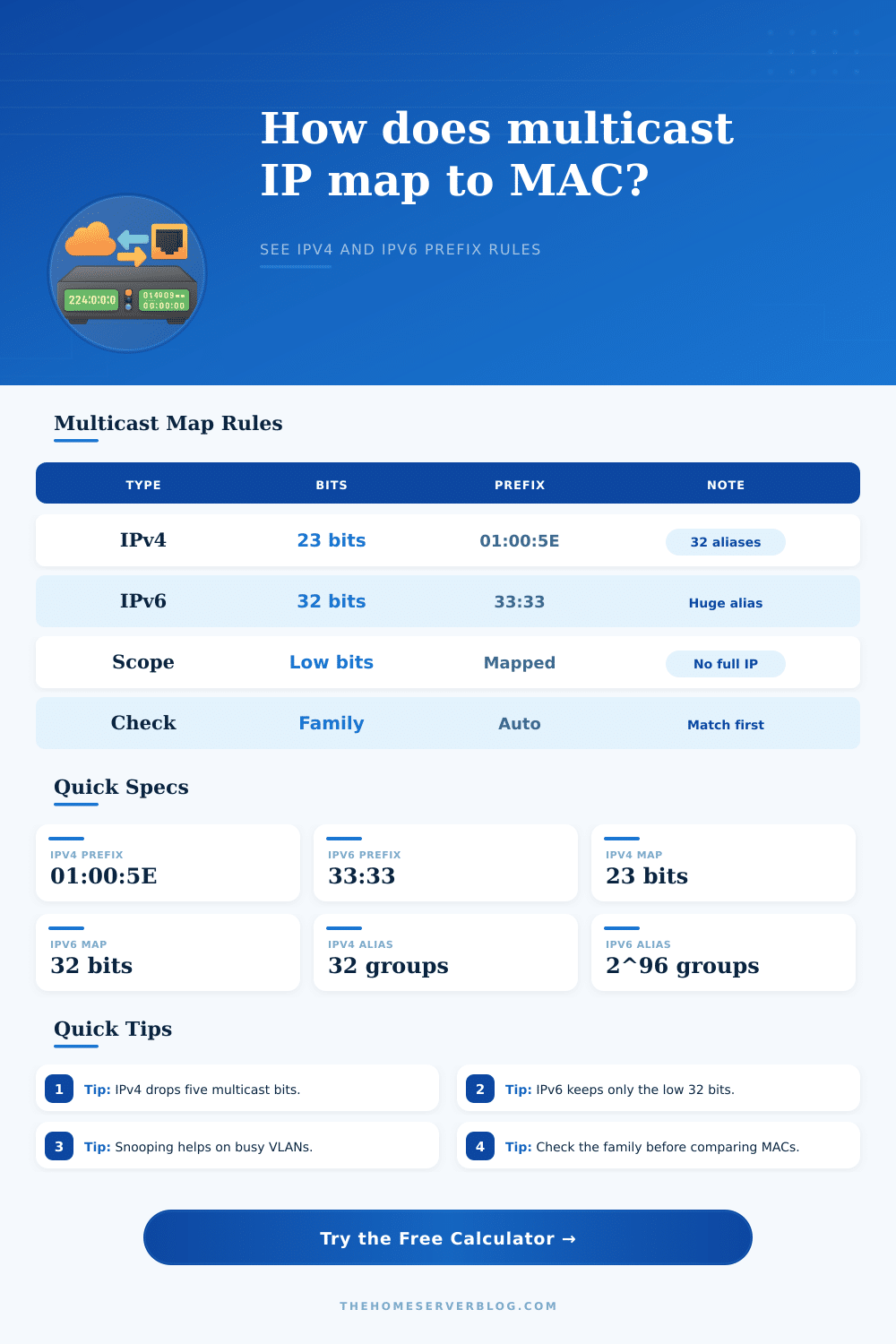
The low 23 bits of the IPv4 multicast address will be placed under the 01:00:5E prefix for the multicast MAC address. The formation of the multicast MAC address will zero out five bits. Zeroing out these bit will result in the aliasing of 32 groups of IPv4 multicast IP addresses to the same multicast MAC address.
Consequently, the switch may forward multicast traffic to the port even if the port has not join the specific group of IPv4 multicast IP addresses. The mapping of IPv6 multicast addresses are performed different than the mapping of IPv4 multicast addresses. For IPv6 multicast addresses, the low 32 bits of the IPv6 multicast address will be placed under the 33:33 prefix for the multicast MAC address.
The alias window for IPv6 multicast addresses is much more larger than for IPv4 multicast addresses. The large alias window allow many group of IPv6 multicast IP addresses to be aliased to the same IPv6 multicast MAC address. The upper bits of the multicast IPv6 addresses vanish at the data link layer, so link-local IPv6 multicast groups will work as intended on the link, but global scope groups may result in unexpected traffic pattern on the link.
Multiple multicast protocols can cause significant trouble on the same network segment. As with mDNS, SSDP, and OSPF, if you do not have IGMP snooping configured on you’re switch, the flooding of all multicast traffic to every device on the segment can cause congestion on your network. By considering the impact of each multicast protocol on the network segment, you can weigh the number of multicast groups on the network against the size of the alias window.
Exceeding the capacity of the alias window in IPv4 will flood the network with unneccessary multicast traffic. In addition, if your switch does not implement IGMP snooping, you cannot filter the multicast traffic until you know to which multicast MAC address the multicast IP address will map. The misconception that IPv4 and IPv6 multicast mappings is the same will cause you to miss half of the multicast traffic being sent across the network.
The five bit of IPv4 multicast mappings that are dropped during the mapping to a multicast MAC address must be accounted for in order to properly filter multicast traffic. Some network protocols relies on these mapping rules to function correctly on the network. For example, VRRP and solicited-node neighbor discovery rely on these rules every day on the network.
In a lab environment, OSPF hello packets will use the same multicast MAC address space as all-routers multicast packets. On the routed edges, the snooping mode will change from flooding to precise joins. In both case, the mapping of the multicast IP to the multicast MAC address will be the same.
By analyzing the multicast group, understanding how the math impact the VLAN to which the device is assigned, you will find that the static prefix to the multicast MAC address is what allow an Ethernet switch to route that multicast traffic. You should of checked the math carefully to avoid problems. Its important to understand how the math works so you dont have alot of trouble with the switchports.