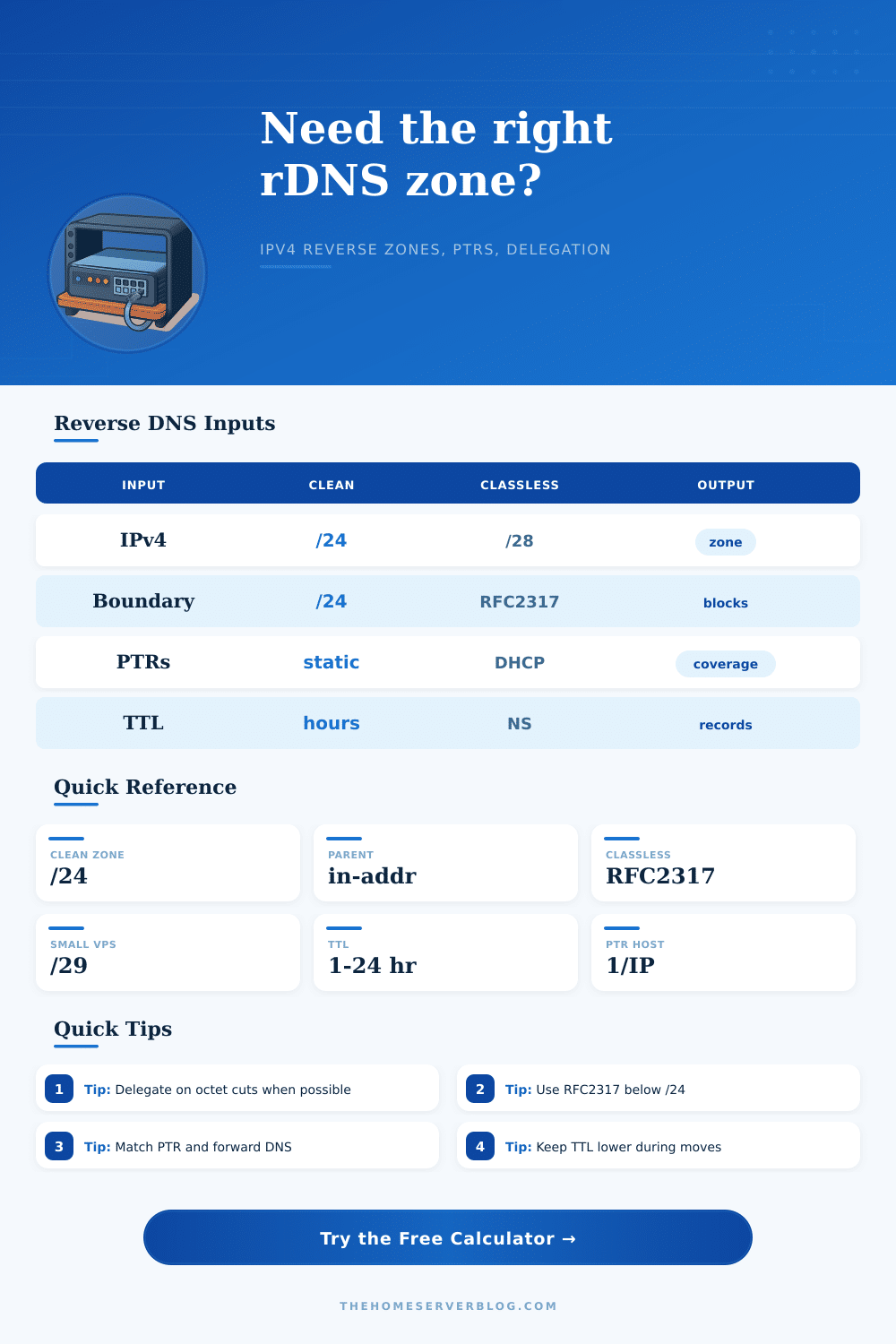
IPv4 Reverse DNS Planning
Reverse DNS Zone Name Generator
Generate in-addr.arpa zone names, classless delegation labels, PTR coverage, delegated block counts, and practical zone file record estimates for IPv4 reverse DNS.
Full reverse DNS breakdown
| IPv4 allocation | Best reverse zone boundary | Typical zone name | Practical planning note |
|---|---|---|---|
| Single /24 | /24 | 2.0.192.in-addr.arpa | Cleanest customer delegation; 256 reverse owners live in one zone. |
| Contiguous /23 | Two /24 zones | 2.0.192 and 3.0.192 | Most providers delegate each /24 rather than creating a non-octet parent. |
| ISP /20 | Sixteen /24 zones | 0-15.16.172 zones | Operationally simple for BIND, PowerDNS, or hosted DNS platforms. |
| Private /16 lab | /16 or /24 splits | 168.192.in-addr.arpa | Use a /16 only when one team owns every subnet and DHCP scope. |
| Customer /28 | Classless inside /24 | 16-31.2.0.192.in-addr.arpa | Parent zone normally holds CNAME records for every delegated address. |
| Network | Range label | Parent owner sample | Delegated PTR target sample |
|---|---|---|---|
| 192.0.2.16/28 | 16-31 | 16.2.0.192.in-addr.arpa | 16.16-31.2.0.192.in-addr.arpa |
| 198.51.100.40/29 | 40-47 | 40.100.51.198.in-addr.arpa | 40.40-47.100.51.198.in-addr.arpa |
| 203.0.113.128/26 | 128-191 | 128.113.0.203.in-addr.arpa | 128.128-191.113.0.203.in-addr.arpa |
| 10.20.30.248/30 | 248-251 | 248.30.20.10.in-addr.arpa | 248.248-251.30.20.10.in-addr.arpa |
| 172.16.4.200/32 | 200-200 | 200.4.16.172.in-addr.arpa | 200.200-200.4.16.172.in-addr.arpa |
| Provider style | Zone overhead assumption | Good fit | Watch point |
|---|---|---|---|
| BIND style zone file | 1 SOA plus 2 NS per zone | Self-hosted authoritative DNS and lab documentation | Serial management and include-file hygiene matter. |
| PowerDNS native zone | 1 SOA plus 2 NS per zone | Database-backed hosting panels and API-managed PTRs | Record count can grow quickly with dynamic DHCP sync. |
| Route 53 hosted zone | 1 SOA plus 4 NS per zone | Hosted public reverse zones delegated by an ISP | Some ISPs will only delegate clean octet boundaries. |
| Cloudflare reverse DNS | 1 SOA plus 2 NS per zone | Provider-managed zones for supported IP resources | Classless delegation may still need parent-provider support. |
| ISP NS delegation | Parent NS plus optional CNAMEs | Customer blocks, mail pools, and tenant assignments | Ask whether the ISP supports range labels or slash labels. |
| Project | IPv4 block | PTR plan | Recommended zone approach |
|---|---|---|---|
| Mail gateway pair | Two public /32 records | Exact PTRs matching forward mail hostnames | Provider-managed PTRs or classless delegation if part of a larger pool. |
| Small VPS customer | /29 public block | Gateway, nodes, monitoring, and spare names | RFC2317 range delegation inside the provider parent /24. |
| Home lab RFC1918 | 192.168.10.0/24 | Static services plus DHCP sweep | Clean /24 reverse zone in local DNS. |
| Managed tenant rack | /26 or /27 per tenant | Tenant hostnames with node numbers | Classless zone per tenant range, with parent CNAME records. |
| ISP access network | /20 or larger | DHCP-generated CPE PTR records | Split into /24 reverse zones for easier automation and recovery. |
You can’t help but feel like Reverse DNS is an unknown stranger in town when your networks a bit too quiet. A spam filter is blocking outgoing email, and your next security audit report missing PTR records. The root cause of this consternation? People do not understands how reverse and forward DNS differ. The former is straightforward because you control the domain name, while the latter brings along some technical and political nuance that most admins aren’t aware of…until they has to be.
Plugging in your network bounds on the calculator above does all that math for you, saving you from guesswork as to whether your block cleanly falls within an octet cut or not. The single most important thing you really need to understand about setting up your reverse zone is whether your block fall into a clean octet cut or requires classless delegation.
How to Set Up Reverse DNS
If you have a full /24 block, things are simple; you can ask for a standard NS delegation to cover a whole 256-address range. Because that’s a self-contained zone file with its own nameservers and SOA records, most providers won’t mind delegating that kind of control to you… They’d rather keep the operational burden off their end.
Things get ugly if your allocation isn’t large enough for a /24 (e.g., it’s a /28 or /29), because there’s no clean mapping into the hierarchical structure of in-addr.arpa. This means no simple delegation of NS records for the puny slice, you’re stuck with classless delegation as described in RFC 2317. This means the parent zone owner will create a CNAME that points to a specific range pointer, which then point back to your managed reverse zone. Those label conventions are laid out nicely on the page; it is enough to say, though, that this requires explicit support from your ISP.
It requires extra configuration overhead for them, and many won’t be bothered. They’ll provide some way for you to manage PTRs yourself via their own management tools. But this reliance on the parent operator is where most plans go off track: maybe you set up an ideal zone structure, but your upstream provider won’t provide the required CNAME glue records. More often than not, this occurs when it shouldn’t, so again, always check with your provider beforehand to see if they’ll support classless delegation (before you’ve even written your zone files). Otherwise, you’re stuck with adapting to them providing a hosted PTR service, which typically means paying more and having less control over record updates.
If you’re dealing with a larger block such as a /20 or larger, it’s usually better to break that up into several smaller /24 chunks (which will also isolate any problems while speeding up zone transfers). If your nameserver software have trouble handling large data sets, this can help; the tool will give you an idea of how many records there would be in the resulting splits. Then you’ll know just how many zone files you’d have to deal with vs. You will also see how much freedom each split gives you to work on it independent.
No matter what block size you are on, your mail servers should get some focus here as well; A mismatched or missing PTR record immediately raise flags with receiving servers, and will frequently send your otherwise valid emails to their spam folder. Ideally, your reverse pointer (PTR) would be static, match the forward hostname precisely, and not use some generic DHCP name for your mail infrastructure. That’s just begging for deliverability headaches later on. It could of been avoided if you checked first.
Lastly, you should set reasonable Time-To-Live (TTL) values. Lowering the TTL makes changes spread more rapid but puts a higher load on your authoritative servers. Raising the TTL decreases load but slows down troubleshooting because stale records will be kept by resolvers for longer durations. You’ll have to find what’s appropriate based off the volatility of your IP assignments as well as the amount of traffic you expect your nameservers to recieve.
In the end, it’s not really about tech magic; it’s about communicating clearly with upstream providers. You might be able to set up PowerDNS or BIND to perfection, but no one gets anything unless the parent zones has delegated authority properly. Most failures occur when folks treat reverse delegation as a solo project instead of a joint operation, which brings us back to where we started: the sensation of being an uninvited guest. To avoid this, just invite your provider into the party early and learn what limits they work under so you can set boundaries that match how much they are willing to support you.